It isn’t far into its runtime before the double meaning in the title of David Robert Mitchell’s rather unclassifiable throwback blockbuster The End of Oak Street becomes clear. The first alludes to the film’s literal location, a cul-de-sac at the back of a neighborhood called Flowervale, circa 1982. Our first glimpse of it is one of suburban perfection: the Platt family— mom Denise (Anne Hathaway), dad Greg (Ewan McGregor), teenage daughter Audrey (Maisy Stella), and son Brian (Christian Convery)— clumsily hop across the yard in a sack race, smiles emblazoned across their faces as bright as the sun beaming across their street on this summer afternoon. It’s the neighborhood’s annual block party, and people lounge in lawn chairs strewn across front yards as meat sizzles on the grill and water balloons whizz through the air, but it’s fast apparent that all isn’t as sunny as it seems. Audrey, a space enthusiast, declares her desire to attend Cornell to a friend, noting in the same breath that her family could never afford it. Brian brings the family dog, Starbuck, to the gathering in spite of his mother’s demand that he leave him at home. Denise chats with an elderly neighbor, Mrs. Huddleston (Ann Gee Byrd), who gives her feedback on the draft of a novel Denise has been writing in secret— a novel that revolves around a woman who considers leaving her spouse and children. And Greg departs without warning to pick up some extra cash at his side gig delivering pizzas, upsetting Denise, who was counting on a family day. Mitchell efficiently rolls through all this backstory in just a few minutes. It’s just enough time for the audience to recognize that this is a family in turmoil.
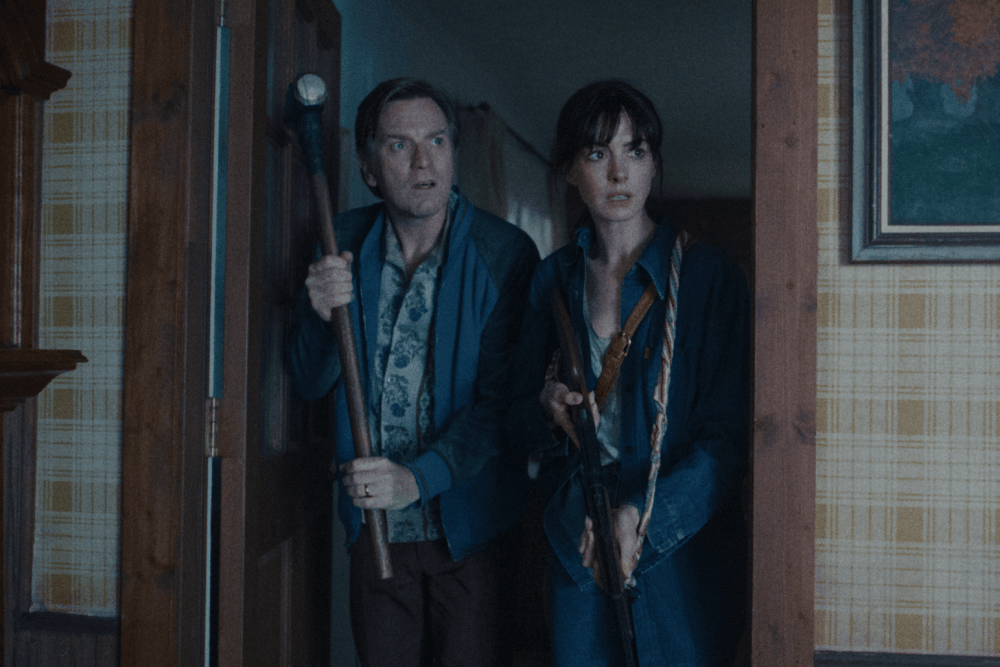
The other “end” of Oak Street refers to the state of its existence. You see, strange, unexplainable things have been popping up throughout the neighborhood. Mrs. Huddleston shows Denise a weird, tropical-looking plant that sprouted in her backyard, growing to an astonishing height in just a couple of days. Denise takes a photo of it to the library, but can’t identify it; the librarian (Emily Kuroda) says it remarkably resembles a prehistoric plant that has been extinct for millions of years, an observation that the pair laugh off. Blinding white lights and high winds, not typical of your usual thunderstorm, come and go in the middle of the night. And the Platt’s pesky next-door neighbor, Mel (P.J. Bryne), wakes up one morning to a towering pile of shit in his backyard, an occurrence he chalks up to a childish prank. The Platt’s wake up to a wild storm in the night, one that leaves them devoid of electricity, phones, and water. The next morning, the clues that indicate that all on Oak Street is not, in fact, business as usual, tantalizingly mount: a far-off scream here, a glimpse of a large, spiky tail disappearing into the trees there. Every potential exit ends either in stretches of water, or gaping crevices. Whether Oak Street’s residents have traveled back in time, or its visitors have traveled forward, is never really clear, and the intricacies of and reasoning for whatever happened aren’t details Mitchell is particularly interested in delving in to. Suffice it to say, dinosaurs now live on Oak Street.
Mitchell’s third feature as writer and director following his 2014 breakout stalker horror It Follows and his decidedly less well-received (but a new cult favorite) 2018 Hollywood neo-noir Under the Silver Lake finds him riffing on vintage Amblin fare; walking out of my screening, an older woman enthusiastically told me it was “like Jurassic Park meets Stranger Things.” But despite its nostalgic trappings, from the meticulously detailed retro production design to Michael Giacchino’s twinkling, wonder-sparking score (and the fact that Steven Spielberg’s most prominent impersonator, J.J. Abrams and his production company Bad Robot, is a producer on the film), The End of Oak Street distinguishes itself from the plethora of recent media donning Spielberg drag, sometimes scrambling to faithfully replicate both the aesthetics and the tone of beloved kid-centric 80s classics like E.T. and The Goonies. Mitchell doesn’t let that limit him; rather, he shapes the narrative to his own dark, crude sensibilities. This is a violent film, one featuring some of the most terrifyingly-mounted dinosaur action set-pieces seen in a Hollywood movie in years, especially considering how thoroughly the dull and puzzlingly dinosaur-negative Jurassic World franchise has dominated that terrain. Impossibly thick and long snakes slither through homes. Pterodactyls pick people off of roofs. Raptors race through backyards, mowing down anyone in their path. The sheer variety of creatures present is delightful to witness, especially for anyone who has ever had a dinosaur phase, and the quality of the special effects is largely effective, aided by the realism of their design (I can’t recall another dinosaur movie that bothered to depict them with feathers rather than scaly skin). All of this is taken in by Mitchell’s perpetually roving camera, used to great effect in his previous films. Here, as in It Follows, it traces the contours of his environments in a manner that both crafts a sense of dread, of something watching the characters, but also absorbs the scale of the set-pieces, conveying the community aspect of the neighborhood as the view drifts from an intimate conversation between adults to a group of children pushing their bikes along the sidewalk. That this is a living, breathing place is never in question, and— outside of a family conversation in which Mitchell cuts back-and-forth between numerous split diopter shots— the camerawork is equally alive without skewing toward being overly showy.

Ultimately, however, this is a film about family and parental sacrifice, and while none of the characters are especially quirky or memorable in the way those in those sci-fi classics are, the family dynamic is believable thanks to the cast’s convincing (outside of McGregor’s inconsistent accent) performances. Late in the film, Mitchell takes a bold narrative swing, one that he undoes by the film’s end. Is it a treacly cop out? I don’t think so. The End of Oak Street may be intense, but it isn’t cruel. The end credits contain a dedication to Mitchell’s father, Robert Allen Mitchell, who passed away in 2024, and whose lifelong affinity for dinosaurs and classic monsters movies was the impetus for Mitchell making this film. Not unlike Spielberg’s own recent summer release, Disclosure Day, The End of Oak Street is a movie that employs extraordinary circumstances in the service of depicting the kindness and empathy of ordinary people, whether that’s adopting a young girl left alone into your family, or warning even those you don’t get on well with of pending danger, or sacrificing your own life to protect the ones you love. There’s a bit of Mitchell having his cake and eating it too— the final plot twist allows him to explore some bleaker avenues while ultimately absolving them of any real consequence— but that’s easy to forgive once you realize that this lovingly crafted romp marrying B-movie thrills to tender family drama is also a film about beginnings, not ends.
The End of Oak Street is now playing in theaters. Runtime: 99 minutes. Rated PG-13.


