Toward the end of Boorman and the Devil— David Kittredge’s impressively thorough and candid documentary about the legendarily troubled production of Exorcist II: The Heretic— the director speaks briefly to Jeff Kanew. Kanew is primarily remembered today for directing 80s comedies like Revenge of the Nerds and Troop Beverly Hills, but in the mid-1970s, he was cutting trailers. He was simultaneously assigned to the trailers for two 1977 releases: John Boorman’s Exorcist II, and William Friedkin’s Sorcercer. In 1973, Friedkin helmed the adaptation of William Peter Blatty’s best-selling novel The Exorcist. It was the rare horror movie that crossed over, riding the wave of boffo box office and critical acclaim all the way to a whopping 10 Academy Award nominations. At a time in Hollywood when sequels were both not the norm, and not guaranteed to turn a profit, Friedkin had no interest in making additional Exorcist movies, so Warner Brothers courted Boorman, the British filmmaker who shot to stratospheric success with his 1972 survival thriller Deliverance, and film he followed up with his daring, provocative sci-fi Zardoz. Friedkin, meanwhile, went on to make Sorcerer, an adaptation of the novel The Wages of Fear and Henri-Georges Clouzot’s 1953 film of the same name.
I mention all of this because that sequence in the documentary provides a neat, tangible connection between Friedkin and Boorman, the first and second Exorcist, and subtly communicates its thesis statement, which argues that Exorcist II’s failure actually wasn’t so singular, and wasn’t deserved. Kanew describes how he cut the trailer for Exorcist II, navigating the movie’s lack of punchy, marketing-friendly dialogue scenes by editing shots to the rhythms of Ennio Morricone’s screeching, primal score. He approached the Sorcerer trailer the exact same way, cutting to the pulsing beats of Tangerine Dream. Kanew recalls both trailers premiering in the theater back-to-back, the Exorcist II one going over with the crowd like gangbusters, while the Sorcerer trailer was met with no reaction. Decades later, Exorcist II has continued to be so maligned, and Sorcerer— despite being met with lackluster reviews on its initial release—is now universally upheld as one of the most exciting films of the 1970s. Time has been kind to it; to Exorcist II, not so much.

Spanning a nearly two-hour runtime, Kittredge’s exhaustive film, which opens with a quote on artistry by British playwright and novelist Hanif Kureishi (“The artist must live on the edge of failure. There can be no omniscience; any work could be a triumph, disaster or a bit of both”), doesn’t try to argue that Exorcist II is actually great, in fact. Less geared toward hitting the expected horror beats, skewing toward something more spiritual and attacking crisis of faith head-on, Kittredge remembers the film making a strong impression on him when he was a teenager, which he rented despite knowing that it had a bad reputation, and his admiration for it ripples throughout Boorman and the Devil and in his conversations with those involved, which includes everyone from stars Linda Blair and Louise Fletcher to Boorman’s creative partner Rospo Pallenberg to critics Bilge Ebiri and Stephanie Zacharek to fellow filmmakers Mike Flanagan and Karyn Kusama to audience members who attended the preview screening of the film to Boorman himself, who is interviewed in his Ireland home surrounded by notable props from his filmography. Setting the stage with brief overviews of both the first Exorcist’s success, John Boorman’s rapid ascent to fame, and the state of Hollywood filmmaking in the mid-1970s, Kittredge strikes a compelling balance between juicy behind-the-scenes drama, informative breakdowns of the film’s stunning visual effects (which include everything from matte paintings to meticulously animated locusts, and trenchant analysis of just what went wrong where and why. It’s an absolute meal for cinephiles, touching on everything from the casting of megastar Richard Burton as Father Lamont and fresh from her Oscar win for One Flew Over the Cuckoo’s Nest Fletcher as Dr. Gene Tuskin, the endless rewriting that occurred in the middle of filming, the reconstruction of an entire Ethiopian village on a Hollywood soundstage, Boorman’s contraction of San Joaquin Valley fever that stalled production for a month, and the rapid re-editing and rereleasing of the film in response to overwhelmingly negative audience reactions, who mostly laughed at the movie’s wild swings. Kittredge, who also serves as editor, does particularly good work cutting together the interviews so it plays as if every subject is in conversation with each other; Fletcher and Blair are especially, and often hilariously, candid about their experiences and relationship with the other cast and crew members.
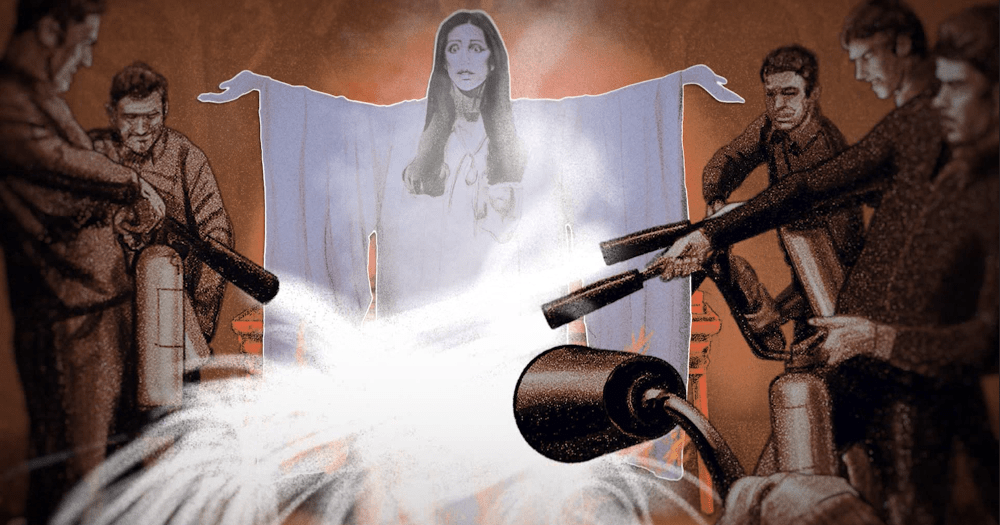
Kittredge illustrates all this via an amalgam of archival footage and motion graphics accompanied by upbeat narration. It’s a lot of information to consume, and the muchness of it somewhat undermines his ultimate point that the 70s were a time where many mainstream directors were given the space to experiment with outside-of-the-box projects that flopped, from Steven Spielberg’s oft-forgotten follow-up to Jaws and Close Encounters of the Third Kind, 1941, to Michael Cimino’s western epic Heaven’s Gate, which became one of the largest financial disasters in Hollywood history. That connection between all those films and filmmakers— whose art is described in the film as “joyous slavery”— is fascinating, but plays as an afterthought, rushed through at the end of Boorman and the Devil before moving on to another topic. However, the documentary does smartly leave us with Boorman, who was knighted by Queen Elizabeth II in 2022 for his services to film, and whose movies Point Blank and Deliverance have been inducted into the National Film Registry, yet whose raw interview indicates a man still stung by the experience of making and the reception to Exorcist II. When each interviewee is prompted at the end of the documentary with the question, “Is Exorcist II: The Heretic a good movie?” their answers wildly diverge, but everyone seems to broadly agree on one thing: that it boldly diverges from its acclaimed predecessor, standing as a ravishingly-realized work from a visionary director. It’s a concept that Boorman and the Devil affectionately and exuberantly upholds.
Boorman and the Devil opens in select theaters starting August 28. Runtime: 112 minutes.


What an interesting idea for a documentary! I’d never heard of it before, so thanks for the review. I love documentaries about the making of movies, and this one sounds really interesting. And, at the risk of people laughing at me, I actually think Exorcist II’s reputation as a stinker is greatly exaggerated. But then again, I’m a fan of Boorman’s Zardoz, so maybe that tells you something! In my opinion, Exorcist II has its moments, a great cast, and some really impressive production values. I also find the premise pretty intriguing, even if it doesn’t completely come together by the end. I actually prefer it over the prequels, and I like it a lot more than the latest sequel, Exorcist: Believer, which I thought was a total disaster. So yeah, that’s my possibly unpopular opinion!
LikeLike