Steven Spielberg’s Disclosure Day— part fast-paced chase movie, part sprawling collage of cosmic ideas that marries empathy-driven storytelling with blockbuster spectacle—opens with a literal gut punch directed at the audience. The camera, assuming the position of a wrestler in the ring, rockets violently backward as he absorbs a blow from his opponent, and continues to rattle and shake as he’s tossed to and fro to his eventual defeat. This isn’t our main character, however, although his experience is an apt warning to viewers for the emotional rollercoaster they are about to embark on. The careening camera instead moves over the ring, into the cheering crowd, and lands on the one attendee who isn’t roused by the violence unfolding before his eyes: Daniel Kellner (Josh O’Connor), who as we quickly learn is present at the match for another reason entirely. Daniel, you see, is a former security specialist who spent time in federal prison for cyber crimes. Now, he’s stolen a piece of alien tech from a top-secret branch of the U.S. government known as the Wardex Corporation (Waived Reporting, Development, and Extraction). They, in retaliation, kidnapped Daniel’s girlfriend Jane (Eve Hewson); the wrestling match is to be the site of the exchange, which goes south fast, prompting Daniel and Jane to go on the run, pursued by Wardex’s persistent CEO Noah Scanlon (Colin Firth).
The screenplay by David Koepp (whose previous work with Spielberg includes writing Jurassic Park and his 2005 War of the Worlds), working off a story treatment by Spielberg that was inspired by 2017 New York Times article titled “Glowing Auras and ‘Black Money’: The Pentagon’s Mysterious UFO Program,” drops us right into the action with no preamble. After the thrilling hook, the narrative doesn’t exactly slow, but it does begin to peel back the layers of its characters’ backstories and ideologies, thinking backwards as the conflict’s physical momentum pushes forward. We learn that Daniel, an advocate for disclosing all evidence of human/extraterrestrial contact to the world dating back to Roswell, New Mexico in the 1950s, is working with Wardex defector Hugo Wakefield (Colman Domingo), and that Jane was a former novitiate in the Catholic Church, her unerring belief in a supreme being despite having lost her faith in people prompting a conflict of faith that causes her to question the consequences of disclosure. We’re also introduced to Margaret Fairchild (Emily Blunt), a perky Kansas City meteorologist whose world is catapulted into confusion when she locks eyes with a cardinal that flies through her apartment window, seemingly awakening latent psychic abilities. Suddenly, to the astonishment of her boyfriend (Jackson, played by Wyatt Russell) and coworkers, she can speak any language fluently without even realizing it, and just look at a person and comprehend everything about them. Margaret inadvertently begins speaking in an alien language on air, English morphing into a series of indecipherable clicks and moans, drawing the attention of Scanlon and Wardex to further alien activity. Dueling chase sequences follow, as Daniel and Margaret’s evasions of Wardex run parallel to each other, before fate inevitably causes their paths to intersect.
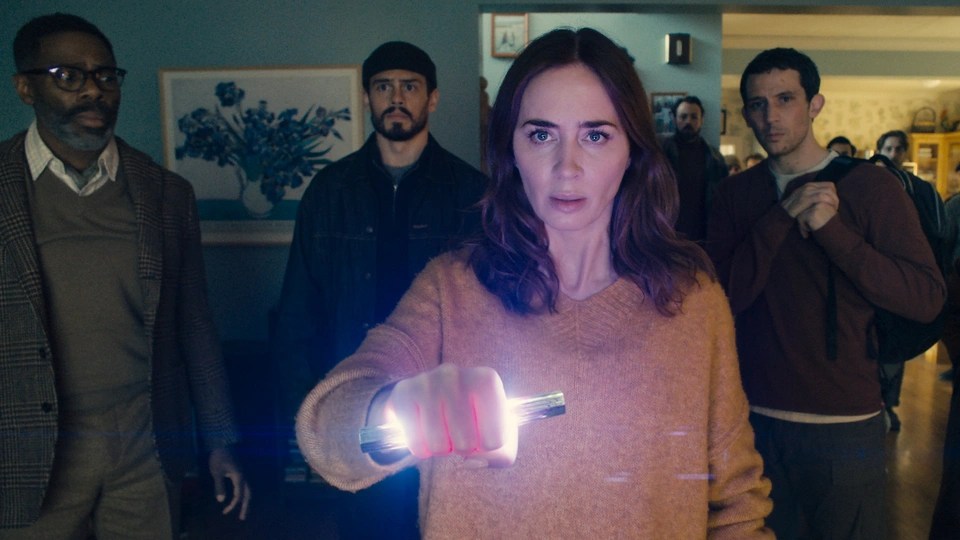
Spielberg is no stranger to tales of extraterrestrial contact. It’s a well he returns to at least every decade or so with slightly varied intentions, from the interconnected dramas of 1977’s Close Encounters of the Third Kind to the profound wonder and deep humanity expressed in 1982’s E.T. the Extra-Terrestrial to the anti-war messaging buried in his 2005 adaptation of War of the Worlds. Of those, the spiritual undercurrent of Close Encounters perhaps shares the most in common with Disclosure Day, as in the latter people wrestle not only with the need to believe, but the need to be believed. Spielberg penned the story outline in 2023, but it’s coincidentally prescient; news reports alluding to a vague global conflict on the brink of exploding cut in and out of the background, suggesting a timeline as uncertain and scary as the one we are currently living in. That’s not to mention the eruption of artificial intelligence over just the last couple of years, and the encroachment of its use in our day-to-day lives. Conspiracy theorists weren’t always internet trolls and crackpots chasing their five seconds of fame; anyone who followed the exploits of Mulder and Scully knows that the pursuit of the truth was once a noble endeavor. Disclosure Day suggests that not only are there well-intentioned people out there still seeking the truth in an age where we’ve learned to question the veracity of everything we see and hear (a fact briefly but pointedly raised in the film’s climax, ASMR for TV news control room geeks), but that people will also sit up and pay attention when the truth is revealed.
That the revelation of the existence of life beyond the stars could potentially salve our Earthy woes is admittedly a big ask and a rather eye-roll-inducing notion, and in its fervency Disclosure Day somewhat trips over its own feet getting it across. Some of the film’s spiritual concepts as it teases out the tension between belief in religion and belief in other forms of life, for instance, are more subtly rendered, like the aliens’ assumption of comforting and familiar animal forms when approaching humans, and specifically the symbolic deployment of a cardinal, traditionally a marker of spiritual awakening, as the form that instigates Daniel and Margaret’s dormant abilities. Other times, it’s blunt, as when Jane attempts to meet Scanlon’s psychic powers with her faith, her grip on her cross cutting into her hand just as Scanlon’s alien device burns his, or when Margaret claims that she will “not be anyone’s religion.” And surely, it’s no coincidence that this conflict wrestling with the burden of the truth largely takes place in Missouri— the “Show Me State.” But as clumsy as its communication of its ideas often is (Koepp’s script is rather clunky and wordy), to call Disclosure Day a rehash of his previous hits, or overtly treacly in its unfailing optimism and faith in people even in an era clouded by doubt and mistrust, would be to discount the evolving nature of the filmmaker’s themes in this mature stage of his life and career. Disclosure Day is as much in conversation with Spielberg’s previous feature, his autobiographical 2022 drama The Fabelmans, as it is with his more expressly sci-fi fare. Much of Disclosure Day hinges on nostalgia, and creation as a method of processing the past. When the early parts of Disclosure Day cut back to Hugo— usually while he’s speaking authoritatively to the person on the other end of a phone call— we see that a structure, a home, is being constructed around him in a warehouse that could just as easily serve as a soundstage that’s home to a film set. It’s late in the film before we discover the true purpose of this structure, and it’s a satisfying reveal that demonstrates just how integral filmmaking itself is to unearthing truths about ourselves and others; looking within, in order to better look beyond.
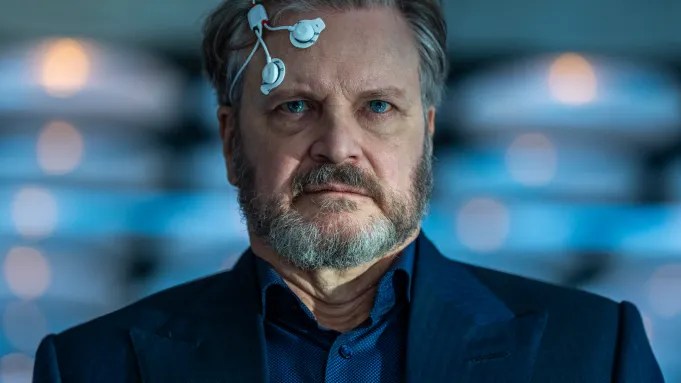
Spielberg’s humanistic storytelling is aided by cinematography by Janusz Kamínski, his regular DP since 1993’s Schindler’s List. While the cold color scheme, stereotypical alien design, and (fortunately brief) wonky CGI doesn’t necessarily render Disclosure Day as a particularly pretty film, the fluid camerawork more than compensates for that. The action set-pieces are exhilarating— a near-collision involving a car and a train is especially gripping— but the thoughtful compositions also expound on the importance of human connection, whether its the layering of characters reflections through windows and screens, or the focus on hand-holding and eye contact (there’s an especially moving scene in the film when Margaret’s abilities allow her to navigate through a crowd of Wardex employees by conjuring images of the people they love; empathy and humanity is quite literally her superpower). The cast’s performances are inconsistent, if acceptable (Firth is a rather one-note baddie; O’Connor’s role ends up being not especially demanding of his soulful talents; other supporting parts, like Russell’s and Hewson’s, are quite thankless), but Blunt is fantastic, tapping into both the comedic and tragic rhythms her part demands with ease. Her serious news anchor reporting is intentionally stilted, her disorientation as she attempts to navigate her perplexing new abilities verges on slapstick, and her being confronted with truths she wasn’t looking for and doesn’t want to see, and a past she doesn’t want to revisit, is achingly sad. Meanwhile, marking his thirtieth collaboration with Spielberg, composer John Williams’ lush orchestrations don’t reach the memorable crescendos of his most iconic scores, but they appropriately surge under the action as opposed to dominating it, provoking a sense of wonder and curiosity that’s in step with the narrative’s goals. It’s a thrill to watch a work from a director who is so assured in what he’s accomplishing. Whether that accomplishment will translate to viewers is as much a gamble as disclosing a grand truth to the global population. But the message is there, for those who deign to listen, and those who want to believe.
Disclosure Day is now playing in theaters. Runtime: 145 minutes. Rated PG-13.


