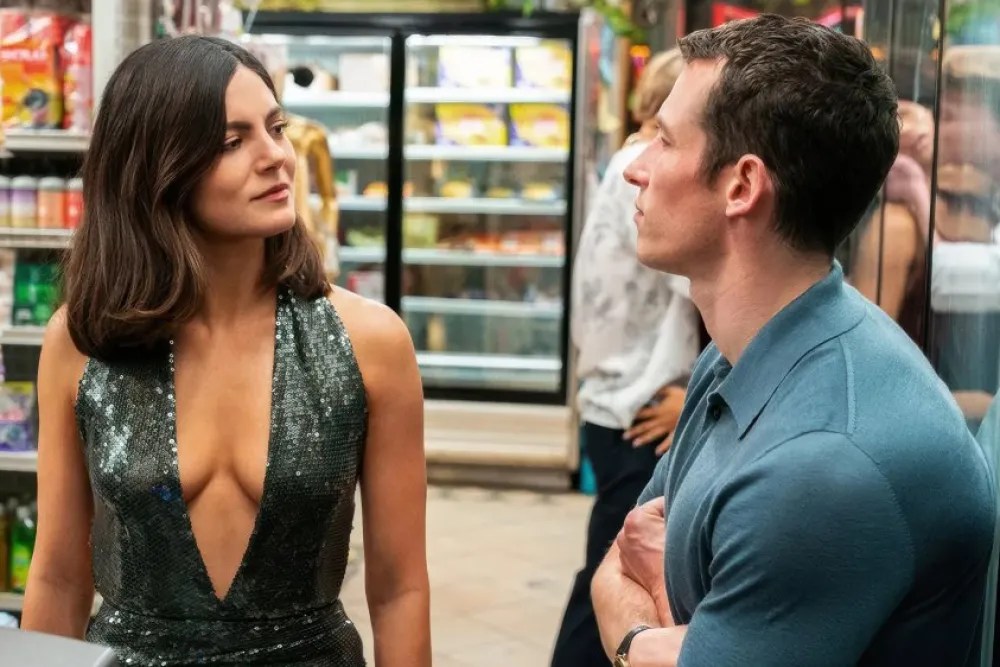
As One Night Only, Will Gluck’s portrait of a dystopian hellscape masquerading as a frothy rom-com, approaches its third act, a potential love interest for Monica Barbaro’s Allie caps a whimsically-delivered monologue about how a government mandate forbidding pre-marital sex outside of an annual 12 hour time frame actually makes the act more special and the decision of who to do it with more discerning with the statement, “Maybe the fascists were right about this one.” It’s a gallingly obtuse bit of writing from Travis Braun and Gluck (who isn’t credited as a screenwriter, but states that he performed a lot of his own rewriting) that synthesizes everything wrong with this shockingly chaste film, whose problems are two-fold. The first is that it was directed by a prude, when it needed to be directed by a horny freak (see: this recent Variety article headlined “‘One Night Only’ Director Will Gluck Cut Out ‘So Much Nudity’ Because People Dislike Sex on Screen: ‘It Takes You Out of the Movie’”). The second is that it minimally engages with the politics of its world. There’s intrigue in the concept of telling a dystopian story but keeping that in the background to swing toward something unexpected. Allie, a stage fright-plagued singer of overly-produced jingles for psoriasis meds and Vag-a-Clear, and Owen (Callum Turner), a pizza shop proprietor whose girlfriend (a criminally underused Maya Hawke) just informed him that she wants to spent the big night sleeping with their neighbor instead, are hopeless romantics looking for more than just a one night stand. Their paths collide over and over again over the course of the evening as they fumble their way toward sleeping with other people, from fighting over the lone condom left in Manhattan to sneaking into a super-exclusive party. The pair are charming enough that they manage to conjure some spark out of this mess, and are game for the narrative’s occasional turns toward slapstick.
However, it’s impossible to consume One Night Only as merely a light-hearted romp when its version of reality isn’t so far off from our own. Throughout One Night Only, politics are brought up just enough so that you are constantly reminded of them, but the script’s insight and world-building are far too shallow to even reach for the potentially sharp black satire on the government policing citizens’ bodies that’s right there. The film’s opening hurriedly rifles through title cards declaring that the mandate was imposed by Congress three years ago. A news report later informs us that it’s enforce by mandatory biometric tattoos on each citizens’ wrist. That same report sees a congressman applauding the mandate’s effects, which include a return to conservative family values and lower teen pregnancy rates. The world-building is questionable and overly slight, to say the least; if you think about the rules for more than a second, it falls apart (people are also required by law to use protection when they have sex, but how is that part enforced? Unclear!). The production design provides occasional amusing glimpses of signage depicting rules such as the sort of displays of affection that are legal and those that aren’t, but mostly I just noticed a distressing amount of Duolingo product placement.
What’s so very frustrating about this, however, is that everyone just seems pretty cool to go along with what seems to me to be a massive infringement on your rights. Gluck decorates the backgrounds of his shots with “REPEAL” signs hanging in windows, graffiti depicting the Statue of Liberty wearing a chastity belt, and occasional folks chanting “Fuck the mandate.” But it’s so performative; no one is shown attempting to take any step toward actionable change or actual activism. Molly Ringwald, appearing briefly as Owen’s mom, shouts about how the government dictating their lives is run by old white men. At one point, Allie (who the film almost immediately establishes as being rather demure, and yet is forced to spend the bulk of the movie running around in six-inch stilettos and a plunging minidress that barely clings to her body) gets caught up in an incident that lands her in a police station, where she questions a cop whether she shouldn’t be concentrating her efforts on serious crimes rather than policing people’s sex lives, and she shrugs with a sort of “it is what it is” response. Everyone is compliant, and all that does it reveal how a concept that sounds orgiastic on paper is actually painfully regressive. Sex work is criminalized. Marriage is the only legal way to have an unrestricted sex life, thrusting couples toward the institution who can’t stand living under the mandate anymore. Heteronormative stories are pushed to the forefront, the representation of other orientations explained away by Allie’s friend (King Princess) who spends the night at home babysitting with a statement about how queer people have been working around straight people’s laws for decades. The biometric tattoos that the government forces every citizen to get on their wrists are used as a cute bonding moment between the leads (hey, at least you’re permitted to pick out what the tattoo looks like). And as Allie and Owen spend the night searching for a “real connection” (the sort of swooning romance demonstrated by Cary Grant and Deborah Kerr in the 1957 drama An Affair to Remember, illustrated along with the Empire State Building on a postcard the pair pick up in a bodega) on the one day of the year when everyone’s priority is getting laid, it becomes increasingly apparent that the movie makes a distinction between sex and love, that the former is cheap while the latter is pure, rather than two things that are intertwined. It’s giving Hays Code era Hollywood, where explicit allusions to sex were minimized under the rule of committees run by older, white, conservative men to the point that many people look back on that time period and assume based on its sanitized cinematic representation that most people led very chaste existences; for instance, Mick LaSalle points out in his book “Complicated Women” the neutering of the line “I can always tell when an affair is waning” in the 1933 pre-Code film When Ladies Meet to “I can always tell when one of his infatuations is waning” in its 1941 remake.

Calling One Night Only “sanitized” may be a stretch, but its lack of nudity and actual sex scenes beyond a few glimpses that the camera quickly pans past is backed up by a rotted political perspective that can’t commit to commenting on the obvious tie between its heightened fantasy world and our very real reality that has seen the American government in recent history overturn Roe v. Wade, adopt legislation intended to control what women can and can’t do with their bodies, and suppress the rights of LGBTQ+ people. Maybe some people are merely content with consuming mid-tier romantic fluff; for me, it’s impossible to ignore everything else circulating around the film’s generically attractive leads. Technologically, we may not be at the point of One Night Only yet. But ideologically, we’ve been burning in this hell for a long time.
One Night Only is now playing in theaters. Runtime: 102 minutes. Rated R.


