What do you do when the object of your desire turns against you— or you turn against it? That tension between lust and livelihood is explored quite literally in writer and director Adrian Chiarella’s debut feature Leviticus, which fast proves to be an incredible concept for a queer horror movie that’s ultimately too sparsely realized to craft an intriguing hook for its characters or story.
Naim (Joe Bird) is relatively new to his small Australian town, having recently moved with his single mother Arlene (Mia Wasikowska, who also serves as a producer on the film and is effective in what is a small and rather thankless role). Insinuations to a tragedy involving Naim’s father are made, but never expanded on. His mom, however, is clearly a devout member of their local church. We know this will be an issue because just prior to seeing her sing hymns along with the rest of the congregation, we witnessed Naim spontaneously make out with Ryan (Stacy Clausen)— a boy he was hanging out with in the desert landscape around where they live, a classmate he claims always ignored him at school— in the film’s opening scene. They sit on opposite sides of the church, but exchange knowing glances as they fail to join in with the song.
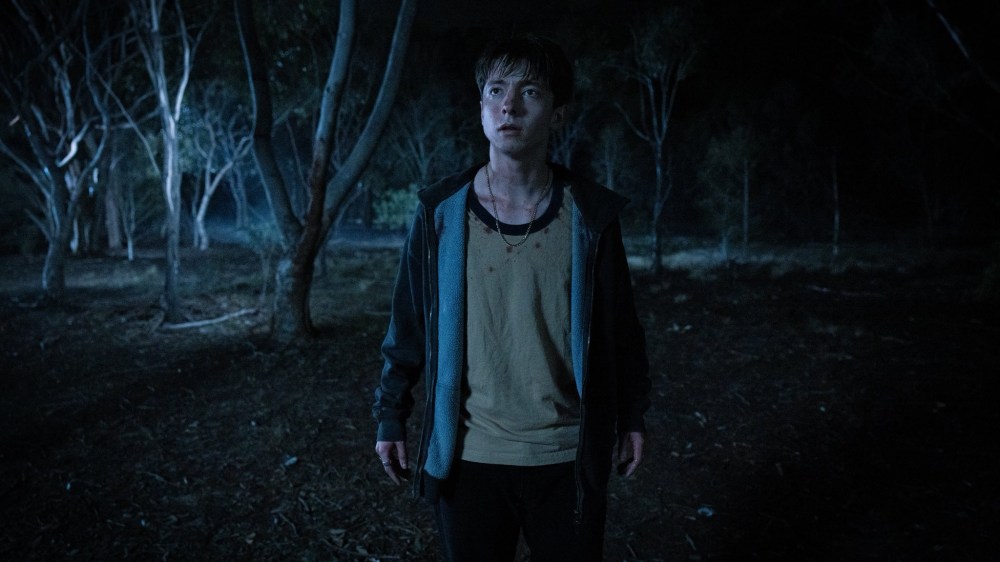
That religion will play a key role in Leviticus is evident from its title, which it shares with the third book of the Bible that outlines priestly laws and conveys the need for spiritual and moral purity among God’s acolytes. The monster horror aspect of Leviticus kicks in after Naim happens to see Ryan kiss another boy, the preacher’s son, Hunter (Jeremy Blewitt), and in a fit of jealousy tells on them. In an allusion to the conversion therapy methods that have historically plagued queer people, and particularly weaponized by religious conservatives as a way of persecuting them and drawing their victims’ own feelings of self-loathing and identity struggles to the surface, Ryan and Hunter are forced to participate in a ceremony— nay, exorcism— conducted by a so-called Deliverance Healer (Nicolas Hope), after which they each begin being stalked by a creature no one else can see, but one which is visible to them in the form they are in to the most.
Leviticus follows a long tradition of queerness in horror, rendering the otherness experienced by monsters and supernatural beings to which queer readings can be applied more explicitly. “Blunt” may actually be a better term; in Leviticus, forbidden desires can literally kill you, as we see in the film’s chilling prologue (a girl enters a pool shower and receives pleasure from someone she is obviously comfortable with but who the audience cannot see, with fatal results). But Leviticus fails to interrogate its ideas with much rigor. Conversion therapy is indefensible and horrid, but the film’s perspective on conservative values and religious tradition in relation to queer relationships is whittled down to its bare bones, the former acting with nothing but evil, prejudiced intentions on the latter, which may be more excusable if there was more heft to the character writing and a more defined narrative arc. As it stands, all of the film’s tension is derived from Naim and Ryan being drawn to each other, even as they are unable to determine whether the other is the real deal, or the monster bent on their demise. “This is what they wanted,” they tell each other at one point. “Us to be scared of each other.”
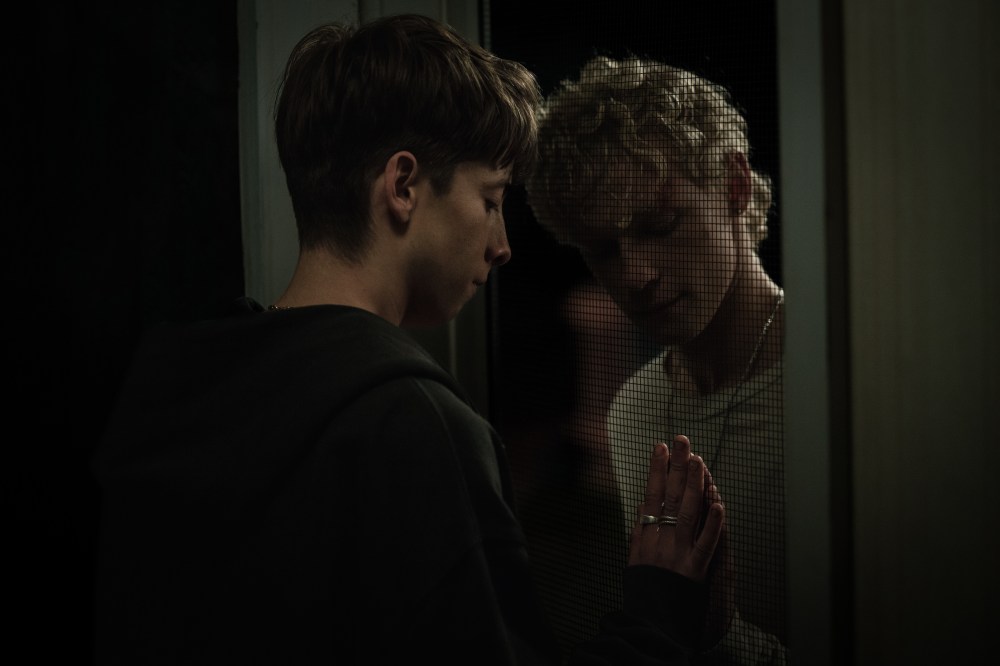
Leviticus does, at least, make apt use of its spare production design and to further highlight that fear of themselves and something other roiling within the characters, and their isolation from the rest of their community— the recurring visual of sheets on a clothesline rippling in the breeze, providing glimpses of illicit trysts occurring behind their covers, is an indelible image, while two leads are often depicted in spaces that segment them from other people and each other, whether they are divided by a fence at a gathering, or a screen door— even if its cinematography frequently telegraphs scares before they happen. Leviticus is less outwardly frightening than a typical horror movie, playing more effectively as an atmospheric and chilling mood piece, and one that manages to work in moments of passion and joy that prevent it from wholly feeling like its characters are mired in violence and misery. Look no further than the scene where Naim and Ryan— who both inhabit their characters’ vulnerabilities in terrifically moving performances that lend them more depth than is present on the page— sit next to each other in the back of a bus and share a tender moment, even as the creature bent on keeping them apart pursues them. As much as Chiarella’s film often feels incomplete, like the dry run for a richer, more layered story, it’s those sorts of sequences that help make it whole.
Leviticus screened at Cinema St. Louis’ 2026 QFest, and opens in theaters on June 19. Runtime: 88 minutes. Rated R.


