I was five years old when Pixar’s first feature-length film, Toy Story, was released in theaters at the end of 1995. Now I’m 35, and the fifth installment of what’s become a classic animated series with an unfathomable amount of supplementary media and that kickstarted an entire studio’s popularity is just entering theaters. It’s so easy feel exhausted by the elongation of a franchise that wrapped itself up with a neat and immensely moving bow with its third entry in 2010, to question whether its continuation is truly for artistic purposes or merely to milk a proven cash cow for all it’s worth, to wonder how a series that has endured for this many years can possibly justify its existence. And yet, the series has proven its relevancy time and again, becoming increasingly reflexive as the years go by, targeting its stories not only at children but at those viewers who were children when the first film was released, and have since grown up, and likely relinquished their own childhood toys, and maybe had kids of their own, kids who they show that first Toy Story to with a nostalgic gleam in their eyes, kids who are being raised with an entirely new menagerie of playthings. I was almost 20 and just finished my freshman year of college when Toy Story 3 was released, a movie about leaving home for the first time, and letting go of the things you have outgrown and no longer need. I’ve spent the bulk of my life since then working with preschool-age children, and have witnessed firsthand how over the last several years especially the prevalence of tablets and smartphones have eroded kids’ ability to focus and communicate down to nothing because their parents and teachers would rather shove a screen in front of their face to pacify them rather than engage with them on an actively personal level.
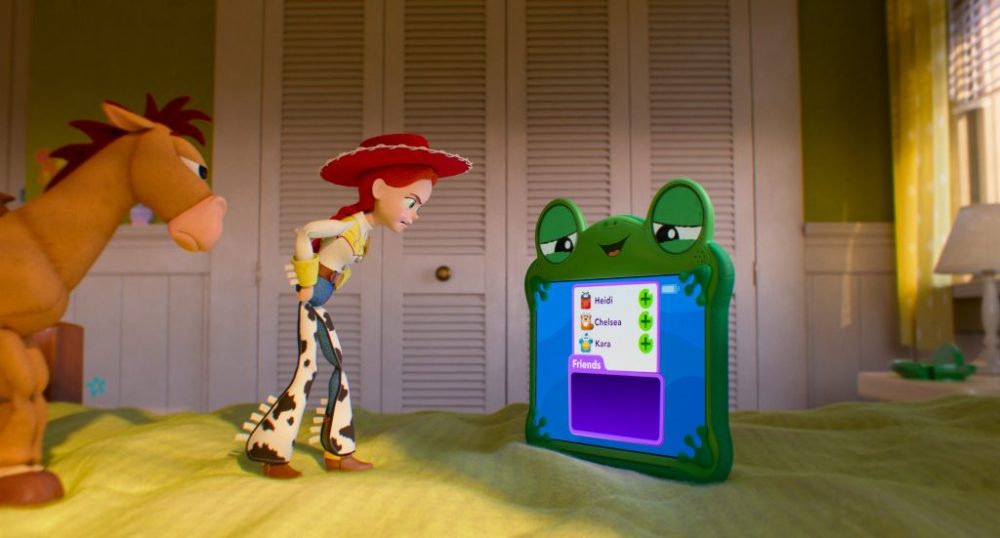
That’s the exact crisis that Toy Story 5 confronts: not only the rather franchise-specific question of how analog toys can possibly maintain their relevance in the digital age, but the broader pondering of how rapidly-evolving technology impacts humans’ capacity to relate to the world around them. Set approximately a couple of years after 2019’s Toy Story 4, Toy Story 5 finds the current owner of Andy’s former toys, Bonnie (voiced by Scarlett Spears), continuing to enjoy her independent playtime while struggling to cultivate friendships with other children. When she desperately asks her concerned parents why no one wants to be her friend, they purchase a Lilypad tablet for her, having seen the advertisements that promise that it helps build friendships. Meanwhile, Bonnie’s favorite doll Jessie (Joan Cusack) learns from the neighbors’ discarded toys that tech has taken over; everyone who’s anyone owns a smartphone or a tablet that they use to play games and chat with others. The introduction of Lily (Greta Lee) into Bonnie’s life forces Jessie to fight for her like never before, panicked at potentially being left behind again as she was by her first kid.
There’s a considerable amount of talent behind Toy Story 5: it was cowritten (with Kenna Harris) and directed by Andrew Stanton, who not only has writing credits on the first four Toy Story movies, but also directed a couple of Pixar’s most acclaimed films, Finding Nemo and WALL-E. The film also finds Pixar’s animators utilizing the company’s innovative new technology to stunning ends; for better or worse (I believe there’s an argument to be made for animated movies becoming less stylistically interesting the more realistic they are), more rigging controls and detail for different types of hair lend the characters more texture and movement. For all that, Toy Story 5 also has more extraneous asides (including an admittedly amusing bit that involves an upgraded batch of Buzz Lightyear action figures, washed away in a cargo ship crash) that cause it to feel less cohesive. Too many character and narrative arcs take turns that are too hurried to fully buy in to.
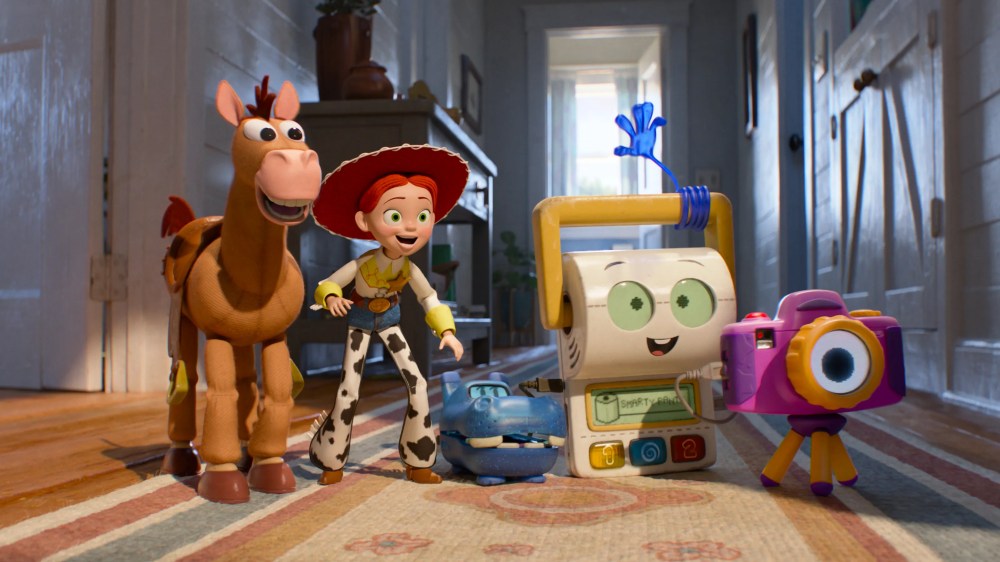
And yet, even though Toy Story 5 never plays as as sharp or as funny or as emotional as its predecessors, it still manages to justify its existence. It still manages to turn on the waterworks, even if it takes a while to get there. It nods at the nostalgia it knows audiences possess for its existing characters— the reunion and competitive banter between Woody and Buzz (with Tom Hanks and Tim Allen returning to voice them, respectively), and a running joke poking at Woody being an “old man toy,” a fact made more real by the obvious age inherent in Hanks’ voice now— but doesn’t make that the focal point of the film. It’s Jessie who actually takes center stage in Toy Story 5, and the arc she’s given is quite lovely, skillfully grappling with her past while propelling her character forward. And while each subsequently film’s world-building has been significantly less creative, it’s remarkably perceptive regarding its themes. It’s interesting to hold Toy Story 5 in one’s hands at the same time as the previous weekend’s big new release, Disclosure Day, two films that grapple with technology’s impact on humans’ capacity to relate to the world around them. Where Spielberg’s movie looks with a hopeful eye at the tension between peoples’ yearning to believe and their existence in a time where rapidly evolving artificial intelligence makes it near impossible to trust what we see, Toy Story 5 deals more practically— albeit still sentimentally— with the cyclicity of new tech replacing old, and the enduring pleasures of analog items in an increasingly digitized world. One of the most fascinating pieces of the film is the inclusion of a trio of toys that are more high-tech than Jessie and the gang (these include a hand-held potty-training game, Smarty Pants, voiced by Conan O’Brien, and Craig Robinson as a GPS hippo, Atlas), who claim that they were relegated to the drawer after a mere three months with their owner, a horse-loving girl named Blaze. It’s an effective and straightforward way of communicating how rapidly technology evolves now, that the newest thing could be replaced by an improved iteration in under a year. In a way, the series has always been about that— the first Toy Story was all about an old-fashioned doll confronting his pending irrelevance in the face of usurpation by a new-fangled action figure sporting all the battery-operated bells and whistles— but I appreciated the nuanced approach this film took to portraying how screens can both distance us from reality and increase anxieties about our relationships and self-worth, but also aid us in cultivating genuine connections with other people whose paths we might not have crossed otherwise. A part of me still questions the film’s earnest optimism; I can’t shake the feeling that a lot of kids will likely watch Toy Story 5 not in theaters, but on Disney+ on their tablets. Whether Toy Story 5 enacts change as much as it entertains appears unlikely, but sometimes, the mere act of addressing a problem is enough to start a conversation. Somehow, 30 years in, Toy Story continues to justify its existence.
Toy Story 5 is now playing in theaters. Runtime: 102 minutes. Rated PG.


