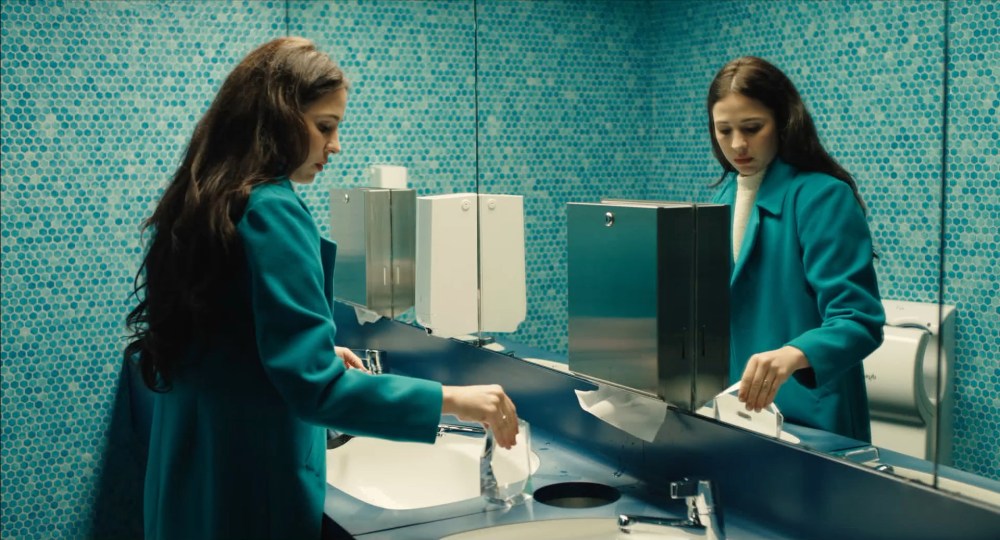
At first glance, Lina (Isabel Aimé González Sola) appears to have it all. A comfortable life with her husband Pedro (Esteban Bigliardi) and daughter Sofia (Emma Fayo Duarte) in Argentina. A successful career as a fashion designer. So successful, in fact, that she travels to Switzerland to accept an award for her work. The opening of Milagros Mumenthaler’s third feature, the arresting psychological drama The Currents, however, immediately tips off the audience to something unsettling, holding close on Lina’s blank face, her reflection in the window of a Geneva high-rise superimposed over the frigid cityscape outside, soundtracked by the intense whooshing of the wind. Lina smilingly accepts her award, nonchalantly shoves it into the trash in the restroom afterwards, and wanders the narrow, meandering streets around the city until finally, clad in a chic turquoise wool coat and gloves, she strolls onto a bridge and, seemingly without any thought, climbs over the railing and plunges into the icy river below. She’s deposited at her hotel by an ambulance, wrapped in a gold space blanket she wears like haute-couture, her inscrutable expression failing to reveal that anything significant has occurred. But when Lina returns home to Buenos Aires, it’s clear that something is deeply wrong, from her distant mood to the fact that she’s now suddenly afraid of water. A woman on the verge, indeed.
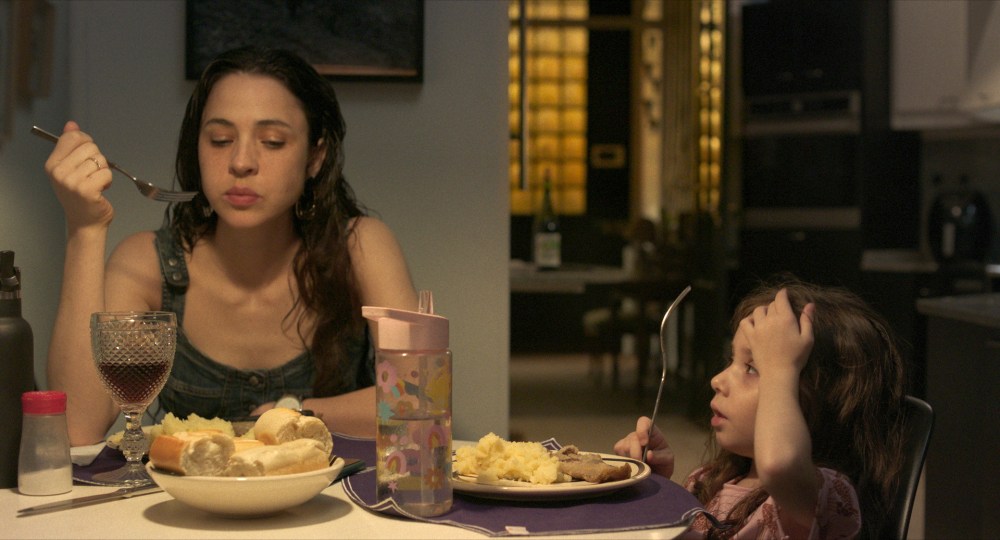
There’s a knottier issue at the heart of The Currents that reaches deeper than the anticipated woman-bristling-against-maternal-conventions thread, even if the film’s few more obvious overtures gesture toward that. Pedro is baffled by his wife’s sudden change, from her emotional unavailability to her physical appearance; she stops washing her hair, which spills over her shoulders in greasy tangles. Sofia is a distraction; the bleeps and bloops of a game on her tablet dominate the soundscape during a work meeting Lina has with another designer, Julia (Ernestina Gatti), like a ticking time bomb on Lina’s sanity as the camera holds on her face, barely appearing to register Julia’s pitch. Another day, she forgets to pick her up from school, too occupied with finagling with a project. But even though The Currents plops us into Lina’s story right at the apex of her breakdown, without any explicit portrayal of her previous life to compare with the after, shades of her past unveil themselves as Lina navigates her world. She visits an old friend, Amalia (Jazmín Carballo), who has taken over proprietorship of a humble salon in a working class neighborhood from her late mother, and who knows her not as Lina, but Cata. The division of Catalina’s name suggests a division in two phases of her life (an autobiographical element, perhaps, as Mumenthaler was born in Argentina but grew up in Switzerland), evident further in the terse but familiar manner in which Amalia addresses her, and the way she knows just how to care for Lina’s body, which she’s taken to wiping down with sponges to avoid direct contact with water. The implication is that this has happened before.
Toward its end, The Currents introduces a thread of generational trauma that contributes perhaps too much of a concrete reason for Lina’s unraveling, even if the preceding movie stands as a unique take on grappling with that subject. The film’s obliqueness, after all, is largely what makes it so beguiling, as is Mumenthaler’s strong directorial vision, which hinges on artifice in a way that situates the film somewhere in the space between Todd Haynes’ Safe and Alfred Hitchcock’s Vertigo both aesthetically and thematically, a continuation of the cinematic canon of women discarding iterations of themselves as they drift farther from reality. The haunting, voyeuristic aspect of the latter is particularly evident when, at one point, Lina follows Sofia up to the top of the lighthouse at the Palacio Barolo, the brilliant rotating beam illuminating parts of the city, and people, and desires, a literal shedding of light that serves as some sort of awakening for Lina. The score, comprised of existing compositions, pushes the film to an even more heightened, overtly cinematic, place. The lighthouse scene, for instance, is backed by Gustav Holst’s “Venus, the Bringer of Peace,” the second movement of his orchestral suite “The Planets.” The piece gradually builds on horns and strings, and the result is grand and stirring and rather curious, and paired with the roving eye of the camera, crafts a mysterious atmosphere that’s not unlike what Bernard Hermann’s iconic theme does for the stalking sequence in Vertigo. Where music isn’t employed, the lush sound design amplifies the noises that Lina is drawn to: the churning of a sewing machine, the thrum of a percussionist beating a drum, and that wind, which seems to carry something dangerous and frightening in its unknowableness on its currents.
Mumenthaler’s camera follows those sounds, tracing landscapes that are simultaneously beautiful and eerie in how they are divorced from reality just so (Buenos Aires is a big city, and yet it is so quiet, and so sparse), and Sola’s beguiling lead performance works in tandem with the material. She never reaches a hysterical pitch; her calmness, rather, makes what’s going on with her that much more difficult to penetrate. The cues that link her with the art featured in the film perhaps indicate its logic the most; the inclusion of pieces by Francisco Goya, a key painter in the Romantic era that eschewed the reason that defined the Enlightenment in favor of emotions, that depict the unknowable nature of the self; the focus on apocalyptic art at the same time that Lina’s world seems to be teetering on the brink of oblivion. Another character, Julia, defines romantic acts for Lina further, stating that she sees romance “as a way of being, a deep aspiration that’s necessarily mixed with frustration…I don’t know if they’re real, or just an artifice to fill the void.” That scene feels like a revelation in a film peppered with rumblings of something happening that never fully reach a crescendo. Or maybe it’s not. Maybe, instead of trying so hard to fit the pieces together, to solve the puzzle, it’s better to just let yourself be swept away by wherever The Currents take you.
The Currents screens locally at the Webster University Film Series July 30-August 1, and is now playing in select theaters nationwide. Runtime: 104 minutes.


