I glided off of Christopher Nolan’s adaptation of Homer’s epic poem The Odyssey in much the same way I do Denis Villeneuve’s Dune movies, the mass appeal of which I decided long ago I will never comprehend. I sincerely believe you can make a serious-minded epic without requiring every cast member to deliver broodingly one-note performances, that you can have a little fun and still warrant consideration as a thoughtful work.
That’s not to say that Nolan’s The Odyssey is totally devoid of merit; in fact, there’s much to admire about the handsome production, which includes lots of exterior location shooting and thunderous sound and scope and practical effects that adhere to realism without sacrificing the story’s more mythical elements (the Cyclops that serves as one of the story’s most iconic and exciting action set pieces is brought to life via a combination of animatronics, puppetry, and live performance from actor Bill Irwin). Matt Damon is appropriately grizzled as Odysseus, the Greek king of Ithaca who vanished for years following his storied victory in the Trojan War, leaving his wife Penelope (Anne Hathaway) to fend off suitors seeking to take his place on the throne and his son Telemachus (Tom Holland) setting off on a journey of his own, accompanied by his teacher and Odysseus’ friend Mentor (Ryan Hurst) to try and discover what happened to the father he never got to know.
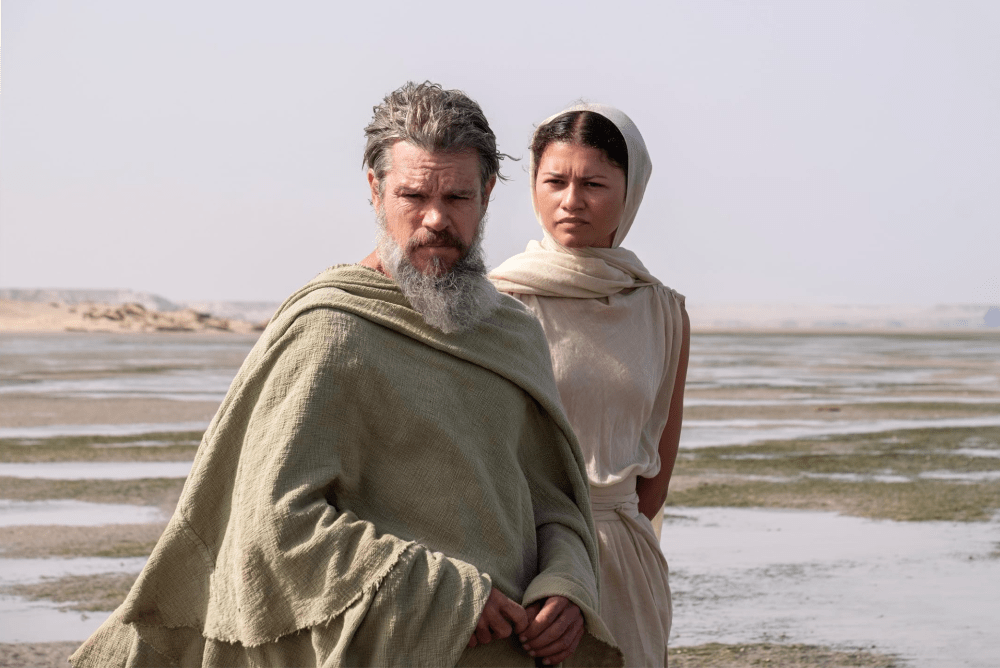
The bulk of what has generated controversy around The Odyssey has stemmed from historical inaccuracies in the costuming, language, and the actors’ employment of primarily American accents, as well as some outright racist outrage surrounding Nolan’s casting choices, like Lupita Nyong’o as Helen of Troy, often described as the most beautiful woman in the world and the abduction of whom triggered the Trojan War in the first place. I’m not especially interested in whether or not the soldiers’ helmets are the same ones used in Ancient Greece, or the streamlining of the language into more plain-spoken dialogue (Nolan cited Emily Wilson’s 2017 translation of The Odyssey, noted for its freshness and readability, as a key influence on his script, and I believe the more accessible approach for a film of this scale is the right one). I’m far more interested in what the story makes me feel, and for all its melancholic ruminations on men’s hubris, corruption, the slippage of time, and the fact that sometimes you truly can’t come home, The Odyssey is self-serious almost to a fault. It’s an evolution of the Hollywood epics that were especially popular in the 1950s and 60s, their massive ensembles, lavish production designs, and grand widescreen cinematography engineered to draw viewers away from their new-fangled televisions and into the movie theater to see something you can’t see anywhere else. Nolan’s movies have increasingly become the 21st century equivalent of that. It’s basically a game to try and see The Odyssey in as many different formats as possible (IMAX, 70 mm, IMAX 70 mm, 35 mm, Dolby Vision, the list goes on); it’s a cultural event even for those who don’t patronize the movie theater that often. But The Odyssey also adheres to a trend that dictates that performances in “serious” fare should prioritize grit over personality, as if the two can’t coexist. Zendaya, occasionally appearing as a vision of Athena to Odysseus, never convincingly sells any emotional depth. And no film should ever rely so heavily on a leading performance from Holland, whose face is a void, a vacuum, a black hole where nothing goes and little of any substance emerges.
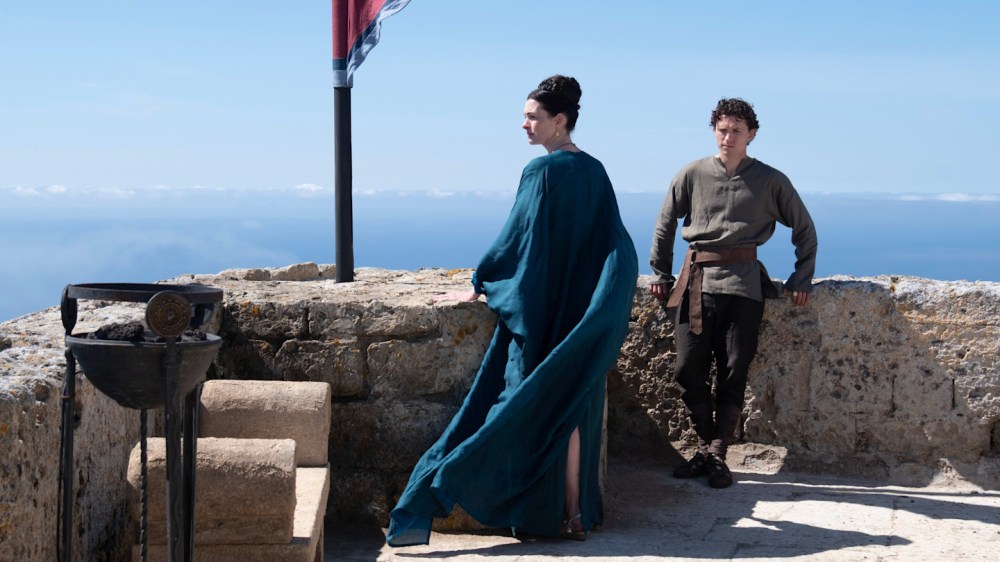
That criticism isn’t universal, even though actors I typically enjoy largely come off as drab and uninteresting. Robert Pattinson, playing the detestable nobleman Antinous, is at least trying to have fun and does pull off a subtle but telling mouth twitch toward the end that’s expressive in a way that most of his costars are not. John Leguizamo is brilliantly utilized in a character part as the blind herder Eumaeus, whose unerring loyalty to Odysseus is one of the truly moving aspects of this adaptation. Samantha Morton is winning as the witch Circe, but like Nyong’o, she’s underutilized. I don’t think any of us are surprised that the “Christopher Nolan can’t write women” discussion is circling back around, but it’s frustrating to see how the action swerves away from potentially intriguing themes and thorny character beats just because he either can’t or won’t or doesn’t know how to center a woman in the story. Penelope’s explosive assertion, when repeatedly pushed to take a new husband who can sit on the throne, that she has been the one sitting on the throne all this time, for example, is a fascinating narrative strand that isn’t followed through beyond that inflammatory statement.
In short, it’s really time that Nolan brought on a co-writer, especially considering the amount of women who consistently perform key roles in other aspects of his work, like producer Emma Thomas. There are other technical aspects of The Odyssey that fall short, like the inconsistent sound mixing, dim interior lighting, some awkwardly blocked scenes, and the jarring cuts of Jennifer Lame’s editing, which occasionally work in favor of the memory aspect of the story and its non-linear structure, moving back and forth between past and present, physical spaces, and dreams and reality, but more often distract from the grandeur of the frame. I’m glad that people are excited for this movie, for having an experience in the cinemas, for engaging with a work that was first composed in the 8th century B.C. I also think it’s fair to ask a little more of our blockbusters, and of the too-revered auteurs given the money and power to create them.
The Odyssey is now playing in theaters. Runtime: 172 minutes. Rated R.


