The White Nights are a natural phenomenon like no other. For a brief period over the summer, the sun barely dips below the horizon in high latitude areas, meaning that daylight sticks around for a full 24 hours. It’s a sight that Marina (Tanya Shahova) has yearned to witness for the last 30 years. Sixty years old and working as a nurse in Bulgaria, she accepts bribes from family members to do a little extra to ease patients’ pain, squirreling away the extra cash in a little tin she tucks away behind the fireplace. Her husband Gosha (Ivan Barnev) who works as a train conductor does the same, turning a blind eye to illegal diesel siphoning. When they’ve finally saved up enough for the trip to Russia, they visit a travel agency to book the trip. Marina’s eyes are wide and glistening as she listens to the agent list all of the destinations on their excursion, and asks if it includes a boat cruise on the Neva River around St. Petersburg. It’s a little extra, but they’ll add it, and pay for the entire trip in cash on the spot. And then Russia invades Ukraine.
That’s only the start of the couple’s problems in Black Money for White Nights, directing team Kristina Grozeva and Petar Valchanov’s entry in the Crystal Globe Competition at this year’s Karlovy Vary International Film Festival. Shooting on location, they imbue the film with a palpable sense of urgency, no more so than when Marina and Gosha try to navigate Sofia’s city center in the midst of protests and parades, searching in vain for the bus that they were assured would take them to Belgrade where they will then hop on a flight to Moscow, having revamped their itinerary to circumvent the war. The celebratory scene (Marina and Gosha snap happy selfies around Alexander Nevski Square) fast devolves into confusion and concern as they realize none of the buses around the square are going to their destination, the repetitive clacking of their suitcases’ wheels on the cobblestone streets as they wander from bus stop to bus stop mounting along with their panic. While later staying with Marina’s younger sister (Margita Gosheva) and her family, they learn that the agency they booked with when bankrupt, absconding with their clients’ money and leaving nothing but an empty office building in their wake.
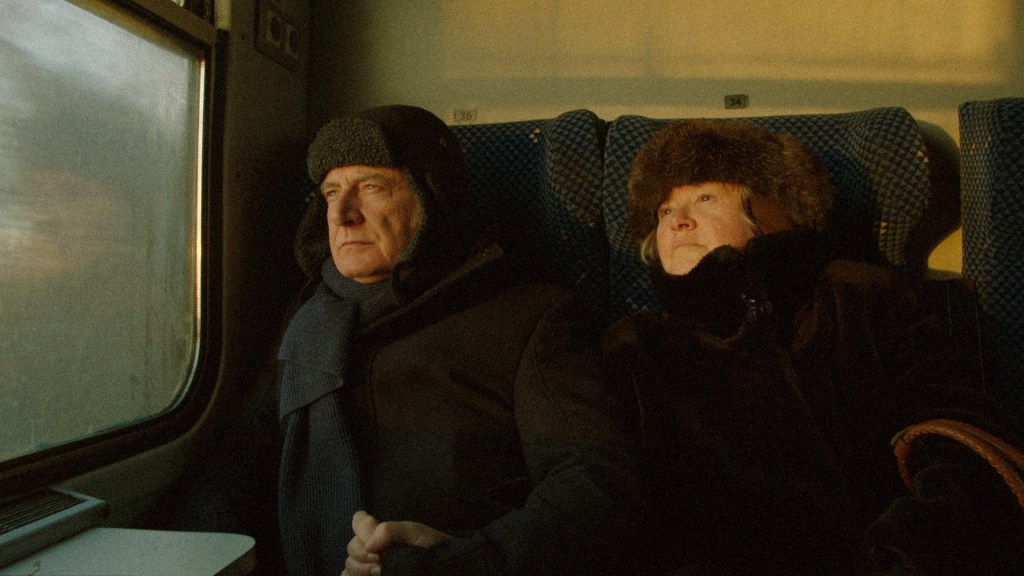
The quest to recover their money— a whopping 10,000 leva— is what drives the action of Black Money for White Nights forward, but the narrative fast becomes less about retribution, and more about the moral and ethical burden that the methods by which they acquired the money places on them, and how that in turn strains their relationship. The devout Martina begins sensing signs that they need to drop the matter. Gosha accidentally breaks her cross pendant and fails to fix it (one of many such “empty promises” that populate the film), so she goes to a church to purchase a new one. The sketchy priest who blesses it tells her that lies bring pain, and stealing brings itching; Gosha is always asking her or someone else to scratch his perpetually itchy back. Gosha, meanwhile, takes increasingly desperate measures as he scrambles to recoup whatever he can.
Grozeva and Valchanov’s crafty and deceptively rich character piece dips into everything from navigating bureaucratic red tape to crisis of faith to reckoning with pro-Russian romanticism, allowing the couple’s secrets and revelations to trickle out through their thoughtful compositions, lensed by cinematographer Alexander Stanishev, and dialogue. Marina and Gosha, for example, are frequently at the start of the movie shown in their home sitting in front of a verdant swath of wallpaper depicting a forest— a symbol of a transformation to come, perhaps. And even when the candid manner of their words read as overly blunt in the third act especially, they’re skillfully delivered by Shahova and Barnev, who believably play off each other as an old married couple as their playful bickering at the start morphs into cutting blows after the missing money forces them to confront their own— and each other’s— belief systems. It would be easy to write Black Money for White Nights off as merely another entry in the growing subgenre of stories about scammers. But Grozeva and Valchanov— who took home the Crystal Globe from KVIFF in 2019 for their film The Father— wisely employ that not to a trite morality tale, but as the instigator for what ultimately proves to be a marital drama. And just when you think the film may be heading toward an overly bleak and cruel finale, it swerves, the dialogue that continues over the end credits both cementing the steadfastness of a relationship that has endured the hardest of hardships.
Black Money for White Nights had its world premiere in the Crystal Globe Competition at the 2026 Karlovy Vary International Film Festival. Runtime: 94 minutes


