Zdena (Pavla Tomicová) works as a mail carrier in the small Czech town where she’s lived all her life. She promised her husband before he passed away that she’d be able to take care of their house on her own, but she’s managing that about as well as her life. The building is in desperate need of repairs from storm damage and age, repairs that are mounting like the nic-nacs and paraphernalia that clutter its interior.
Premiering at the Karlovy Vary International Film Festival, Czech filmmaker Šimon Holý’s fourth feature, Chica Checa (for which he composed the music in addition to writing and directing), is this year’s Crystal Globe Competition’s warm crowd-pleaser. Zdena fast proves to have more on her hands than just a crumbling house. Her mother (Vera Janku) is ill in the hospital, prompting an impromptu visit from her son Lukáš (Jan Cina), who now lives and works in France. Lukáš awkwardly dodges her questions about his job at the bank, or whether he’s seeing anyone (a query he flips back at her, which she similarly evades). Zdena humors her son’s idea of dressing up and performing as Czech pop star Helena Vondráčhová when he hears that his grandmother, recalling a concert she attended long ago, yearns for a visit from her. But when she drops a homophonic slur into casual conversation, Lukáš can’t hold back any more: he reveals to his mother that he is gay, his roommate is his boyfriend, and he doesn’t work at a bank but as a drag queen, playing to rapturous audiences under the stage name Chica Checa (“Czech Girl”).
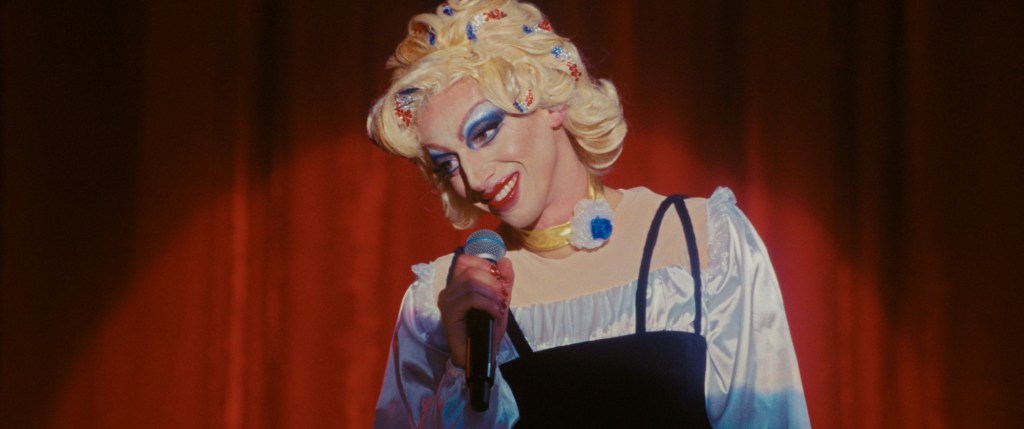
It’s the sort of coming out story we’ve seen a million times before: Zdena leaps from the shock of having to reconcile her love for her son with her traditional ideals to a sort of begrudging acceptance. It’s all very low-stakes, devoid of the sort of tension or dramatic outbursts typically warranted by such a scenario. But it’s stuffed into a film that’s juggling too many other ideas. For Zdena, that includes the pending loss of a parent, a flirtatious handyman, a developer expressing interest in purchasing her home to rehab it as a vacation rental, and realizing that the next stage of her life may require her to travel physically and mentally out of her comfort zone. Individually, many of the scenes are quite lovely. A standout is the sequence in which Lukáš performs as Helena for his grandmother and a handful of other patients and hospital workers. Zdena doesn’t believe her mom will buy that he’s not really her, but she’s missing the point of a drag performance, which Lukáš describes as an “art form.” Lukáš, sporting a blonde wig and sparkly costume and thick make-up, may only truly resemble the real Helena if one squints a bit, but the performance is about the infectious joy shared between the drag queen and their audience, not realism. And the former is written all over Lukáš’ grandmother’s face as she smiles and claps along.
Holý, however, doesn’t effectively string all these threads into a cohesive piece. It doesn’t help that the two lead performances, while they do capably impart both the ease and the anxiety that fills the air around the mother and son, are inconsistent. Tomicová almost always opts for an intensity that doesn’t feel genuine. Cina, meanwhile, turns in a far more naturalistic, and therefore more believable, performance. The frequent employment of wide shots, meanwhile, works well in portraying the rural charm of Zdena’s surroundings in exterior shots, but is oddly distancing in the intimate dialogue scenes. But Chica Checa compensates for all its fumbles with an earnestness that makes it difficult to fault a work that’s so sweet.
Chica Checa had its world premiere in the Crystal Globe Competition at the 2026 Karlovy Vary International Film Festival. Runtime: 96 minutes.


