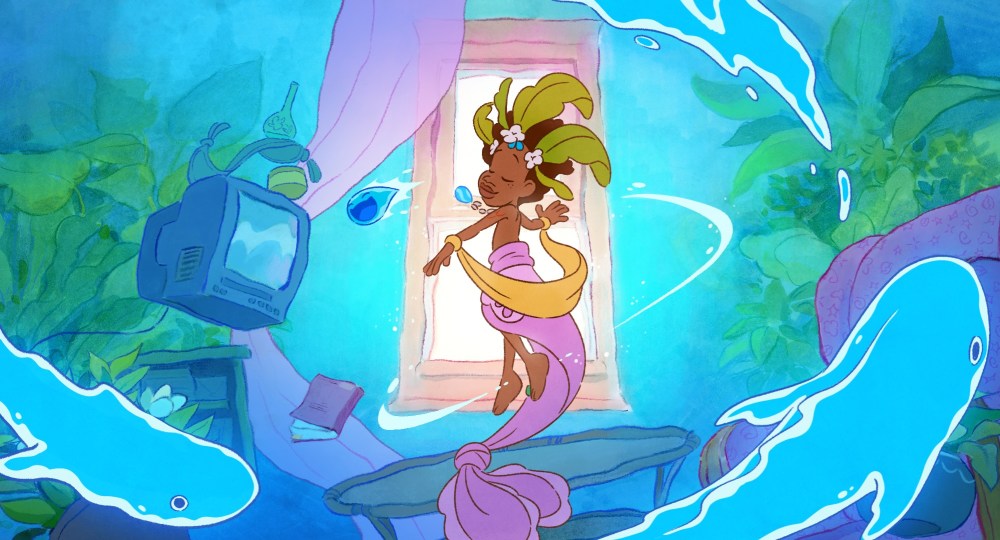
An affirming tale of self-acceptance and identity told with vibrancy and tenderness, director Louise Bagnell’s Julián— premiering in competition at the 2026 Annecy Film Festival— finds its title character and beating heart in a young Afro-Latino boy (voiced by Knyght Darius Jack) journeying with his father (Anthony Sardinha) to spend the summer with the grandmother (Milcania Diaz-Rojas) he doesn’t know. As he rides in the backseat of a Brooklyn-bound car, he prattles on about all the wonderful things he’s going to show and tell his grandma, including a picture he’s frantically drawing of fish and the ocean. His father’s hesitance at his son’s excitement anticipates the tension that will follow after he leaves Julián with his grandmother, cautioning her that his son is not the same sort of kid he was at that age: a clash not just of personalities, but backgrounds and upbringings, that forces the pair to make concessions to relate not just to each other, but also learn about themselves.
Based on Jessica Love’s best-selling book, Julián is a Mermaid, Julián greatly expands on its source material, taking place over the course of an entire summer as opposed to just one afternoon. Brought to life by an earnest voice cast, both Julián and his abuela are given arcs that are fully realized with a clarity and care that make the film essentially accessible for young audiences. Abuela, for instance, misconstrues Julián’s yearning to play with the trio of girls who hang out on her block as a desire to impress them, while Julián actually wants to be a mermaid, with long flowing hair and a sparkly costume he can wear in an upcoming parade. Abuela, meanwhile, bristles at his constant badgering to go to the pool and swim due to lingering trauma just prior to her immigrating to New York from the Dominican Republic. The conflicts are low-stakes and played with a light touch, fleshed out with comic mishaps that are amusing if not especially clever (Julián making a mess while trying on his Abuela’s necklace, refusing to eat her cooking, and so on). Compared to the past filmography of the movie’s lead producer, Cartoon Saloon (The Secret of Kells, Wolfwalkers), it’s far less rooted in folklore and mysticism, despite Julián’s occasional imaginative flights of fancy.
But even if Julián is little more than pleasant, it’s rounded out by good intentions and a beautiful art style. Animation studio Sun Creature crafted a visual language that is a reflection of Julián’s own art, with bold-colored, intricately-designed backgrounds rendered with colored pencils and markers, and old-school, 2D character animation. The aesthetic brilliance also works in tandem with the story’s broader message of coming out and acceptance of those from all walks of life and persuasions: queer people, Afro-Latino people, people from other countries, people from different generations. It may verge on too saccharine, but Julián’s positivity is infectious.
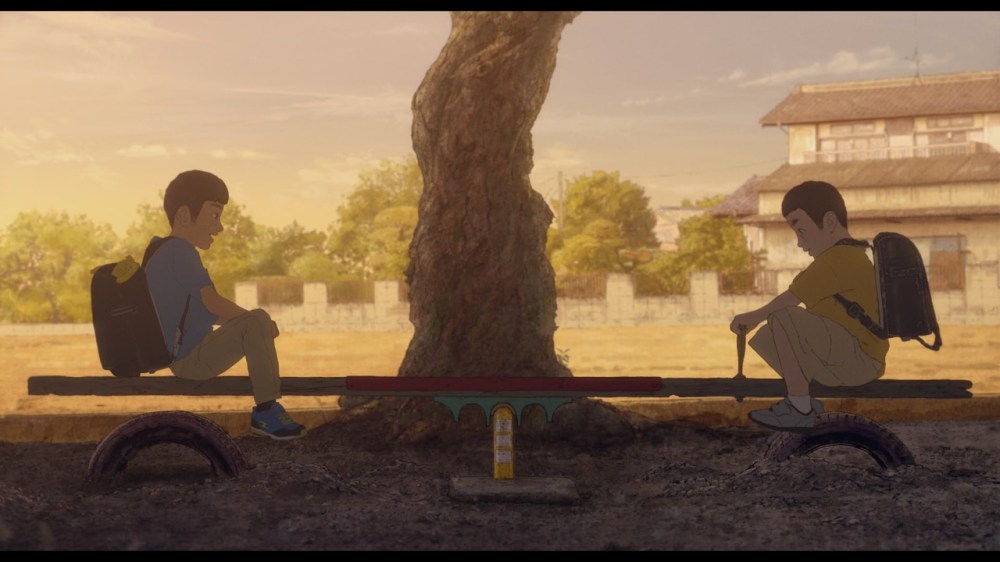
What do you do if you miss the chance to say sorry and it becomes hard to say? That aching, all-too-relatable query forms the backbone of Kohei Kadowaki’s decades-spanning animated drama, We Are Aliens, which premiered in the Directors’ Fortnight sidebar of this year’s Cannes Film Festival and now screens in competition at the Annecy Film Festival. The film quickly jumps back in time following a ruminative prologue, and we meet Tsubasa (Ryota Bando), a lonely third grader who lives with his single mom in a small Japanese town. He breaks free of his seclusion when he finds an origami ninja star placed in his desk, an object that his energetic classmate, Gyotaro (Amane Okayama), employs as an ice-breaker to introduce himself. In no time, the boys are inseparable, a montage backed by J-pop composer Yaffle’s heart-tugging score depicting them stealing glances at each other across the classroom and running after each other on their way home from school, holding hands as they skip through the rain.
We Are Aliens’ title possesses an inherent sci-fi implication that the plot doesn’t suggest, but fear of the unknown kickstarts the conflict that flips its protagonists’ lives around. Tsubasa is unnerved by his classmates’ whispers that Gyotaro is an alien; the dread plays out in his nightmares, surreal renderings of reality in which Gyotaro appears in the guise of a sharp-angled, bug-eyed, blue-skinned extraterrestrial. When one rainy afternoon Gyotaro takes his playfulness a step too far and breaks Tsubasa’s mom’s favorite umbrella, it’s the first fracture in a series of incidents that drive the two apart. As the boys grow into teens and later young adults, Tsubasa falls in with a more popular crowd, while Gyotaro becomes increasingly isolated, made the butt of jokes by school bullies.
Kadowaki realizes his story using a striking combo of rotoscoping and painterly animation. The photorealistic style still lends itself to some distinctive, at times exaggerated, animated effects; the sketchy lines of the characters’ faces, for instance, effectively convey their distress. He also bisects the narrative, telling the first half from Tsubasa’s perspective before rewinding and retelling what we just saw through Gyotaro’s lens. The final product doesn’t feel too much like we’re watching the same scenes over and over— the repetitiveness more works to show how the exact same event can be perceived differently from different perspectives, while the movie rarely zooms out from Tsubasa and Gyotaro— but the film does eventually begin to buckle under the weight of its myriad flashbacks and mounting collection of traumas, losing the poetic rhythm established in its first scenes and becoming increasingly jumbled. Still, it’s a moving, if overlong, examination of the impact of bullying and, on a broader scale, of the small mistakes and misgivings that are difficult to come back from but nag at you for the rest of your life. Kadowaki appears to understand that initiating any relationship is an act of engaging with the unknown: it could be a happy and fulfilling experience, or devolve into meanness and jealousy and resentment.


