I knew immediately after I watched his previous feature, All the Long Nights, on a whim in Berlin a couple years ago that Japanese filmmaker Sho Miyake was going to be one of my guys. Two Seasons, Two Strangers (which won the Golden Leopard at the 2025 Locarno Film Festival) is similarly a carefully observed study of loneliness and longing, complicated by a more adventurous and playful narrative structure that asks intriguing questions about the nature of authorship. The diptych, loosely based on a pair of manga short stories by esteemed cartoonist Yoshiharu Tsuge (Scenes from the Seaside and Mr. Ben and His Igloo), is divided by a transitional interlude revolving around a post-film Q&A. As the opening shot of the movie depicts a screenwriter, Li, putting pen to paper, we know that the following tale of young male and female travelers (Natsuo and Nagisa, played by Mansaku Takada and Yuumi Kawai) who connect on the beach while visiting a seaside town stems from her imagination, not reality. But the later scene calls into question just how much of what we’ve been watching truly was her creation. She fumbles over her response when a student asks if the director had accurately translated her work to the screen, and if what the final film was what she had envisioned; a professor, when prodded for his thoughts, said that he found it “sexy” and perhaps a little “erotic”— not descriptors that really apply to the tender, melancholic, and platonic (even though an air of romance could be read into their tentative rendezvous) story that preceded this.
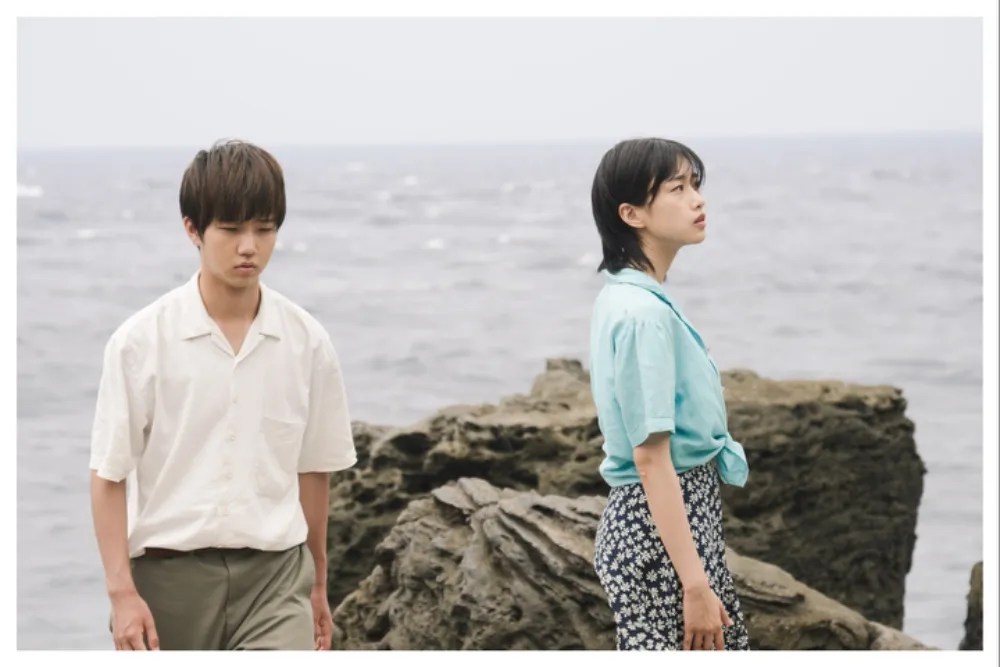
If the first story is a manifestation of Li’s emotional state, in which she perhaps envisions herself as her adrift protagonists, the following story puts it in action, making her the main character. The second half, which trades in deep blue waves and pouring rain for white-blanketed hillsides and pouring snow, mirrors the first, as Li— struggling with writer’s block and traveling with seemingly little foresight— ends up the sole guest at a solitary innkeeper’s (Benzo, played by Shinichi Tsutsumi) isolated cabin, having been shut out of every fully-booked hotel in the area, where her curious mind and attentive eye quickly begins to piece together his backstory from the visible fragments of his past scattered throughout his home. Typhoons and blizzards swirl around the characters, nature’s unrest paralleling their own. Aquatic life serves as a recurring reminder of human tragedies; the young man observes that he once found the bodies of a mother and baby on the beach, skeletonized by the octopus that lives nestled under the shoreline’s craggy rocks, and the innkeeper steals a valuable carp from the home where his ex-wife retreated to with their daughter, simultaneously an act of vengeance and a tangible reminder of what he lost.
At one point, Li’s narration explicitly voices that she “can’t stop thinking about travel.” The impermanence of place, and the specific sort of isolation wrought by displacement, appears top of Miyake’s mind here, pulled forth by the restlessness of his characters (in the first half, the woman comments to the man that she tries to keep busy to distract herself from her loneliness; he replies that being busy can also be lonely; she despondently responds, “Oh. True.”). They’re the same feelings and worries that I personally confront almost every day, which may be why I felt especially attuned to its pensive rhythms. Speaking of authorship, Miyake gently bends and melds Tsuge’s two stories into his own vision, but I believe in a way that is not antithetical to the artist’s original intent. It’s the sort of adaptation I love to see: one that meaningfully builds on its source material, weaving a profoundly perceptive portrait of quiet empathy and deep humanity.
Two Seasons, Two Strangers is currently playing in select theaters. Runtime: 89 minutes.


