On the press tour for Star Wars: The Mandalorian and Grogu, director Jon Favreau cited Flash Gordon— specifically the 1936 Universal serial starring Olympic athlete Buster Crabbe, divided into 13 15-20 minute chapters that would screen before feature films in the theater— as a key influence on his movie. The space adventure was an inspiration for George Lucas as well when creating what would become his groundbreaking 1977 space opera, but it’s structurally a little more apt a comparison here, as Favreau’s film is an extension of his The Mandalorian TV series that debuted on Disney Plus in 2019 and has had three seasons to date. Cowriting the screenplay with series co-creator and newly-minted Lucasfilm Chief Creative Officer Dave Filoni and Noah Kloor, who penned episodes of The Mandalorian and its subsequent spinoff, The Book of Boba Fett, Favreau imbues the film with an episodic structure that’s reminiscent of old-time adventure serials, in which each chapter was simultaneously a contained adventure and the next step in a larger story, often ending on action-packed cliff-hangers to keep audiences coming back for more.
But serials, whether they are westerns or science fiction or crime thrillers or about comic book superheroes, are exciting and fast-paced. They cover a lot of ground in very little time. In contrast, The Mandalorian and Grogu is bloated to the point where it is marked by pockets of dullness that are difficult to sit through. Perhaps even more egregious, it does little to contribute to the lore or broader arcs of its characters. Favreau initially wrote an entire fourth season of The Mandalorian before the lengthy break due to the writers’ strike prompted Lucasfilm to pivot toward considering a return to Star Wars in theaters. It’s been seven years since the last Star Wars movie, 2019’s sour The Rise of Skywalker. This was long overdue, and yet, the plot lacks so much forward momentum, it leaves one to wonder just why this story warranted the cinematic treatment.
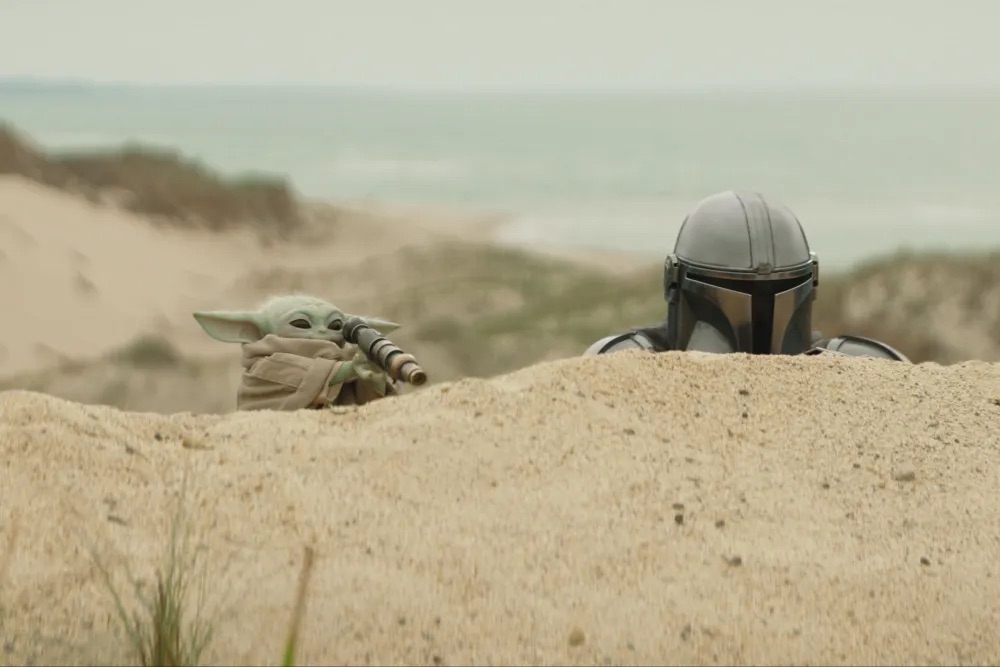
The opening title cards establish that former bounty hunter Din Djardin (Pedro Pascal, aided by body doubles Brendan Wayne and Lateef Crowder) now works for the New Republic hunting down Imperial warlords attempting to maintain some semblance of the defeated Empire, alongside his tiny green adopted alien son, Grogu. After a thrilling opening sequence that sees them successfully dismantling an Imperial stronghold, the pair return to base, where New Republic commander Ward (Sigourney Weaver) immediately pushes them into another mission: rounding up former Empire leader Janu Coin. But some overly-convoluted political maneuverings mean that Din actually needs to find Rotta (Jeremy Allen White; hearing a Hutt speak Basic for the sake of securing a celebrity voice actor is admittedly rather off-putting), the son of crime lord Jabba the Hutt who has been captured by a criminal syndicate, so that his aunt and uncle (dubbed the Twins) will provide intel as to Janu’s whereabouts.
The Mandalorian and Grogu, to its credit, distinguishes itself from previous live-action Star Wars both narratively and stylistically. There are no lightsabers in this film, no Force users besides Grogu, no grand struggles between Jedi and Sith, the Light Side and the Dark Side. The beginning of Din and Grogu’s adventure, which takes them to a neon-soaked city on the planet Shakari, contains shades of a noir thriller, as they interrogate the likes of Ardennian sandwich shop owner Hugo (voiced by none other than the king of crime movies, director Martin Scorsese), backed by the pulsing electronic beats that dominate Ludwig Göransson’s new score (he returns to the franchise after composing the now-iconic theme for The Mandalorian, and the first two seasons of the television show). The story largely stands alone, making it accessible to theatergoers who perhaps have never seen or are not wholly up to date on the series, while avoiding the introduction of narrative threads and characters whose presence is clearly intended to set up future spinoff features and series, distracting from the primary conflict. What easter eggs and nods to previous characters and aspects of the franchise are achieved in a manner that is fun for fans while not losing those who aren’t in the know; these include the inclusion of Zeb (a core character in the animated series Star Wars Rebels and voiced by Steve Blum, albeit brought to life by some rather wonky CGI that isn’t very seamlessly composited alongside the live-action elements) and Rotta, a character first introduced in the much-maligned 2008 Star Wars: The Clone Wars animated movie. Puppetry and stop motion animation created by Tippett Studio (founded by OG Star Wars visual effects artist Phil Tippett) abound, and while it isn’t always in step with the noticeable sheen of the environments and effects crafted using the latest in digital technology, there’s something endlessly charming about their herky-jerky movements and handmade quality. The Mandalorian and Grogu is a veritable menagerie of funky critters and weird aliens; replicating the vibe of the animated series that Favreau and Filoni first met behind the scenes on, it never shirks from getting a little strange verging on cartoonish, and that in itself is commendable, as is the fact that so much of it revolves around non-human characters who either don’t speak English or don’t speak at all, and yet emote just enough to prod us to care for them. Moreover, for the first time in Star Wars, the film has opening credits, a jarring shift away from George Lucas’ shakeup with the initial film in 1977, championing a story-first opening over the standard Hollywood approach of placing credits before the movie.
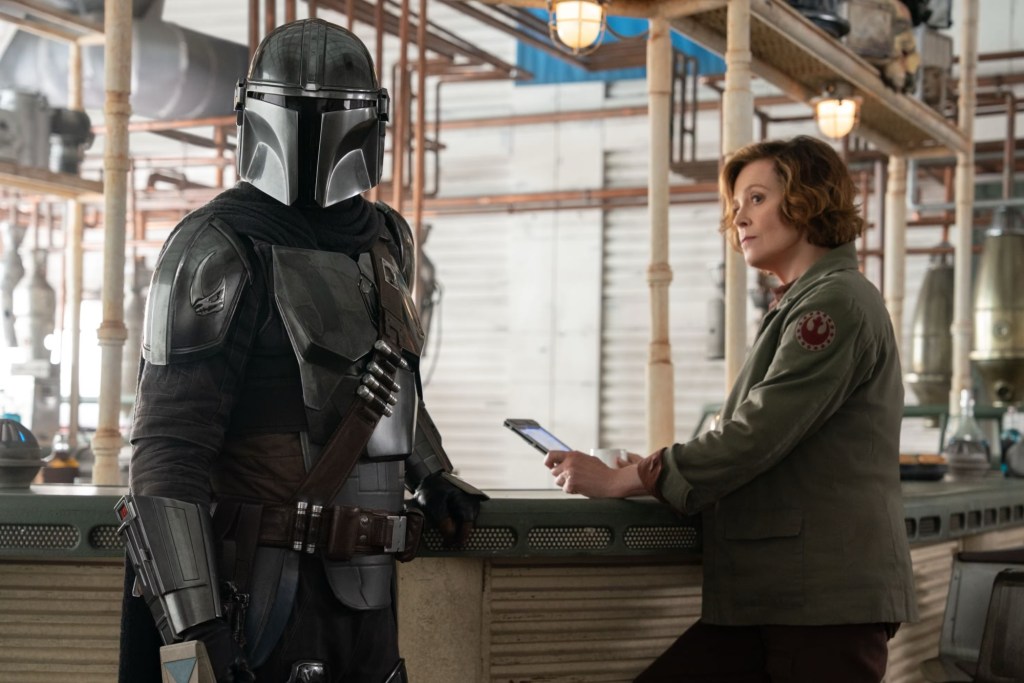
But the story itself is somehow overloaded and featherweight all at once, becoming quickly bogged down in circuitous captures and rescues while doing very little to grow its characters. Pascal is barely given any time without his helmet, and whether he’s acting with it on or off, his vocal performance (likely primarily ADR, with the suit actors accomplishing the bulk of the physical work while earning half as much credit) is rather checked-out and one note, lacking the emotional vulnerability we need to see more of as he steps deeper into his responsibilities as a father. Favreau’s workmanlike direction gets the job done but lacks verve and a distinctive stylistic voice, and much of the film’s lighting either highlights or attempts to obscure its artificiality (many of the interior scenes are underlit). Grogu makes some notable strides in demonstrating his independence, particularly in the final act. It’s Din trusting him to act just a little more than he did before that is the biggest step forward their relationship takes, and while that’s important, it feels like there was a missed opportunity to attempt an even bolder swing. Despite the poor pacing the ebb and flow of the story’s episodic structure entails, causing it to play more like the preamble to something more exciting as opposed to the main event, The Mandalorian and Grogu goes down easy and may be just entertaining and approachable enough for fans of all ages, but it also leaves one wondering: is this the big screen return of Star Wars we’ve really been waiting for?
Star Wars: The Mandalorian and Grogu is now playing in theaters. Runtime: 132 minutes. Rated PG-13.

 Katie at the Movies