The Station, Yemeni-Scottish director Sara Ishaq’s thoughtful and humanity-filled fictional feature debut premiering in Critics’ Week at Cannes, begins with title cards that utilize the language of storytelling to set the framework for its world:
“Once a land known for its abundance and powerful queens, Yemen was a bustling gateway between civilizations…
But wars fueled by forces near and far turned fertile fields into battlegrounds and thriving cities into ruins.
While inspired by real-life experiences, this story’s events, locations, and rival groups are depicting a parallel world caught in an endless cycle of fighting.
As men vanish into battlefields,
Women are left to hold society together.”
In a few sentences, this prologue informs the viewer about much of what is to follow: that this is a fictionalized take on reality, and, as on the final frame, the other sentences fade away, leaving the phrase “Women are left to hold society together” as one last punctuation mark, that a group that is typically sidelined in this society will be thrust to the forefront. Yemen, which hugs Saudi Arabia’s southern border, is a predominantly Arab Muslim country; as such, the lives of its female inhabitants often unfold in private, their faces hidden by veils and their livelihoods hidden behind closed doors. With The Station, Ishaq blows those doors wide open, centering on Layal (Manal Al-Mulaiki), who— in the midst of a country torn asunder by civil war— runs a women-only petrol station. Its patrons come to Layal to purchase precious fuel for reasons ranging from the trivial (one woman insists she needs it for her daughter’s extravagant wedding) to the essential (many just need to keep the lights on, or cook their meals). Within the compound, women uncover their heads and laugh and chat and break bread and smoke and peddle their wares. There are only three rules those there must abide by: no men, no weapons, and no politics.
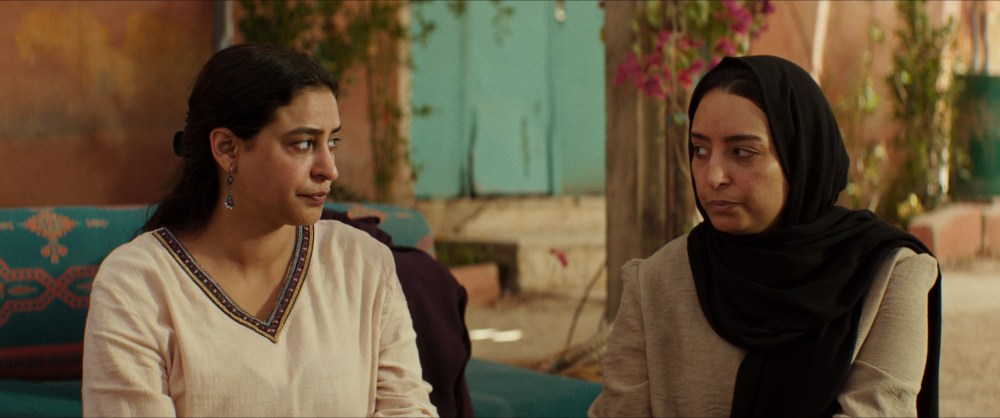
There is one exception to that rule that Layal abides, however, and that’s the presence of her younger brother Laith (Rashad Khaled), a sweet kid with a pet lizard who endures the ridicule of both his sister’s adult female colleagues and boys his own age for living among women, with no masculine presence in his life. It’s when the 12-year-old Laith faces potential forced enlistment in the army as he’s about to come of age (Layal is confronted by the wife of a local sheikh that she must pay up in order to keep him there) that Layal joins with her estranged sister Shams (Abeer Mohammed) to try to save him. Shams, who is perpetually haunted by the loss of her brother and husband in the fighting (one of the sources of tension that fill the air between her and Layal, while enhancing the latter’s impulse to protect Laith), lives in a nearby territory controlled by the other side, and is made to be accompanied by Ahmed (Saleh Al-Marshahi), a 13-year-old boy who forms a sort of brotherhood with Laith, running parallel to the sisterhood in a way that adds intriguing layers to the film’s excavation of the different impacts of war depending on age and gender; the boys, for instance, are made to grow up even when they are still essentially children, forced into stereotypically masculine molds that they may not want to fit in to, while the absence of grown men places more burdens on the women.
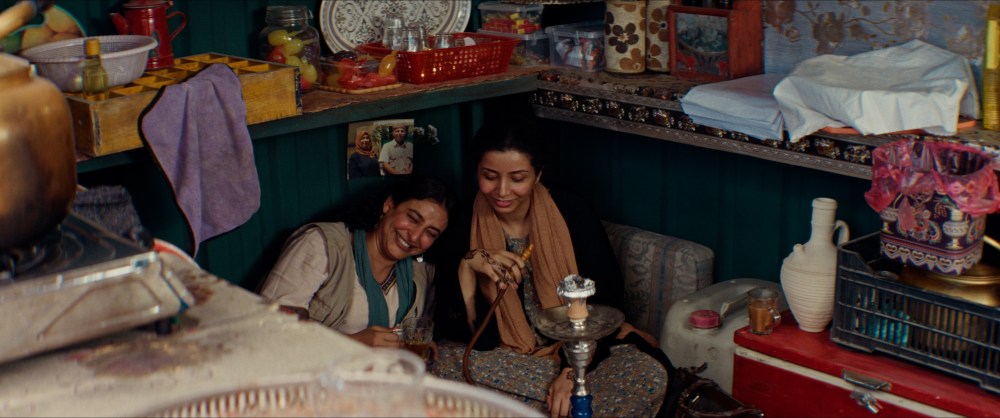
With its vibrant textures and warm, saturated environments (enhanced by cinematographer Amine Berrada’s fluid camerawork), The Station’s aesthetic is a deviation from the cold expectations set by most war films. In fact, the war, while essential to the story’s rhythms, isn’t explicitly depicted, but its impact on the characters is clear in the narrative turns and visual and audial clues— the whir of jet planes cut encroach on the station’s seclusion, and the proliferation of posters from which stare the faces of martyred young boys that virtually haunt Layal’s dreams, for one. Originating as a documentary before, after years of development, morphing into a fictional story, Ishaq’s rendering of a real-life conflict in non-specific, unpolitical terms (the warring factions don’t have names or symbols; they are only delineated by the colors they wear) may seem like taking the easy way out of a parsing through a complex political conflict. While that may have been frustrating in another context (and sometimes is here; the desire to assign beliefs or blame to one entity or another is a strong, natural impulse), here it grants space to the characters, allowing more room to play with its subversion of expected gender roles. Even as the external pressures on the women serve as constant reminders that they still exist in a patriarchal system, they embody essential roles in their society, and (brought to life by a cast of remarkably skilled, mostly non-actors) do so with intelligence, wit, and humor. The final act, in which events finally push the characters to go on the run, venturing into more fast-paced, thriller territory, finds the women repurposing objects of repression to achieve their liberation. It, along with the rest of the film leading up to that moment, stands as a powerful showcase for their resilience.
The Station had its world premiere in Critics’ Week at the 2026 Cannes Film Festival. Runtime: 112 minutes.


Glad you’re covering Cannes! This one sounds great; I hope it’ll get released on streaming soon or hopefully it’ll screen at a local film festival later this fall. The fact that it originated from a documentary makes it all the more intriguing.
LikeLiked by 1 person