Displacement has been a common theme across many of the films I’ve watched at this year’s True/False Film Festival, the annual event in Columbia, Missouri celebrating nonfiction filmmaking, and with the current genocide unfolding in Palestine, each of them feels particularly urgent. Coincidentally, two Armenian films by women documenting the Artsakh War and the way it has upended the lives and families of the people living there screened at this year’s festival: Emily Mkrtichian’s There Was, There Was Not, and Shoghakat Vardanyan’s 1489. Read my short reviews of those films below.
THERE WAS, THERE WAS NOT
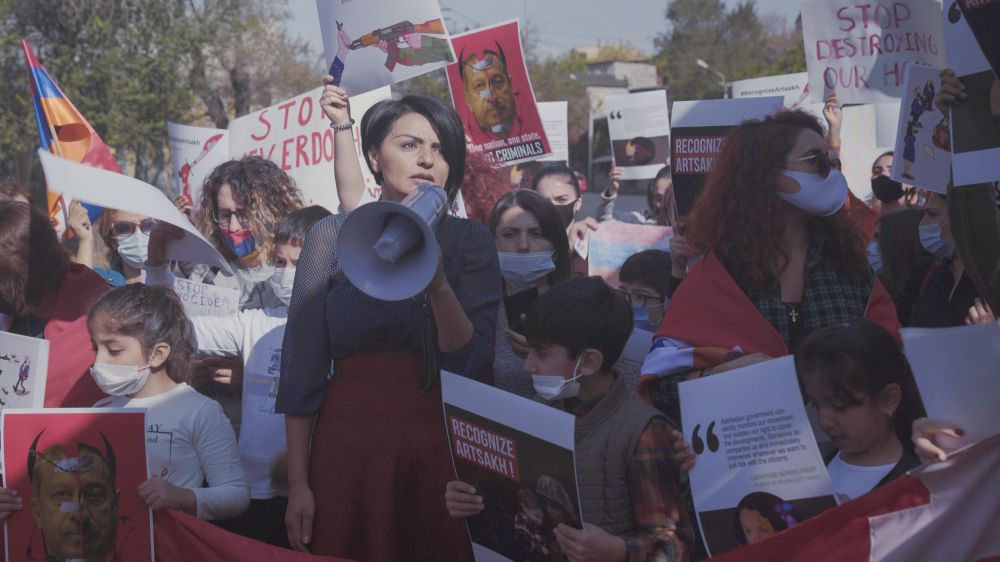
Armenian fairytales don’t begin with the words “Once upon a time.” Their first line, rather, is “There was, there was not.” It’s via this mythical framing device— complete with the act of literally paging through a storybook— that director Emily Mkrtichian presents There Was, There Was Not, a tale of four women from the now-nonexistent Republic of Artsakh woven around the onset of war following the 2020 invasion of the territory by the neighboring Azerbaijani military.
There Was, There Was Not begins in 2018 with insightful and intimate observations of the daily lives of Mkrtichian’s subjects. Siranush worked hard to obtain a political science degree and ran for office in 2019 on a platform advocating for women’s rights. Sveta supports her three daughters by working in the minefields, locating and disarming mines left over from the previous war in the early 1990s. Sose is a world class martial artist who has represented Artsakh in competitions around world. And Gayane founded the only women’s center in Artsakh, devoting her life to helping women escape abusive situations. Each of these stories is rich enough to merit a movie of their own, but Mkrtichian balances not only each individual character, but the divide between each character’s work and home life (there’s a lovely interlude where we peel potatoes with Sose’s charming grandmother), with ease.
She also eases into the transition between life in pre-and-post war Artsakh about as neatly as one can when the threat of explosions are suddenly ever-present and the distant sounds of gunfire become the soundtrack to your life. Not that there wasn’t some form of warfare occurring before in the regular business of living in a country where women are often considered second-class citizens; Gayane, for instance, frequently butts heads with a government that labels the informational pamphlets she distributes as pornography. That the film familiarizes us so thoroughly with each woman in the first half strengthens the second half, when the women apply their skills in new ways to help their community in a time of crisis. Sose joins the military, becoming the only woman in Artsakh to fight on the front lines (her almost single-minded militancy feels a bit out of step with the nuance of the rest of the film, but witnessing so much of her softness with her family and her desire to have a family of her own balances that out); Siranush leads protests to raise awareness of the atrocities occurring on her homeland; Gayane opens a new center in Armenia. The result is as hopeful as it is somber; Artsakh may, in a technical sense, no longer exist, but its culture is perpetuated through the resiliency of its people.
There Was, There Was Not had its world premiere at the 2024 True/False Film Festival. Runtime: 94 minutes.
1489
On September 27, 2020, the Artsakh War broke out in the territory situated between Armenia and Azerbaijan. Seven days later, Soghomon Vardanyan, who was in the midst of serving his compulsory military service when he was sent to the front lines, briefly called his mother. His family never heard from him again, and the dread and uncertainty in not knowing whether he was dead, injured, or merely missing inspired his concert pianist sister Shoghakat to pick up a phone camera and start filming. Her debut feature, 1489– so named for the code assigned to “body of individual missing in action— packs an emotional wallop as it follows a family going through the unfathomable.
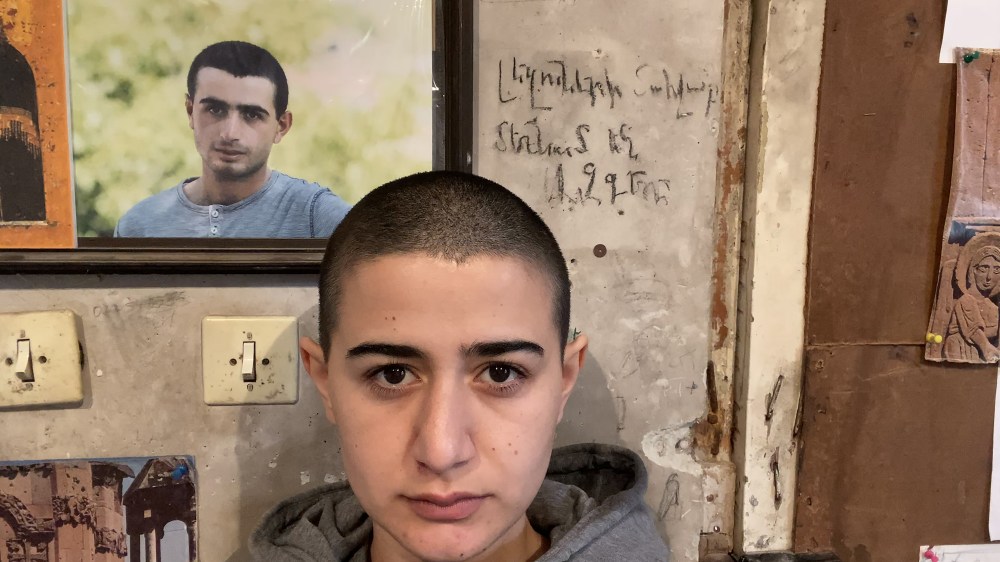
Vardanyan is clearly learning how to film on the fly here (there are amusing moments where her father attempts to suggest what angle she should shoot from to cast her subject in the best light), but she exhibits a clear eye for framing and composition (coming from an artistic family, her lovely father an artist, mother a photographer, and brother a fellow musician, this isn’t much surprise). One of 1489’s most powerful images may not have emerged as organically as the film surrounding it, but it effectively and efficiently communicates the feelings of loss and remembrance woven throughout: Vardanyan, having just shaved her head (as she said during the post-film Q&A, she only did this because her hair and skin were bothering her), stands by a photo of her brother, the spitting image of him.
Many of 1489’s scenes, particularly toward the back half of the film, are so painful and private that it almost doesn’t feel as if we should be watching them. And yet, what Vardanyan is doing here serves a triple purpose: an act of healing for her and her family, a cry for help for all of the other families struggling through similar circumstances, and a damning document for a world that doesn’t seem interested to acknowledge Azerbaijan’s atrocities.
1489 screened at the 2024 True/False Film Festival. The film is currently seeking distribution. Runtime: 76 minutes.


