I can’t think of a better first film screening of this year’s True/False Film Festival than Girls State. Jesse Moss and Amanda McBaine’s follow-up to their 2020 documentary Boys State (which also played at True/False) explores the other branch of the American Legion’s program that allows group of politically-motivated high school students from across their home state to gather for a week and build a government from the ground up. While Boys State concerned the Texas iteration of the Boys State program, Girls State takes place at Lindenwood University in St. Charles, Missouri, right on the outskirts of St. Louis. And where Boys State was more entrenched in the inner workings and politics of the students as they campaigned for various offices, there are a couple complicating factors that in some regards make Girls State a more enriching and complex work: namely, the fact that the Missouri Girls and Boys State programs are occurring on the same campus for the first time, inviting comparisons between the two, and the recent leak of a draft to overturn Roe v. Wade, a hot button topic in a largely conservative state where a woman’s right to an abortion is already restricted.
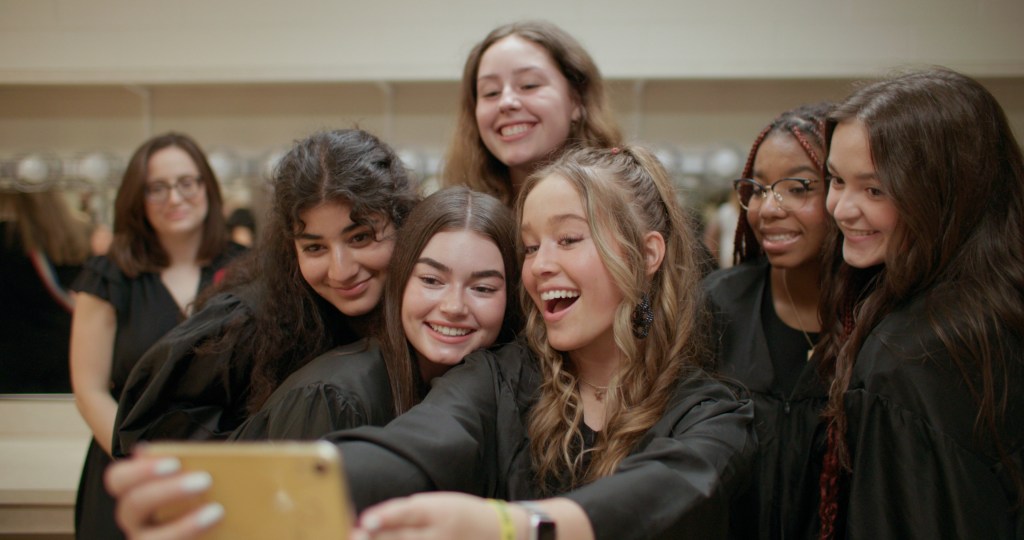
Moss and McBaine pick seven girls out of the large group of students participating in the 2022 Missouri Girls State to follow over the course of the week, and their ebullient personalities make the film a heartening and frequently hilarious watch. We all knew some version of these girls in high school: Emily, who is buoyed by her enthusiasm to be the best at everything, and is a member of virtually every club, council, and team at her school; Nisha, who feels like a social misfit but is passionate about making change; Faith, who found as she grew older that her beliefs didn’t match those instilled in her by her family; Tochi, who experiences microaggressions as one of the few Black students in a program whose participants are primarily culled from predominantly white communities. And sure, their conception of politics isn’t fully formed (Emily hesitantly states that she can distinguish the more left-leaning girls because they are “I don’t know…louder?”). But as the girls express, hearing and learning ideas from new people is one of the reasons why they wanted to join Girls State. It’s also one of the frustrations they come to have with the program, the lack of actual political discussions occurring prompting speculation as to the sorts of debates and access the neighboring boys program has.
The unbalanced narrative and pacing is somewhat of a detriment to Girls State—the shift in focus between the girls is uneven— but that messiness is also part of its charm. The story doesn’t hit the expected crescendo (the election for governor, initially posed as the film’s potential climax, comes just after the midpoint), but rather it transitions into other storylines that tackle different issues as they arise, like Emily (who aspires to a journalism career) deciding to pen a piece for the program’s paper investigating the inequalities between Girls State and Boys State. They get gym and sports, the girls get to perform a corny choreographed anthem. They don’t have a strict dress code, the girls do. They get the governor of Missouri to swear in their elected officials, the girls don’t (not necessarily a bad thing when we’re talking about Mike Parson, but still). The film concludes on a rather sudden melancholy note— unfortunately, that’s just the state of being a woman in America at this moment in time— but where it doesn’t make any bold political statements, it makes up for in its effortless portrayal of the myriad ways in which women are held to a higher standard, compelled to compare themselves against others in everything from appearance to charisma to intelligence. And as difficult as it can be to sustain female friendships under that sort of pressure, the love and respect that these girls hailing from different physical and ideological backgrounds exhibit for each other as they celebrate their successes and commiserate over their losses packs a powerful and empowering punch. No image encapsulates that dichotomy more succinctly than that of the majestic symbol of America, the bald eagle, flapping madly on the arm of its carrier at the program’s closing assembly.
Girls State screened at the 2024 True/False Film Festival. It is scheduled to be released by Apple TV+ on April 5. Runtime: 96 minutes.


