Chalk it up primarily to the proximity of my watches, but the film I kept being reminded of while watching Godzilla Minus Zero— writer, director, and visual effects artist Takashi Yamazaki’s sequel to his tremendous 2023 film Godzilla Minus One— was the 1952 drama Children of Hiroshima, which I caught a screening of at KVIFF over the summer. An early but pivotal work from Kaneto Shindō, the director who would best be known for the 1964 folk horror film Onibaba, the movie follows a teacher whose summer visit to post-war Hiroshima lays bare the horrendous fruits of the atomic blast: her family was killed by the bomb, and she reconnects with a former colleague left sterile by the radiation and her parents’ former servant (Osamu Takizawa), scarred and blind and caring for his only surviving relative, his precocious grandson Taro (Takashi Itō). Children of Hiroshima was commissioned by the Japan Teachers Union at the end of the U.S. occupation of Japan and based on the 1951 book Children of the Atomic Bomb, in which Japanese educator Arata Osada collected first-person testimonies of the nuclear bomb’s horrific aftermath. The group was none too happy with the resulting movie, which they viewed as concentrating too heavily on human stories as opposed to a broader, more incisive political critique. Indeed, Children of Hiroshima does skew heavily toward sentiment; that’s evident both in its melodramatic storytelling, and the overall production, which at times employs a stirring, choral-dominated score that strives to guide the audience’s emotions, and whose most memorable scene is a terrifying reimagining of the bomb’s aftermath, backed by the sound of a ticking clock, and which sees children sobbing over bloody bodies and scarred faces staring blankly at the camera. But ultimately, it doesn’t need that, really; you can’t discount a film that so gracefully exudes so much sympathy for humanity, right down to the final sequence, which sees the characters gazing worriedly at the sky as the sound of a passing plane whirs overhead.
I can already hear the similar critiques that will surely be levied toward Minus Zero for concentrating so heavily on the human characters compared to its kaiju icons. The story picks up in 1949, two years after Minus One, which ended with former kamikaze pilot Kōichi Shikishima (Ryunosuke Kamiki) blasting Godzilla to bits over Sagami Bay. Kōichi has since cobbled together a sort of found family of war outcasts; he’s married Noriko (Minami Hamabe), who miraculously survived a sonic blast from Godzilla that left her with a wonky golden eye and a sinister dark mass on her shoulder, and they’ve adopted the little girl, Akiko (Sae Nagatani). But the appearance of a new monster from space— a dragon-like creature they dub Ghidorah that flies and spits lightning bolts from its mouth— threatens the tentative peace they found. Kenji Noda (Hidetaka Yoshioka) is now director of Japan’s Large-Scale Defense Bureau, and quickly assembles a team to combat this new threat; Noriko’s injury appears to worsen; and Kōichi must choose whether to risk breaking apart the family he’s found to fly again in service of the country.
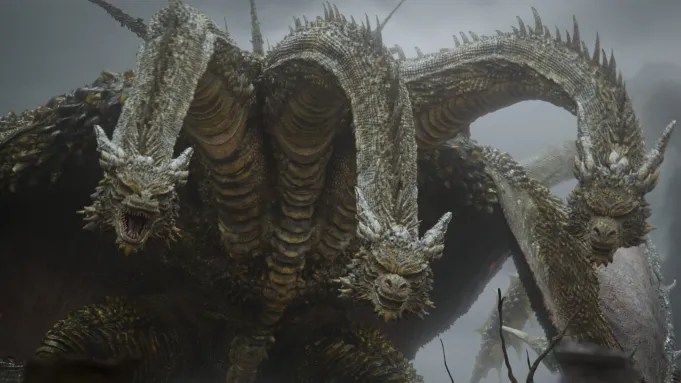
Why does it seem like everyone walks out of every Godzilla movie claiming, “Not enough Godzilla”? I suppose that’s fair in this case; I wasn’t keeping time, but it’s surely close to halfway through the film before we catch our first glimpse of the King of the Monsters, and the action highlight of the film— a white-knuckle aerial battle with the newly-appeared King Ghidorah, who fast becomes Godzilla’s rival— occurs entirely without his involvement.
But the best and most memorable entries in this long-running series feature compelling human stories too, the monsters reflecting their contemporary anxieties, from nuclear war to environmental devastation. Minus Zero may be a period piece, but those themes resonate strongly today too; the lightning-spewing Ghidorah is attracted to extreme weather, and the gravity beam that shoots from the mouths of his three heads generates hurricane-force winds that hurl buildings and people about like rag dolls. But the film also broadens the scope of its examination of Japan’s post-war struggles initiated in Minus One. Noriko works at a war orphanage; when Kōichi picks up her and Akiko at the end of the day, they struggle to downplay Akiko’s eagerness to see her dad as the cluster of orphaned children look forlornly on. Former pilots in the war grapple with finding new jobs and starting new lives. The U.S. Army’s occupation of the country is ongoing, with designs on seizing and weaponizing Japanese scientists’ studies of the regenerative powers of Godzilla’s G-Cells. It’s a lot for one film to wrap its arms around; admittedly, the novelty of Minus One’s fresh approach to the material wears off fast, opting for a more scattered narrative that tries to touch on a lot of different issues as opposed to telling a more focused, character-driven story. Subsequently, the film plays up familiar elements that more closely skew toward the franchise’s Showa Era entries: precocious children, old men, eager scientists, and monster-on-monster thrown-down climaxes.
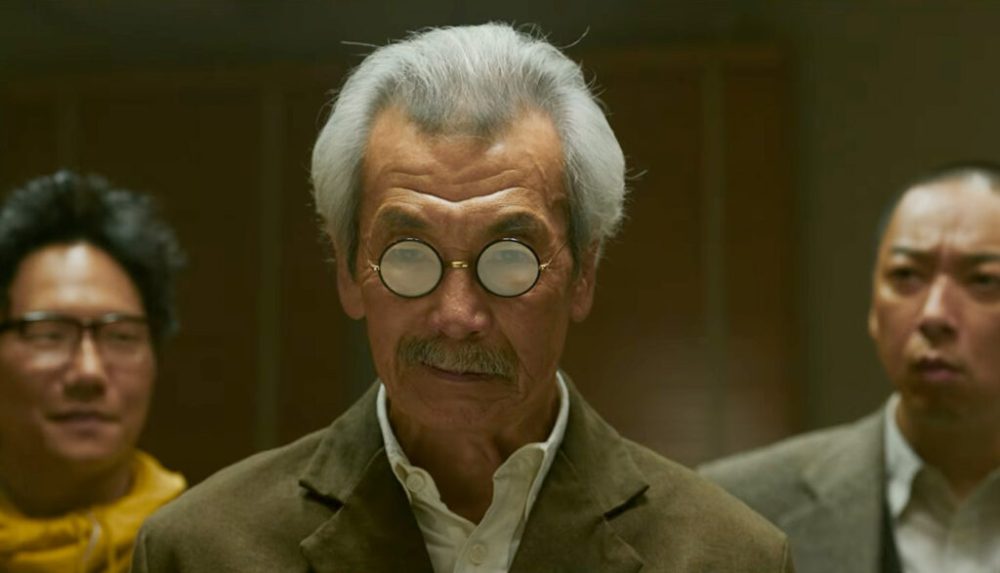
That we’ve seen all that before is the surface-level reading. It’s fascinating, rather, to consider the ways in which Minus Zero subverts those elements in favor of a story that upholds humanity’s fundamental goodness. Compare this to Gareth Edwards’ 2014 Godzilla movie, and an oft-memed scene in which Ken Watanabe’s scientist Dr. Ishirō Serizawa declares of the monsters, “Let them fight,” intense close-ups and the crescendoing score playing up the anticipatory thrill of a massive monster battle for the audience. In Minus Zero, that idea is floated again, but by a scientist (Min Tanaka) who discovered the charred remains of his wife, daughter, and grandson in the ruins of Hiroshima and, grappling with survivor’s guilt, sees the pending battle as an a opportunity to act on his maniacal revenge fantasy against America. It isn’t remotely played as a cheer-worthy death match, even though one person in my screening emitted a tiny, exuberant holler. For that scientist, Godzilla’s reappearance is divine providence. For the rest of the Large-Scale Disaster Response Bureau— whose teamwork, illustrated best through a moving montage of shots looking down at a desk, folks scrutinizing charts and making calculations and bringing each other food and sleeping on their folded arms under the soft glow of a lamp as they work late into the night, is heartening to witness— it’s another moral boundary they may need to cross. Makoto Aoyama (Masami Nagasawa), a meteorologist who is brought in to help predict when best to lure Ghidorah using her exacting forecasting expertise (and who represents a welcome shift in this film’s elevation of women to key roles in the narrative compared to its predecessor), somberly considers their role in coercing two creatures of unknown origin into killing each other: “The sinfulness of it gives me pause.”
As the story becomes grander, so do the special effects. Minus Zero is far gnarlier than the first film (it’s the first Godzilla feature to earn an R rating stateside), with thunderous action set pieces whose visual scale are matched by the bone-rattling sound design and the shrieking exclamation marks of Naoki Sato’s score that immediately set nerves a-jangling, while maintaining the strains of almost Sirkian high melodrama. If Godzilla Minus One, with its highly improbable, romantic plot twists and themes of self-sacrifice and redemption, was Yamazaki’s Magnificent Obsession, then Minus Zero is his Written on the Wind: wracked with guilt, characters are torn between personal, familial, and professional obligations with less and less of a legible roadmap to help them navigate a world where dreams of peace and prosperity are only an illusion.
Godzilla Minus Zero is now playing in theaters. Runtime: 135 minutes. Rated R.


