Desire— the release of it, and the suppression of it— can drive people wild. Wicker— Eleanor Wilson and Alexander Huston Fischer’s romantic fantasy based on Ursula Wills’ short story “The Wicker Husband”— understands that applies not just to physical lust, but also to the need to be an object of desire, to be wanted and cared for and thought of as an individual beyond carnal pleasures. It’s an old idea that the filmmakers craft a new take on using old storytelling traditions, and the resulting film is uproarious, clever, and surprisingly tender.
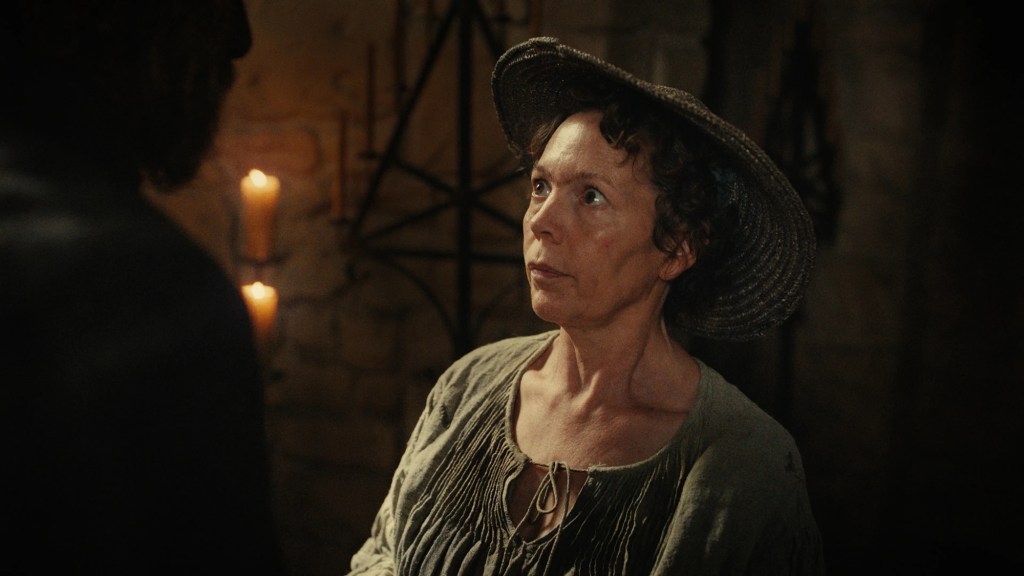
Wicker situates itself within the realm of folklore and fairytale immediately, with the Basket Weaver’s (played by Peter Dinklage; all the characters are referred to by titles as opposed to proper names, hewing both toward the weight placed on roles in classic stories, and the gendered culture of this narrative specifically) florid narration detailing the nature of the fish gathered and sold by the Fisherwoman (Olivia Colman). If there’s one person in the village who isn’t desirable, it’s her; the Fisherwoman lives alone in a hut on the edge of town, and is frequently derided by the other townsfolk for her spinster status, unkempt appearance, and smelly wares. Wicker also appropriately opens with a wedding, an affair that traditionally signifies new beginnings and the consummation of romantic love, but in this case is effectively employed as a tool to convey the deep sexism that this conservative village is built on. At the end of the ceremony, the Bottlewasher (Gustav Lindh) and the Tailor’s Wife’s Sister (Marli Siu) don’t exchange rings or vows; rather, the Bottlewasher clasps a collar tight around his new bride’s neck as she— veil still shrouding her features— promises to obey her new husband, while the preacher victoriously declares that they are no longer a “man and woman,” but “a man and his wife.” The ceremony is followed by an equally regressive ritual geared toward the young, unmarried maidens of the village, in which they all shake an egg until it bursts, the color of the smoke wafting from within indicating who will be married next. Observing the ceremony, the Fisherwoman says to her old friend-turned-rival, the Tailor’s Wife (Elizabeth Debicki), “It’s a funny tradition, isn’t it?” “The maid’s eggs?” the Tailor’s Wife replies. The Fisherwoman cocks her head and grins: “Marriage.”
Fate, as it would have it, however, finds the marriage egg in the hands of the Fisherwoman, who quickly decides to act on it and asks the Basket Weaver to make her a husband. The fact that we haven’t yet experienced much of the loneliness of the Fisherwoman’s daily routine makes this turn from scoffing at marriage to desiring it almost incomprehensibly rapid. For all the unique characters this film sketches just clear enough for the audience to recognize them and their personality and how they then augment the tale of the village’s reckoning with itself, the lack of interiority is sometimes a detriment, which particularly comes into focus with a late-film turn regarding the Tailor’s Wife’s Sister that doesn’t follow through on its intriguing implications. At any rate, the Basket Weaver promises to deliver a husband to the Fisherwoman, telling her to be at the church in one month’s time. When she sees her soon-to-be husband (Alexander Skarsgård) at the altar for the first time, she’s startled to see that he’s comprised entirely of wicker, willow branches woven in shades of brown across his face, limbs, and torso. The Fisherwoman doesn’t get cold feet, however; a night of extreme pleasure leads her Wicker Husband to offer to fix her broken bed, and then other things around her house, for the simple reason that it makes her happy.
The Wicker Husband, naturally, causes a stir among the villagers, but it fast becomes less about his appearance or unnatural existence, and more about the fact that the marriage between him and the Fisherwoman is built on mutual love and respect— a foreign concept to seemingly everyone else in the town. When they appear at a dance following the butcher’s wedding, their movements— marked by soft caresses and sweetly gazing into each other’s eyes— are notably different from the choreography acted out by the other participants, which is built on violent thrusts and couples’ mimicking slapping and choking each other. One woman observes that the Fisherwoman and Wicker Husband’s marriage is “lopsided” or “inverted,” breaking from traditional social norms by having the woman work while the man tends house. An awakening begins to rumble through the village, the women realizing how suffocating their marriages are and that they deserve more equal partnerships, and the men realizing that perhaps their sexual unfulfillment can be attributed to their treatment of their wives as possessions, rather than people. That these people don’t appear to know that such a way of life is even an option until they witness it themselves speaks to the inherited biases that can ripple across generations so long as no one dares to question them. Truly, if there is a primary problem with Wicker, it’s that for that boundary-rattling of a premise colored by a sly, bawdy sense of humor, it still feels too safe. Even with the narrative’s aim reaching beyond a sexual awakening, there’s room for this to be freakier, hornier, and even darker. It’s that tantalizing glimpse at the darker nature of creation that the film’s final act swerves too quickly away from that largely undoes its climax, while the inevitable festering of distrust that starts to manifest in the Fisherwoman’s attitude toward the Wicker Husband is overly predictable.

Still, Wicker is a special film, a crowdpleaser with a social and political conscious that uses familiar fantasy archetypes to deliver a feminist fable with a perpetually-relevant message rooted in reality. The special effects used to bring the Wicker Husband to life are seamless, and compensate for the otherwise lackluster photography, which primarily uses wide shots that lack visual interest. Skarsgård’s gentle delivery is a solid foil to Colman’s bluster, and Debicki has arguably never been better as the woman whose chilliness may not be due to an upheaval of the status quo, but to what said upheaval prompts her to realize about herself. The real magic isn’t in the conjuring of life within inanimate materials; it’s in the knowledge that it’s never too late to try to change your life to fulfill your desires, and making the leap to do so.
Wicker is now playing in theaters. Runtime: 105 minutes. Rated R.


