These two films, blending drama with shades of black comedy, premiering in this year’s Toronto International Film Festival‘s Discovery section tackle current trends, with varying degrees of success: Ghasideh Golmakani’s self-reflexive film about filmmaking and the oppressive restrictions imposed on women in Iran, Head to Head, and Tom Nicoll’s anxiety-inducing study of the dark side of the life-coaching movement, Salvation.

In Iranian cinema, the making of a movie often becomes a part of the movie itself, driven in no small part by the restrictions the country’s government places on its filmmakers. Just look at the daring works by the likes of Abbas Kiarostami and Jafar Panahi, often made illegally, in secret. Ghasideh Golmakani’s debut feature, Head to Head, is clearly indebted to the films of those renowned male filmmakers, but possesses the additional aim of highlighting both the daily struggles of Iranian women existing in a culture that constantly oppresses them, and the struggles female filmmakers face in making their stories heard.
Head to Head’s uproarious premise centers around the production of a film by a director named Bahar (Mehrnoosh Satari), who intends to prod at the absurdity of the restrictions placed on women by casting male actors to play them, forcing to to wear skirts and headscarves. The cast puts up with her demands because her previous films have been critical darlings; the hustle and bustle of film festivals and the glamor of red carpets await them. But their reluctance fast bubbles into frustration before exploding in anger as Bahar asks for take after take, instructing the clueless men on just how to walk and sit, refusing to permit them to remove their hijabs even as the heat is suffocating, and holding their cell phones hostage, which is of particular annoyance to Bahar’s most volatile cast member, Sina (Saeed Naderi), who is anxiously awaiting news about his visa in the hopes that he can move to find better opportunities abroad.
This first stretch of the film is quite funny and dynamic, if too studied to feel like the emergence of a distinct new voice; the long, repetitive takes and circuitous conversations, for instance, feel especially in line which a lot of Kiarostami’s filmmaking style. But halfway through, the making of Bahar’s film is disrupted and the cast and crew are forced to evacuate the compound where they were clandestinely working outside of the strict gaze of the moral police, and the film itself— which easily could have been played for straight comedy— becomes something different, more layered and introspective if rather blunt in its voicing of its themes. Now it’s Bahar (who we learn was previously arrested for not wearing a hijab in public) who refuses to cover her head out of principle, even as those with her, including actors Sina and Nima (Amir Hajimohammadi) and her longtime cinematographer Ebi (played by Ebrahim Azizi, and who we learn has been sneakily shooting some extra footage for Bahar, unbeknownst to the cast and smartly differentiated from the main film via a different quality camera and more casual, hand-held aesthetic), beg her to comply so they have a better chance of evading arrest. Pacing-wise, the film lags, even as the stakes grow higher, the bulk of the action transitioning to conversations occurring inside a van traversing the Iranian landscape, with some much-needed levity provided by an unassuming older woman they pick up on the road. Despite some small stumbles in the filmmaking, the winning cast, cleverly self-reflexive story, and playful tackling of gender roles that invite viewers to really empathize with Iranian women, make Head to Head a worthwhile entry— and Golmakani a notable new voice in— Iranian cinema.
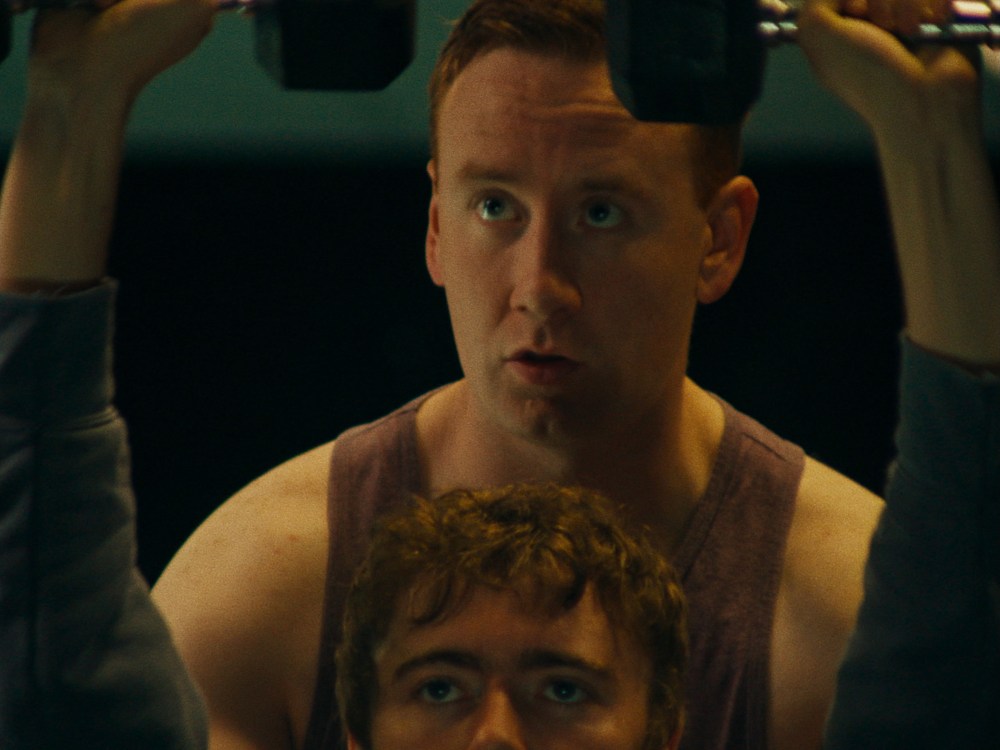
Possessing a clear understanding of the sometimes performative nature of self-affirmations and life coaching’s social media presence with a dash of the anxiety-inducing character spiral of Uncut Gems, Tom Nicoll’s grim drama Salvation tackles the dark side of the positivity movement. The tone is set almost immediately, as Danny Carlton (Liam Harkins), the protagonist of Nicoll’s debut feature, graduates from his weeklong life coach training, obtaining his certification as ominous music thrums over a sequence that ought to spark some hope or joy.
That Danny sincerely wants to help people is clear while he’s still being mentored by Marshall (Kevin O’Loughlin), the life coach who inspired him. Danny’s delivery of his mission statement is met with a shrug from his teacher, who tells him that he thinks he needs to be more focused on the monetary side of the business. “But it’s not just about the money,” Danny says. “It kind of is,” Marshall tells him. When Danny returns to his home in Greenock, Scotland, he finds that Marsall is sort of right. He drives himself into debt trying to set up his business, obtaining short-term loans, paying for advertising and a website, establishing half of his shared flat as a meeting space. And he only gets one sign-up who sticks: Scott (Stephen McMillan), a lost 22-year-old whose mental hurdles may be too tall for Danny to get over. As Danny gets in over his head with a sketchy loan shark (Conor McCarron) and puts his mother Jackie (Kathleen McDermott) and her boyfriend Gavin in a tough spot, alienating their affections, he grows increasingly desperate, roping Scott into the conflict as his unwitting accomplice.
Throughout Salvation’s runtime, I kept thinking to myself, “There’s something here.” The performances are earnest. The critique that positivity alone can’t fix your life, that you must care for others as well as yourself to build a strong support system you can fall back on, is warranted. But despite some swift editing by Raluca Petre that keeps up the narrative momentum, communicating information through montages and maintaining a palpable air of tension, it never feels like Salvation really gets off the ground. There’s some humor in the writing, but it’s delivered too drily to spark laughter. I get the sense that Salvation may have been more effective as a full-throated satire, which would allow Nicoll to play up the absurdity of Danny’s situation, and the life-coaching world at large. As it stands, Salvation adheres to realism a little too strictly, all while leaving too many ellipses in Danny’s character development. We don’t get much sense of what drove him to life coaching in the first place, beyond allusions to his past floundering to find his calling and make something of himself. We don’t get much of a sense of why he’s bad enough at it to only maintain Scott as a client, beyond one scene where he shuts down a suggestion from a woman in his group. Some of the most effective and immediately relatable scenes find Danny struggling to not only explain what he’s currently doing for work to friends and family, but justify his reason for wanting to do it, to their visible confusion. The tension between egotism and sincerity, and how the former eats the latter, isn’t explored with much nuance, taking the punch out of the finale, which sees Danny turning toward another form of exploitation under the guise of helping others. It’s a shame, because much like Danny himself, Salvation shows a lot of potential.


