Miwa Nishikawa’s riveting historical drama Children Untold stems from rather unique origins: the story for the writer and director’s feature film is derived from her own, as yet unpublished, novel, inspired in turn by research and archival testimony she began gathering while working on her 2020 movie Under the Open Sky, whose protagonist was modeled on a war orphan who turned to crime to survive. That feels more than appropriate, as Children Untold, which follows 12-year Kotoko (Ami Koyae) in the immediate aftermath of World War II as she navigates a newly devastated Japan, orphaned and homeless, possesses an epic sweep without losing its intimate focus, not unlike a great work of literature.
Opening this year’s Toronto Film Festival’s Platform section, the start of Children Untold is rather sunny, both literally and metaphorically, as Kotoko and her friend and classmate merrily bang out forbidden tunes on the piano in a brightly-lit room. Kotoko is the daughter of musicians, and appears to show some talent— not to mention a spunky personality and strong will— as she’s away at school and far removed from the conflict, while her older brother fights on the front lines. The glow of fiery explosions she glimpses on the horizon at night isn’t scary; rather, there’s a strange beauty to it. But life takes a swift turn when Kotoko disembarks from the train back home. Her friend’s father and sister are there to meet her; he’s noticeably wounded, and says that most of their village was razed. There’s no one to meet Kotoko, who’s remarkably resourceful— she appears to clock immediately both that no one is coming for her and that there’s likely no home for her to go back to, the calculations of her next move practically written across her face— but later wanders numbly through the wreckage of her neighborhood, her fingers stroking the jagged keys of a piano, the one marker of the grave that was once her house.
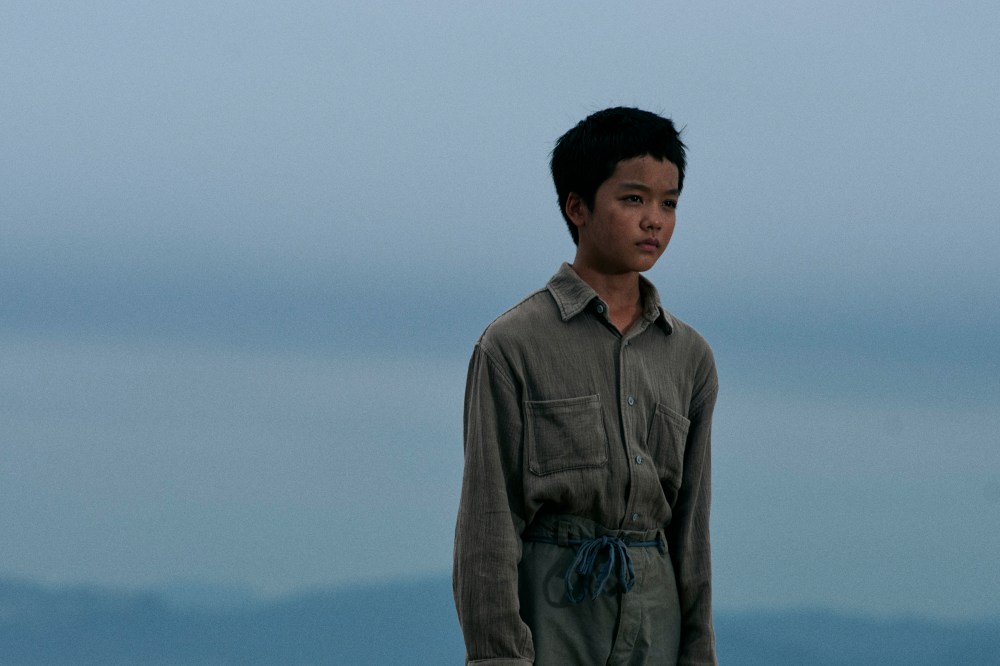
Kotoko, who’s played with so much maturity by Koyae and whose curious eyes we see absurd and comprehend everything around her in real time, adapts quickly to the harsh reality of this new world, but not easily. Penniless, she adopts appearance and manner of a boy and a new name— Shigeo— as a self-preservation tactic, so she can obtain work while evading men’s sexual advances (these men are often American soldiers still lingering in the war’s aftermath, a heavy-handed but effective illustration of the one country’s encroachment on and power over the other). She soon falls in with a band of young male war orphans who live under the protection of the local yakuza, selling, stealing, and trading on the black market, carving out friendships and a fragile sense of community as her true identity becomes harder and harder to conceal.
Kotoko’s journey is paralleled by that of her music teacher, Sone (Fumi Nikaido), whose fiancé was killed in the war, leaving her unmarried and pregnant. She’s strong-armed into prostitution to survive, but— keeping a promise she made to Kotoko’s father to look after her— searches high and low for Kotoko. Her storyline sometimes distracts from Kotoko’s, despite their tales being so intertwined, but her presence also offers another angle of the war’s impact on those left behind, and the Japanese government and society at large’s failure to protect and help them. Kotoko’s story is one of the 120,000 documented war orphans caught in the middle of the conflict; the actual number is likely much higher.
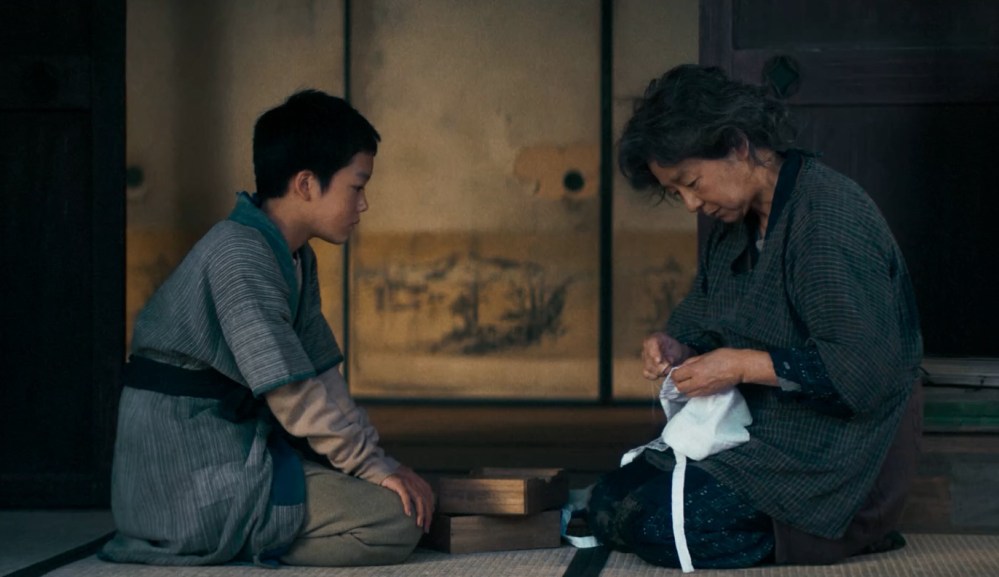
But Nishikawa is a humanist filmmaker, and she makes sure to portray the moments of compassion among strangers that crop up even in the bleakest of moments, especially the older women who recognize that Kotoko isn’t really a boy but help her keep her secret regardless. One of them (Yoh Yoshida) shields her body from the eyes of the other boys when communal bathing; when she gets her first period, another woman (Yuko Tanaka) teaches her how to care for herself. For a film comprised primarily of intimate gestures and human connections, it’s told with great grandeur, both in its length and in its technical precision. Norimichi Kasamatsu’s cinematography fluidly traverses verdant countryside and grimy city streets, providing a rich portrait of a country wrecked by war, made lusher by Marihiko Hara’s classical score, which possesses a timelessness while also tying in to Kotoko’s classical music background. Perhaps it’s overly studied. Perhaps those flourishes overly romanticize a past whose trauma has rippled through generations up through today, undermining its urgency. Still, Children Untold always feels like it informs on a pressing issue without exploiting its victims. Like all great epics, Children Untold puts both its characters and its audience through the emotional wringer, allowing everyone to come out the other side having learned something about themselves, and the world around them.
Children Untold had its world premiere at the 2026 Toronto International Film Festival in the Platform section. Runtime: 150 minutes.


One thought on “TIFF 2026: “Children Untold””