This year’s Karlovy Vary International Film Festival concluded with numerous worthy films being awarded, from directing honors for the cringe-inducing family drama The Guest in the Crystal Globe Competition, to recognition for two very different coming-of-age stories in the festival’s Proxima competition: the appealing comedy Lover, Not a Fighter and the mysterious and mesmeric Incinerator.

At the start of Mads Mengel’s Danish Crystal Globe Competition entry The Guest, Karl (Simon Bennebjerg) and Emilie (Mette Klakstein Wiberg) have just arrived at a sunny seaside resort where their families are gathering to celebrate the christening of their infant son. What promises to be a joyous and tranquil weekend, however, is fast upended by the unannounced arrival of Karl’s estranged mother Vibeke (Trine Dyrholm). Karl is immediately enraged (the pain of growing up at the mercy of his mother’s whims as she struggled mentally has lingered), but his sister Rikke (Josephine Park) insists they give her a chance to be present as a grandmother. But Vibeke’s erratic behavior rubs up against Karl’s lack of sympathy, transforming the gathering into a pressure cooker of old wounds and resentments and fractured family dynamics.
The Guest is an uncomfortable film, one in which the characters’ dirty laundry is aired in about the least desirable environment imaginable, as confused bystanders look on: a pristine luxury hotel, and a lavishly organized celebration, whose many events include fancy dinners and live entertainment. The camerawork echoes the intensely stressful atmosphere, often panning back and forth and zooming in and out between characters without cutting, akin to a handheld camera (which would give this family drama somewhat of a home movie feel), but more elegant than jagged in But The Guest never leans on messy family drama as a source of entertainment. Mengel (who cowrote the script with Christian Bengtson) thoughtfully considers every angle and gives every character their space, from Karl wrestling with bitterness and love simultaneously, to Vibeke overworking to prove her stability to her family, to Rikke trying to hold it all together while struggling with her own feelings of neglect. They’re all richly embodied by the cast, particularly Dyrholm as Vibeke, who never crosses over the line into hysteria when it would be so easy to play her as an overwrought caricature. Generational trauma, what we pass on and what we leave behind, ripples through every interaction, buoyed by the potential for a clean slate we see in Karl’s infant son, These are fully-realized people with real relationships and real problems, and they wield their words like weapons, but Mengel’s empathetic lens never discounts their experiences as it encompasses all their ups and downs. It’s no wonder then that The Guest is as tender as it is cringe-inducing.
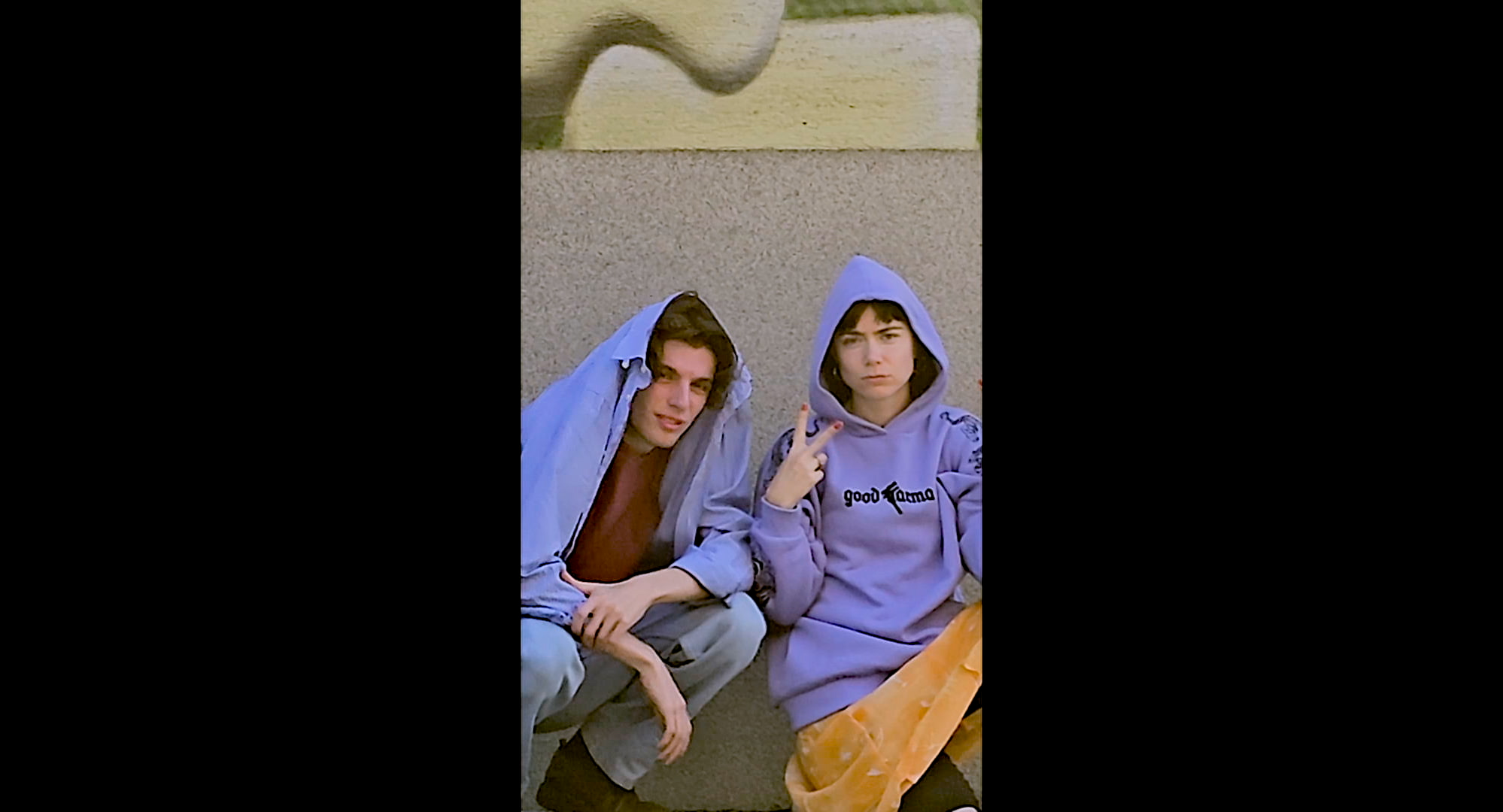
A refreshingly bold and immensely endearing comic portrait of unmoored youth, writer and director Martina Buchelová’s feature debut Lover, Not a Fighter— a Czech/Slovak co-production that was honored with the Grand Prix in this year’s Proxima competition— opens with a classic rom-com meet-cute. Andrej (Adam Kubala) is so inebriated at a tram stop, he’s practically falling asleep on the bench. Miša (Michaela Kostková) finds him and tries to help him come to his senses, to no avail. He still misses his tram. The next time he meets Miša, he’s sober, but the circumstances of their reunion are bizarre: Miša’s father (Jaro Vojtek), attempting to cure her of perceived lesbianism, brings her to Andrej’s grandmother’s home for a dinner date with his similarly adrift cousin, Pet’o (František Beleš). Andrej prays she won’t recognize him as the plastered guy who missed his tram, but he needn’t have worried. She gravitates to him regardless, even if it’s unclear why this shy yet savvy young woman is drawn to such a haphazard personality. At 20 years old, the only thing Andrej appears to be good at is getting stuck in trees after drunkenly scaling them, even if— to his credit— he’s trying to take steps to better his life, including quitting alcohol cold turkey and sequestering himself with his kindly grandmother (Jaroslava Pokorná) to escape his unstable home life (his father, for one, is currently dating a much young woman) and protect himself from other bad influences.
Karlovy Vary’s Proxima competition typically skews toward experiment discoveries, which on the paper doesn’t seem to fit the crowd-pleasing Lover, Not a Fighter. But Buchelová plays both the style and tone of her film with a uniquely appealing offbeat rhythm that’s genuinely funny while also reflective of the narrative’s Gen-Z perspective. Unlike most movies centering on the latter, however, there’s no grating or abrasive editorializing in Buchelová’s narrative construction. She divides the film into seven chapters that dip in and out of the primary narrative strand; one concerns Miša’s younger sister’s tentative brush with first love, another slides back in time to look in on a younger Andrej. Onscreen text contributes amusing title cards and cheeky commentary on the characters’ actions that reads with the casual familiarity of a close friend or confidante. Lines between fantasy and reality are blurred (Andrej dreams that there is a boy band living in his closet, serving as a sort of personal hype squad) and character beats are heightened to absurd ends (Miša’s dad plans to move his family into a luxury bunker). The influence of the digital world on how young people especially process and see their surroundings is pulled forth by the film’s visual language. That introductory scene of Andrej and Miša at the tram stop is presented as a vertical phone video; after a several minutes, the screen opens up to a more traditionally cinematic aspect ratio, but the movie switches back and forth between the two over the course of its runtime. It’s stylistically playful, deftly capturing the spontaneity of winningly-performed characters whose goofiness belies their tenderness, their insecurities, and their genuine desire to improve, for themselves and for others. The latter is a trait that grounds Lover, Not a Fighter— which also includes long takes of characters quietly embracing or confiding in each other that break up the chaos— in emotions that are relatable and real.

I could practically see the jokey “she’s just like me fr” Letterboxd reviews materialize before my eyes as I watched director Shuntaro Uchida’s unhurried and bewitching coming-of-age tale Incinerator. Based on a short story by Japanese writer Kaori Ekuni (who’s commonly considered the female equivalent of the country’s renowned surrealist author Haruki Murakami), the film stars a beguiling and appropriately inscrutable young actress credited only as Karin playing Kozue, a peculiar 10-year-old girl whose numerous quirks include lying on the floor for extended periods of time and, most notably, a ceremonial dumping of all manner of personal items she has negative associations with into the incinerator behind her school. Just before classes end for the summer, a theater troupe visits Kozue’s fourth grade class and mounts a shadow puppet show. One of the actors, Jinta (Taiki Shinozuka), a handsome university student, awakens something in Kozue. She catches his gaze and holds it, and for reasons that not even Jinta seems to be certain of, he doesn’t let go.
There’s a hypnotic quality to Incinerator that mirrors both the slippery passing of time and memory (particularly for a young person, particularly in summer), and the uncertainly that accompanies feeling feelings you’ve never experienced before, and aren’t equipped with the proper roadmap to navigate. Takaki Yokohama’s editing leans into long takes that stretch time; cinematographer Shin Yonekura vividly captures Kozue’s world, from deep shadows as she creates puppets with her hands, to the lush greenery of the countryside where she lives. She meets up with Jinta there; he offers her a ride on his motorcycle, and she attempts to guide them to a place her father once told her about, but they cannot find it. The euphoria that the freedom of riding on the back of a guy’s motorcycle to who knows where elicits appears to be a needed respite from Kozue’s stiffing home life, which includes a mother who works overtime at a bookstore and a father who’s barely getting by as a musician. But while the loose narrative makes room for the parents, they’re largely baffled by their moody daughter’s eccentric behavior. All of the performances, really, are rather opaque in a way that holds Incinerator back from becoming a simmering exploration of adolescent sexuality; Kozue can’t put words to whatever she’s feeling, and her cryptic expressions don’t relay much either, while the brooding Jinta indulges in these meetings with Kozue over the course of the summer, although the why of that is unclear. And yet, the deliberate, dreamy quality to Uchida’s filmmaking allows us to project our own feelings into the spaces: discomfort, anticipation, desire. Kozue may be a strange bird indeed, but her oddness is an outlet for expression of unspoken yet nevertheless recognizable growing pains.


