The Cannes Film Festival annually overflows with an embarrassment of riches, but while many eyes turn to cinema’s most prestigious event (celebrating its 79th edition in the south of France this year) for its high profile premieres– ranging from the newest works from some of the most acclaimed auteurs working to much anticipated blockbusters– its numerous sidebars showcase unique and daring works, often from first-time filmmakers. The two films I wrote about below ably exemplify the selection: Blaise, an animated comedy screening in Cannes’ ACID sidebar, and the trucker romance Flesh and Fuel.

Revolution is traditionally an act of transgression. In Blaise, however, it’s harnessed as an avenue for conformity. The sole animated movie in this year’s Cannes Film Festival’s ACID sidebar, directors Jean-Paul Guige and Dimitri Planchon’s feature-length extension of their comic turned TV series plays up their uncanny and photomontage art style and drily humorous writing to craft a uniquely absurdist portrait of a family in turmoil.
The titular character, Blaise Sauvage (voiced by Timéo), is 16 years old, and the living embodiment of the awkward and socially inept teenage boy. He’s sort of dragged along to a protest, the way one would be reluctantly pressed into some mundane social gathering, where he meets and strikes up a relationship with a girl named Joséphine (Nina Blanc-Francard). Joséphine secretly comes from an incredibly bourgeois background, but because they collide at a near-violent revolt, the each of them assumes the other possesses radical beliefs. The narrative also tracks Blaise’s similarly unbalanced parents. His father Jacques (Jacques Gamblin) spends a hefty amount of time unloading his insecurities on Blaise’s school counselor, while his mother Carole (Léa Drucker) attempts to be more personable with her coworkers at her government job, leading to a potentially disastrous workplace romance.
The photorealistic elements of the character models, combined with their disproportionate features and herky-jerky movements (a side effect of the directors swapping from only a handful of different shapes) are apt visual comps for Blaise’s similarly off-kilter tone. Its gags, painfully relatable to anyone who identifies as a human being, are consistently funny— the inability to hear in a noisy nightclub, the insurmountable urge to divulge everything to your therapist— but it’s particularly astute in its understanding of how its characters’ fumblings are byproducts of their worries as to how others perceive them. Carole’s concerns over not appearing as too strict to her coworkers and loosening up— as well as her acute talent for continuously saying the wrong thing, even as she is trying to course-correct what she has just said— steer her into an unsought-after flirtation. Jacques’ solitary existence and concerns over how he looks to his friends causes him both physical and mental injury. And Blaise’s penchant for going along with anything— Joséphine is the forward member in the relationship, while he goes around with a rather, ahem, blasé attitude toward the whole affair— nearly rope him in to spearheading a crusade he wants no part in. The film— backed by jazzy, scatting music that renders its narrative conflicts even more nonsensically— commodifies revolution on behalf of its characters, but it does so without diminishing those sincerely striving toward actionable change, even as grenades are passed along through the story like candy. If anything, it’s a subtly scathing takedown of performative protest by those whose privileged backgrounds afford them the ability to treat it not as life or death, but as an idle pastime.
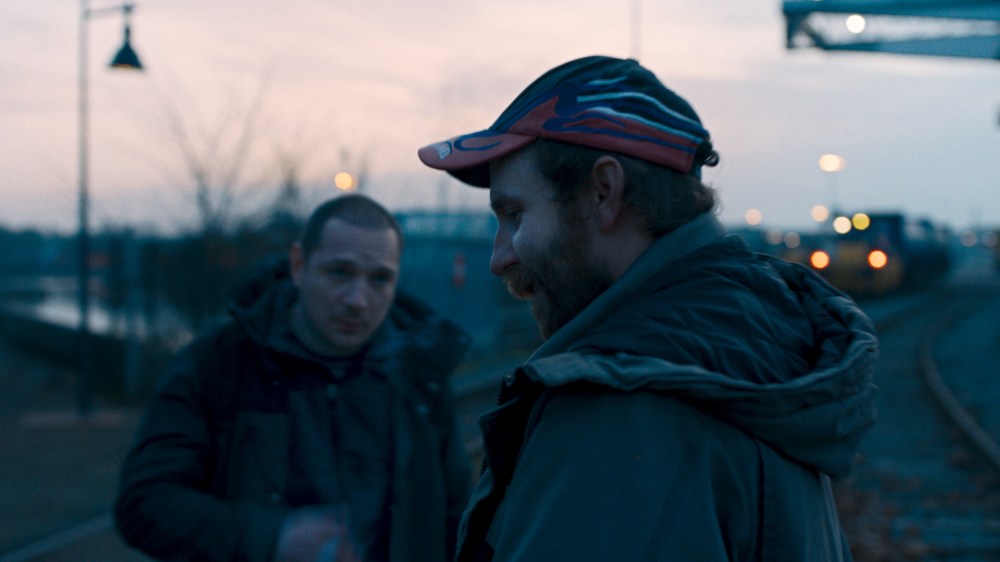
In the tangled woods adjacent to a highway rest stop, strangers— their faces obscured by darkness— join together in the night, their muffled moans of pleasure cutting through the night air. That’s where French truck driver Étienne (Alexis Manenti) first meets Bartosz (Julian Świeżewski), a Polish driver whose assertiveness is an appealing contrast to Étienne’s introverted nature— a classic “opposites attract” love story setup. That isn’t the intended initial direction of their relationship however; their fleeting, anonymous encounter in the woods is disrupted by police, who threaten to arrest anyone they find committing sexual acts in public. Bartosz’s smooth talking fast gets the pair out of the bind with the cops, and in to the start of a bond built on more than mere physical attraction.
Conceived during the 2020 COVID-19 lockdown, when the pressing work of truck drivers delivering essential supplies led to the celebration of a form of labor that’s typically belittling, Pierre Le Gall’s feature directorial debut Flesh and Fuel, premiering in Critics’ Week at Cannes, depicts the tension between devoting your life to an inherently isolating career and pursuing a partnership with another person with surprising tenderness. Almost immediately upending the traditionally straight, masculine associations projected on to the profession (in their first encounter, Étienne and Bartosz lightly brush fingertips before they part), Le Gall revels in portraying acts of love in both words and deeds, framing the story from Étienne’s perspective as the steady worker falls deeper into love (and a sort of dependency) on Bartosz, who isn’t always there, and smartly using the confines of the truck cabin both as a space that crams the pair into closer physical proximity (when they make love, it’s rather clumsily; they can’t help by lay on the horn as they wrestle around the seats and dashboard) and as a tangible representation of the metaphorical claustrophobia inherent in a job that hinges on following strict schedules, heavy travel, and lots of alone time on the road. For every euphoric reunion that Étienne and Bartosz share when their schedules finally align, there’s always the reminder that they only have so much time— sometimes, less than an hour— before one of them must leave again. In what the director himself refers to as an “anti-road movie,” changing landscapes are not a fixture in Flesh and Fuel. Despite how often its characters are on the move, the camera rarely peeks above the dashboards of their trucks, whose distinctive colors and logos turn them into characters themselves, amplifying their loneliness.
The pair’s geographical differences add color to the film’s background. In France, demand often keeps French drivers confined to working inside their home country’s borders, while other drivers have the ability to accept more jobs. That tension pokes at the budding romance between Étienne and Bartosz, as does Bartosz’s constant accepting of work that grants him little to no breaks, and money for sex to fill the gaps of loneliness in between. While this is an intimate story with an equally intimate focuses, Le Gall rounds out Flesh and Fuel with a variety of faces, from the other drivers Étienne works with (from an older mentor figure to a young newbie whose negligence Étienne clashes with) to his family, who just want to know if his job will afford him the time to come home for Christmas. Even as Le Gall swerves away from realism toward the requisite happy ending, his evocative film is constantly weighing economy against romanticism. Can the lives we need afford us to have the lives we want? It may be difficult, but we can try.


Blaise sounds really interesting! Thanks for reviewing this sole animation film!
LikeLiked by 1 person