A man whose job is to blast pieces of gum off of sidewalks. A neighborhood who cares for a small fish pond on their block. A business that preserves dead people’s tattoos. A group of spiritualists who spend 52 days out running a 3,100 mile race in a loop around one city block in Queens. An earnest musician whose band plays covers at a local dive bar. These are just a few of the numerous characters who populate John Wilson’s debut documentary feature, The History of Concrete, a title that conjures dry, factual recitations and dull, gray imagery. That couldn’t be farther from the truth. Wilson’s uproarious upheaval of the non-narrative filmmaking form is consistently colorful and funny, rolling along with a spontaneity that suggests he’s making all this up as he goes along. It’s a film whose marketing, I would argue, undersells its surprising profundity, which has so thoroughly gnawed its way into my brain in the months since I first watched it, I find my thoughts drifting its way constantly.
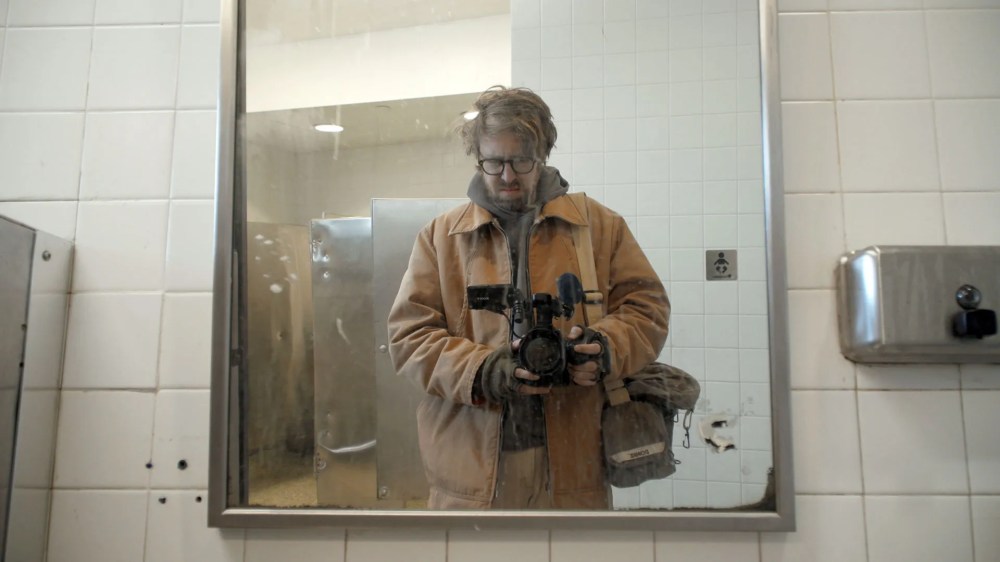
The premise is this: Wilson, on a break from his acclaimed HBO series, How To With John Wilson, and stuck in creative limbo due to the writers’ strike in Hollywood, attends a seminar on how to write and sell a Hallmark Channel film. For the uninitiated, the film quickly runs through the formula: quaint small towns drowning in twinkly lights and Christmas cheer, low stakes conflicts (the local Christmas tree farm is going out of business, a busy businesswoman visiting her hometown butts heads with a local man while trying to plan the annual Christmas pageant) played for high emotional drama, and a love story that always— always— ends with a kiss. The annual barrage of beloved films are popular because of their predictability; a producer states later in the film that Hallmark is the only cable network that continues to grow for that reason. It gives Wilson an idea; not to make his own Hallmark movie, but rather, to apply the Hallmark equation to a documentary. And not just any documentary, but a documentary about the most prosaic subject, an everyday substance that everyone in the world is familiar with, that oh so durable mixture of cement, water, sand, and gravel: concrete.
Wilson, however, doesn’t merely employ this concept as a means to lampoon Hallmark movies, nor is The History of Concrete purely playing industry inside baseball. The struggle to mount his production certainly propels the action forward, and he often cuts back to Zoom meetings with his skeptical production crew as he pitches his project, fighting to get it financed. In between all that, Wilson— effectively demonstrating his aptitude as a humanist documentarian— collects images of people and things around where he lives in New York City, hilariously contextualizing them with his ruminative, affable narration, in the same fashion as How To. But as front-loaded as The History of Concrete is with laugh-out-loud sight gags and eccentric characters who are simply too absurd to not be real, it morphs into something far more introspective in its second half, as Wilson picks up the lessons about permanence he acquired while learning about concrete and applies them to life itself—its fleeting nature, its cycles, its surprises. That he accomplishes that shift so imperceptibly is part of the magic trick of this movie.

A large part of Wilson’s appeal, you see, is his curiosity. It’s in following mundane topics that he meets and forms connections with other people; whether fleeting or enduring, even the most casual conversations often end up in unexpectedly moving places. His film’s tight budget preventing him from licensing existing music, he befriends the lead singer of a band that plays local gigs, a sudden, tragic loss in his life turning into a key plot line of the movie. Wilson’s dogged pursuit of truths about people and the world around him lead from one point to the next, but as improvisational as it appears, his film is quite intentionally structured, if— as most movies nowadays seem to be— about 20 minutes too long. A tightening of some of the more unnecessarily repetitive moments in the back half of the film especially might have made for a punchier denouement. Certain characters and events become recurring components; he frequently cuts back to those aforementioned runners as they get closer and closer to completing their race, for instance, the cyclical nature of their pursuit fitting squarely in with his application of the Hallmark formula— deriving comfort from repeated patterns— and his contemplation of permanence and impermanence. It’s applicable to the world at large, while also being rooted in the specificity of the rapidly gentrifying New York City where Wilson is based. Concrete can be poured and built up to secure places and things, and concrete can patch up the cracks in the rapidly decaying, and concrete can crumble and collapse into oblivion. A fish pond brimming with living, breathing creatures can be thoughtlessly paved over as part of a construction project. A person can pass away, leaving behind people who loved them and communities they were members of to reckon with their void— or just a puzzling bit of art that was permanently emblazoned on their skin. A dedicated group can gather for nearly two months out of every year to run circles around an elementary school, without fail. With the warmth of a cheery made-for-TV holiday movie, Wilson molds the most pedestrian occurrences into a singular experience that transcends mere entertainment. It’s a project that cements him— pun intended— as one of our sharpest archivers of human existence.
The History of Concrete is now playing in select theaters nationwide, and screens locally at the Arkadin Cinema & Bar on October 3 and 5, and the Hi-Pointe Theatre October 3-11. Runtime: 102 minutes.


