This is the first year I’ve dipped my toes into the San Sebastián International Film Festival, the long-standing event on the Spanish coast that’s celebrating its 74th edition this year. I can’t say that I’m surprised that the films I’ve watched thus far have made bold swings in both content and form, with mixed results. It’s certainly true of the two premieres competing for the festival’s prestigious Golden Shell, one of which I vibed with, and the other I decidedly did not: Mikel Gurrea’s Sants, a character study set in the world of religious artifact theft, and Ah Biao’s Border, a noir-like drama set in a Chinese mining town.
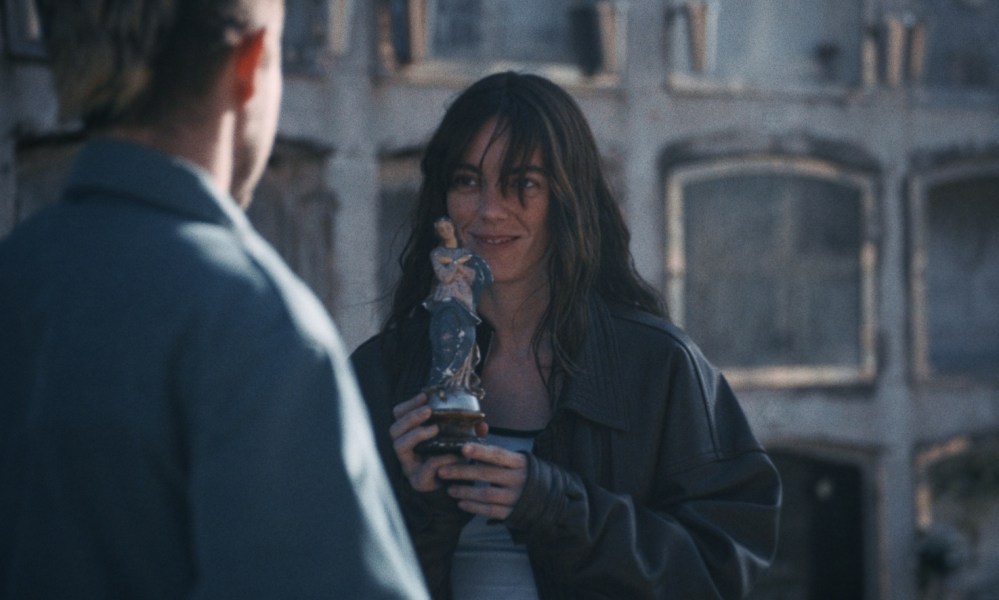
Lali (Victoria Luengo) lives on the edge. A perpetual drifter, she makes a living stealing artifacts and selling them for a profit. The act gives her a rush like no other; the exuberance of making off with a valuable find is written all over the faces of her and her colleagues, and heard in the tinkling of their laughter. The bigger the get, the bigger their excitement. Her fragile existence on the fringes of society is shaken up, however, when she returns home to Barcelona and becomes tied up with two matriarchal figures: Rosario (Eulàlia Ramon), the leader of a gang that steals holy objects from churches and whose intoxicating dispersal of power and tenderness attracts Lali and brings her into their fold, and Lali’s actual mother, Glòria (Ariadna Gil), who recently fell seriously ill and requires near-constant care. But their estrangement hangs thick in the air between them, rendering their reunion and even acts of care as contentious encounters.
Director Mikel Gurrea’s Sants subtly ties the sacred nature of the items the gang plunders— which include heavy statues sporting reverential and chillingly lifeless stares— to Lali’s own crisis of faith. It can’t be a coincidence that both Rosario and Gloria have names with strong religious connotations, although Lali’s reckoning may not be so much based in religion as it is in morality and familial duty. She’s drawn to Rosario not only because she can help her financially while filling a sort of supportive parental void that Glòria cannot, but because she makes her feel like she’s a part of something. Even Glòria, who isn’t fully aware of the business Lali is involved in, recognizes this and later tells her daughter that she’s found her people.
Still, the tension between Lali’s two families mounts, and as the gang’s thefts become more and more audacious, she’ll have to choose what world she wants to be a part of. Every performance— especially Luengo, who is so adept at conveying bitterness— is in tune with the narrative’s emotional highs and lows, making characters feel lived-in even when there’s not much on the page. If there’s an issue with Sants, it’s that as emotional fraught and heart-poundingly thrilling (particularly during a teeth-clenching heist late in the film, as the gang robs a church while the nuns sleep in another adjoining chamber) as it often is, it doesn’t always marry the crime story with the family drama so smoothly, and frequently gestures toward intriguing avenues that the film doesn’t venture down. Take, for instance, the gang’s own tenuous code of ethics; one of them tells Lali that they don’t steal from cemeteries or graves. Still, Gurrea’s largely pulls of his film with the accomplishment of a steady ringleader; Valentina Magaletti’s score thrums in time with its rhythm, while Julián Elizalde’s cinematography plays with the many shadowy sequences, rendering shots like Rembrandt paintings.

Border, Bangkok-based director Ah Biao’s noir-stained debut feature, forbidden desires are as stifling to its characters as the forsaken town they live in. A miner (Zheyan Li) drifts between his home and his job with seemingly little thought, stuck in a domineering relationship with a fellow miner.
Ah Biao quickly establishes the mundane rhythms of the miner’s existence, cutting (with a team of editors that includes Hao Zhou and Xiaokai Ding) from his partner issuing him a command to his blank face in response. Too blank, perhaps. Li plays him so impassively, and Ah Biao’s writing is so spare and gaze so clinical, that it’s difficult to buy in to the emotional awakening he apparently has when he meets and has a sexual encounter with a mysterious, beautiful woman (Feng Qi). His— and our— first glimpse of this woman is of her standing across a street clad in a striking red dress that contrasts almost garishly with the cold, gray factory buildings surrounding her. His partner warns him against women, that she’s a prostitute who only wants him for his money. But like every lovestruck loser protagonist in classic noir, the miner sees only the object of his affection, a way out of the doldrums of his current existence. He asks her if she meant it when she said she’d only be with him. “Can you afford to keep me?” she responds.
It’s little surprise that the woman’s influence serves as a path leading deeper into darkness, not out of it; the tone of the film, punctuated by lengthy silences and inscrutable characters, is quite unsettling. To his credit, Ah Biao provides her with a motivating factor that, when revealed late in the film, colors her in deeper shades beyond that of the typical, cold-blooded femme fatale. He also gestures toward expectations of masculinity and power regarding the miner. But noir is fueled by passion, and Border’s minimalist, detached approach works against it, from the overly cryptic characters, flat performances, and long, quiet takes that (along with the film’s incredibly late title drop) verge on pretentious. Serving as his own cinematographer, Ah Biao displays an eye for mise en scène, situating his characters around or next to each other in space in a way that reads as intentional to their dynamic within the narrative. But no amount of technical artistry can compensate for a hollow emotional core.


