Sometime around Léo’s (Melvil Poupaud) third encounter with a different woman in Nicolas Pariser’s One Minute to Midnight, I asked myself a desperate question: Why should I care about this man? The French drama, premiering in competition at the Venice Film Festival, abandons a plotty narrative in favor of the walking-and-talking structure that can be difficult to pull off without the right combo of charismatic performers and witty, thoughtful dialogue. Unfortunately, One Minute to Midnight contains little of that.
When we first meet the protagonist, Léo, he’s laid over in Paris on his way to Italy to meet with a lawyer to settle his late father’s estate. He never knew his father, who had other children with other women, but who apparently truly loved Léo’s mother. Rather than go back home to eastern France, where his relationship with his partner is on the brink of finally disintegrating anyway, after the lawyer has to unexpectedly delay their meeting for a week, Léo decides to stay in the city, where he can both spend time with his 19-year-old daughter Emma (Clara Pacini) and revisit his old stomping grounds— and his past relationships with women, both personal and professional, whose recollections prompt the now 49-year-old man to reevaluate his treatment of and attitudes toward them, which, we are led to assume, weren’t great.
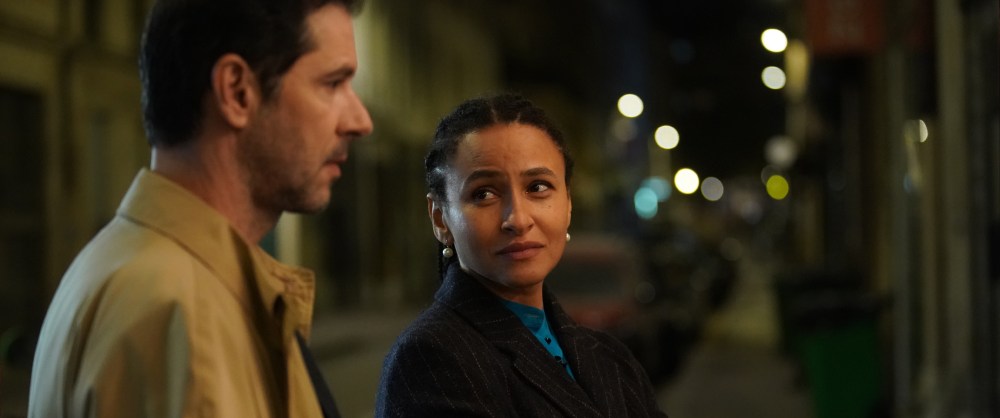
One Minute to Midnight is capably performed and shot, cinematographer Julia Mingo constantly moving the camera with the characters in a way that grants the film liveliness even during scenes of minimal physical action. Pariser’s intentions of shining a spotlight on the misogyny women experience in every corner of their personal and professional lives, and men’s struggles to understand that even retrospectively, are admirable. The women Léo encounters throughout his several days’ journey, from Emma (an activist with a strong moral compass who is deeply involved with current French politics in a way that contrasts with her father’s apathy toward anything happening beyond his immediate sphere of existence), to Giulia (Chiara Mastroianni), once an intern who worked under him and an older, all-male team who’s now a busy and successful journalist, to Éléonore (Léonie Simaga), a former colleague’s wife who Léo encounters at multiple social gatherings, to Tina (Golshifteh Farahani), the woman Léo was once in love with and who he spends the whole movie tracking down, express far more wit, intelligence, and awareness than he does. In fact, they actively demolish his overtures, which they view as self-pitying and performative; Tina even tells him straight up, “I’ve had it with masculine self-pity. Why are you all so glum lately?” The issue is that while empathy toward the women and acknowledgment that Léo has perhaps done some wrong in the past (a realization partly sparked by the constant chatter among his friends that a former colleague, Luc, has recently been accused of rape by multiple women) is clear in the writing, experientially, we’re still situated in Léo’s perspective. Pariser is perhaps too enamored of his protagonist to interrogate these issues with any sort of depth beyond the equivalent of posting a Me Too hashtag. Midway through the film, he visits a film set where a series is being shot in which the main character is based on a younger version of himself (in the scene he drops in on, his character is a jerk being told off by a female coworker), and even Éléonore, despite her criticism, can’t help sleeping with him in the end. There are some amusing nods to the absurd deviations from reality that often accompany filmmaking— a group of young people dance and grind to silence in the former scene, the dialogue is dubbed in after— but it often feels like Pariser heavy-handedly inserting himself into the narrative, which he literally does when he pops up as one of Léo’s former film critic-turned-Orthodox Jew buddies who attempts to impart some wisdom about how life meant something different when he was a film buff, a further bit of humor arriving in the appearance of his wife and teenage children just as he’s denigrating the reality of loving relationships to Léo. Perhaps he isn’t passionately in love, but he’s comfortable.
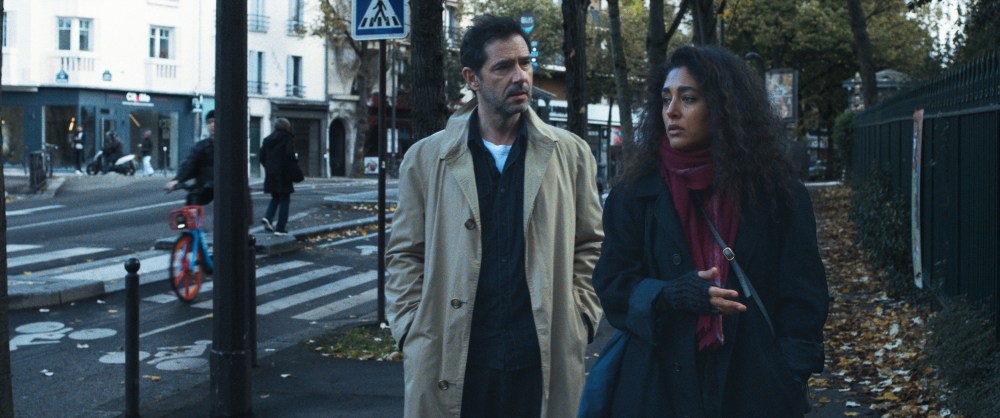
The broad allusions to a frightening yet vague political crisis (at one point, France’s President invokes an article that grants him extended powers said to be akin to a temporary dictatorship, news that seems to shake everyone except Léo, who is still too in his head) may have a universal appeal that doesn’t tie the film down to a specific moment in time, but they only do more to accentuate the lack of narrative incisiveness. There is something lovely, though, about the ease with which Léo and Emma, who seems to be always on her way to some protest or other every time they collide, interact, and the care they exhibit toward each other; the regret Léo feels about not being present for most of her childhood is palpable. The thread of Léo’s late father, which is mostly dropped for the middle section of the movie, picks up again at the end, and suddenly One Minute to Midnight is rife with the curious and melancholic ruminations on love and family that it’s been straining toward its entire runtime. Ultimately, the film leaves us with an image not of Léo, whose ideals represent a relic of the past, but with Emma, who represents a spark of hope for the future. Yet for all of the myriad thoughts swirling around the narrative, the characters whose perspective it frames them from are just too insufferable to allow permit them to hit an emotional crescendo.
One Minute to Midnight had its world premiere in competition at the 2026 Venice Film Festival. Runtime: 107 minutes.


