In Chinese mythology, the red thread of fate— one end tied to the finger of one individual, the other end to another person— symbolizes an unbreakable connection. It binds soulmates across time and space, ensuring that they are fated to find each other. In David Lowery’s cosmic ghost story Mother Mary, the bond between world-famous, Lady Gaga-esque pop star Mother Mary (Anne Hathaway) and her former costume designer Sam Anselm (Michaela Coel) may not be of the romantic sort traditionally associated with the invisible string theory (the queer reading is present, no doubt, although rendered more ephemerally than explicitly), but the depths of their feelings for each other emerge in near-torrential bursts of emotion: pleading apologies and cries for help and angry rants and arch comments that indicate a past we never really see in detail, but the shape of which we can just discern. It’s fitting, therefore, that the red string we eventually bear witness to as the spirit that haunts Sam and Mary independently of each other until they are finally reunited isn’t a delicate sliver, but a magnificent, billowing plume of rich crimson fabric that enters their bodies and wraps around their innards, suffocating them with its folds and leaving them hypnotized, insomniac, practically panting for release.
It’s late into Mother Mary’s runtime before it fully swerves into the supernatural territory that is befitting of the writer and director who crafted such films as the 2017 drama A Ghost Story and the 2021 chivalric fantasy The Green Knight, however. After a moment of clear distress following a costume fitting going horribly wrong, Mary flees halfway around the world to the fashion house Sam now operates out of the English countryside. Dripping wet from the rain and clad in shapeless black sweats, Mary asks Sam— not merely a former collaborator, but a one-time close friend— to design a dress for her to wear in conjunction with a new song she’s written. She’s mounting a comeback tour, a return to live performing following an onstage fall that left witnesses speculating as to whether it was truly an accident, or a suicide attempt.
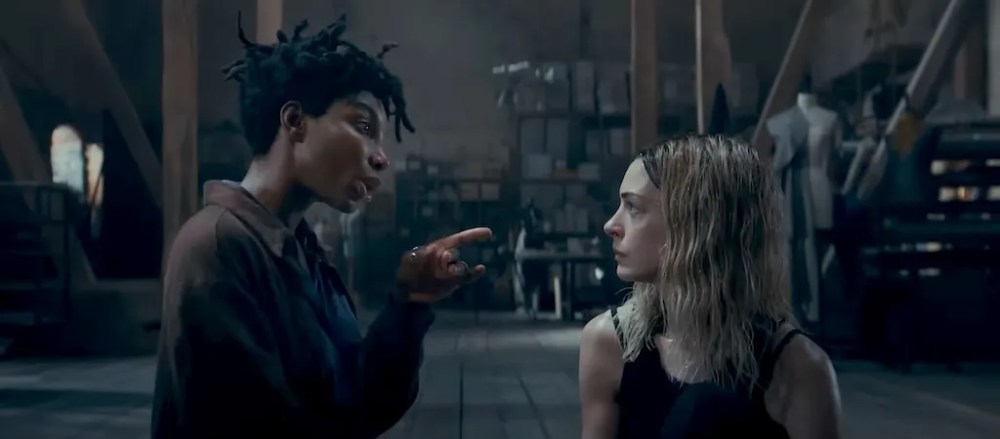
The details of that incident— along with the nooks and crannies of Mary and Sam’s professional and personal relationship— remain fuzzy until later in the film. Practically the entirety of Mother Mary is set within the rustic barn Sam converted into her studio, and while increasingly frequent flashbacks later break up the story’s confined environment and talky narrative structure, the first act is essentially a lengthy back-and-forth between Mary and Sam, the latter’s probing questions about the former’s need for a dress as she (with the aid of a meek assistant, played by Hunter Schafer) take measurements and whips out reams of fabric. What sort of halo should Mary wear with the dress, Sam wonders, referring to the half-moon crowns, ranging from simple circles to elaborate head-pieces built from metal and fabric and jewels that are a signature of her style and make her appear like the divine figure her stage name suggests. No halo, Mary responds firmly; they aren’t her style, they are Sam’s, and she wants to go back to basics. The verbosity of this section of the movie, in which a lot is said while informing the viewer of very little, verges on frustratingly obtuse, while Coel’s interpretation of Sam, all self-importance and sarcastic comments, is initially so mean it reads as flat.
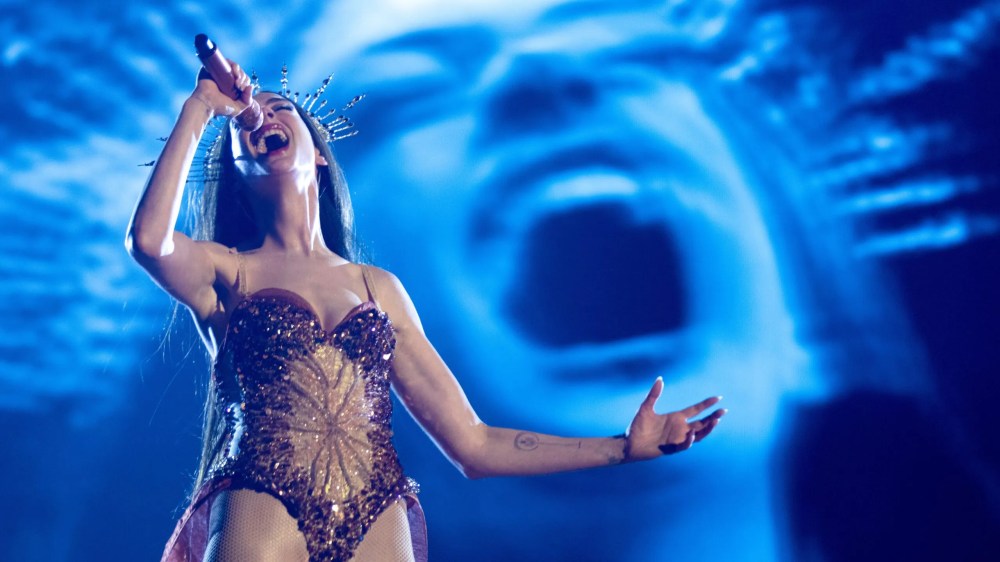
Fortunately, the depth of the characters and the range of the performances expand along with the spaces the story inhabits, even if the accompanying narrative unfurls with more puzzlement than clarity. The glitz of the cacophonous arena scenes, aesthetically inspired by Taylor Swift’s Eras tour and granting a place for Mary’s music (the ethereal tunes, penned by Jack Antonoff and Charlie XCX, all have titles like “Holy Spirit” and “Burial” that are in line with the film’s gothic elements) to live, serve as an appropriate contemporary counterpoint to Sam’s low-tech, spooky studio, where literal and figurative ghosts alike are conjured. Essentially a two-hander, Hathaway and Coel (who gazes at and speak to Mary with rapture in her eyes and devotion in her voice) commit to the wild swings with abandon, particularly the former, whose physicality is embraced by the long shots utilized in Lowery’s direction. When she performs choreography for Sam to demonstrate how she plans to move in the dress (sans music, because Sam stubbornly refuses to listen to it), she gives herself over to the motion, the muscles of her arms rippling as her bare feet slap the hard wood floor. It’s transformative, a jolt of excitement to what up to that point has been a largely static picture, and one that’s admittedly more effective than Lowery’s grander staging and directorial flourishes (although the panning shot of Mary repeatedly ascending and descending the stairs to the stage is a gorgeous tableau that communicates the rigorous routine of her schedule in almost storybook-like fashion).
Depictions of the movements of one possessed carry over in more literal fashion to a memorable supporting appearance from singer-songwriter FKA Twigs as a medium hired by Mary. Like the spirit that inhabits the red fabric that draws Mary and Sam back in to each other’s orbit, Mother Mary is populated by recurring imagery both spiritual and paranormal in nature, but while Lowery is clearly getting at something, so much of the meat of his tale that is inspired as much by the excessive gothic stylings Francis Ford Coppola’s Bram Stoker’s Dracula as it is by pop stardom remains elusive. Or maybe it’s just deceptively simple. Maybe this ghost story nestled within a drama about art and celebrity is just as it seems: the repairing of a fracture between two entities torn asunder who were never fated to be apart. The idol needs the worshipper as much as the worshipper needs the idol.
Mother Mary is now playing in theaters. Runtime: 112 minutes. Rated R.


