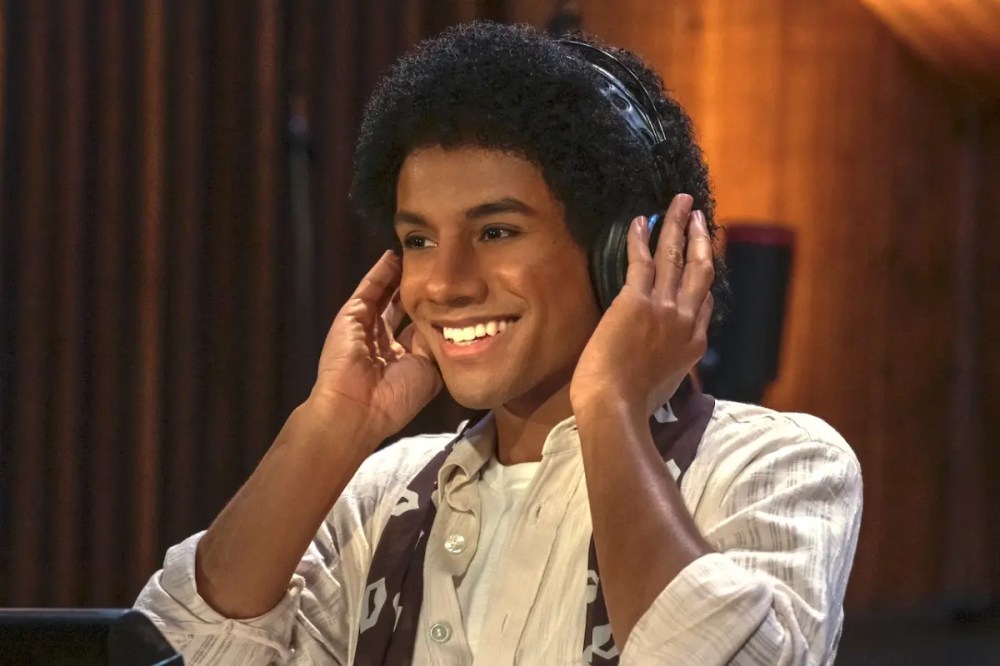
During the first act of Michael— director Antoine Fuqua’s dramatization of the life and career of pop star Michael Jackson from his beginnings with the Jackson 5 in the 1960s to his Bad tour that capped off the 1980s— young Michael (Juliano Krue Valdi) steps into the recording booth at Motown’s Los Angeles headquarters in front of its president, producer Berry Gordy (Larenz Tate), and starts to sing. The 10-year-old can’t help shuffling his feet to the beat, however, and has to stop and start a couple of times before he finds the right groove with the microphone. But as he belts out the opening notes of “Who’s Lovin You” (a cover of the Miracles song whose drawn-out notes showcases Michael’s vocal range), a awe-struck expression dawns on Gordy’s face. Afterward, he tells Michael that for as long as he’s been in this business, he’s never heard a voice like his, and believes that he’s special in a way that could transcend run-of-the-mill celebrity. Unfortunately, that very scene— the transcendent studio recording session where the performer is entirely in their element, the camera occasionally cutting to the mesmerized faces of those watching on the other side of the glass— is one of musical biopics’ most tired cliches. Michael is so blinded by the almost god-like star power its subject wielded at the height of his fame, it spends the bulk of its two hour runtime blundering in search of a story, ultimately opting for idolatry over an incisive character study.
It becomes even less surprising that Michael is so drenched in sugar when looking at the movie’s credits. Many of his siblings, all represented in some small fashion in the movie— with the notable exception of Michael’s also-famous musician sister Janet Jackson, who according to Michael doesn’t exist, doesn’t even warrant a small mention— serve as executive producer, while John Branca and John McClain serve as producers alongside the project’s instigator, Graham King. Branca and McClain were, according to Michael’s will, produced after his sudden passing in 2009, appointed executors of Michael’s estate, which they continue to manage to this day. One of the numerous uncomfortably queasy aspects of Michael is watching how Branca is portrayed in the film— played by Miles Teller, he’s hired on the spot by an older Michael (Jaafar Jackson) as his lawyer to help him cut ties with his domineering father and one-time manager, Joe Jackson (a cartoonishly villainous Colman Domingo) for his intelligence and cunning, and continues to pop up every so often as the steady supportive friend— versus the rocky reality of the pair’s working relationship (Michael fired Branca on at least a couple of occasions).
No feature-length biopic, particularly one centered on so complicated a subject as Michael Jackson, is going to be comprehensive, and it’s unfair to expect them to be so. Still, it’s disappointing to see Michael sanitized to the point that the entire film is rendered bland and dull. The film works overtime to show how Michael is a gentle soul bursting with natural talent, robbed of a normal childhood by fame and an abusive father; rather than spend his time partying and socializing like many celebrities of his stature likely would, he lives at home with his family behind the gates of their vast Encino property, watching old movies with his mother (Katherine Jackson, played by Nia Long), gathering exotic animals as pets (Michael spends a lot of time in his room playing with his pet chimp, Bubbles, and the too-obviously animated critters further distance the film from any feelings of grit or groundedness), frequenting toy stores, and dreaming of the Neverland he read about in a picture book he had as a child. The film lifts up Michael’s charitable nature (there are frequent cutaways to him visiting sick children at the hospital) and demonstrates the intense, almost cult-like hold he had over his fans (the final scene, which depicts Michael performing “Bad” during his tour in London, cross cuts between him and female fans passing out cold in the audience) but conveniently ends prior to the 1993 child sex abuse allegations that prompted a devastating blow to his commercial and popular appeal. Reportedly, screenwriter John Logan’s original script did attempt to confront the case and its impact on Michael, but that thread— along with numerous other bits and pieces that got halted by the Jackson estate’s legal entanglements, like the inclusion of Diana Ross, a key figure tied to the Jackson 5’s beginnings who was completely cut from the film— was entirely altered and reshot, leaving not a whiff of scandal in its place.
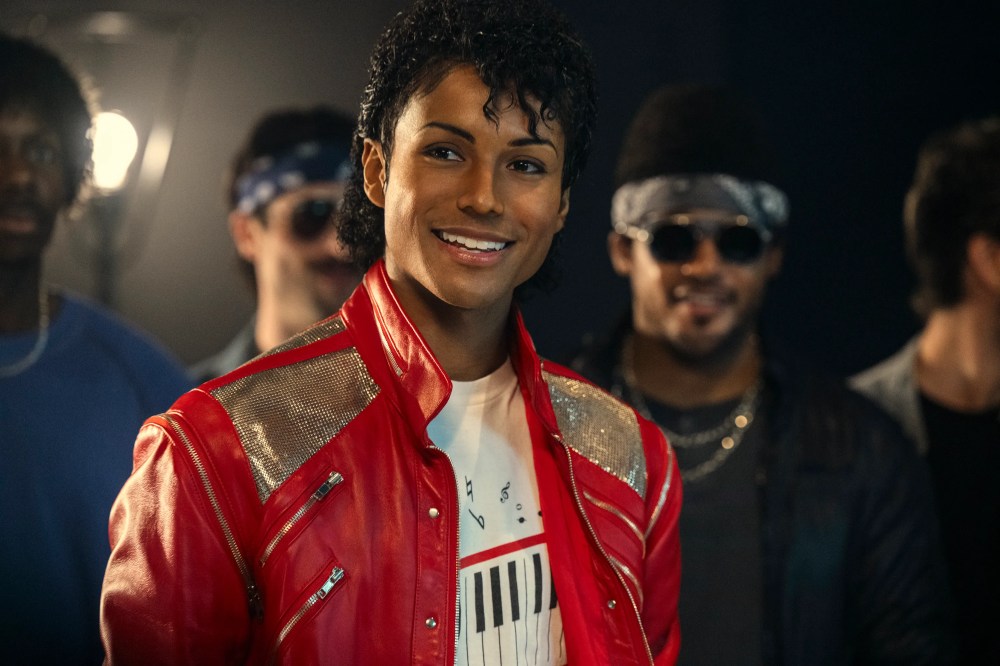
Maybe all of that would be more bearable if Michael actually made an effort to interrogate any of the weighty topics it glances at. It’s clear that Michael is alone, perhaps stunted in a perpetual childlike state; there are several moments like the one in which he returns home from a toy store having purchased a Twister game, but can’t get his older brothers, who are busy shooting hoops, or going on dates, to play with him. But the film fails to reconcile this side of him with the creative brain that conceived hit songs with mature themes like Billie Jean. Besides a couple of irritatingly obvious montages that are in step with the music biopic subgenre— Michael’s consistent viewing of old horror movies like The Fly and Night of the Living Dead serves as his inspiration for “Thriller,” while catching a news report about gang violence in Los Angeles spurs him to gather local dancers for the video— the film never actually stops to consider what fuels Michael’s musical fire, or why he’s even doing all of this in the first place. It doesn’t help that Jackson’s performance is largely flat. Making his film debut, the son of Jermaine Jackson and Michael’s nephew does an impressive job recreating his uncle’s staggering dance moves and vocals, but his performance is little more than an imitation. When he isn’t singing or dancing, when he’s asked to hit some dramatic note, his face and line delivery are emotionally vacant. Take the scene where Michael and Branca pay a visit to the president of CBS Records, Walter Yetnikoff (Michael Myers, in a one scene role), to push him to get MTV to air the “Thriller” music video. Yetnikoff demurs, because MTV never spotlights Black artists, and Michael shoots back that he is a proud Black artist, but the issue of race and Michael’s barrier-breaking fame is never raised before or after this under-a-minute scene, and Jackson fails to read his lines with the sort of fire required to back up his words. It’s a pathetic attempt to make a statement that is performative rather than heartfelt.
Admittedly, I enter most music biopics these days with my expectations in the gutter; I’ve seen enough of them by now to know the tropes, and to know that most audiences want to see their subjects as heroes rather than humans, and want to attend a concert, not watch a story with a lot of dramatic and thematic heft. Still, it’s disappointing to see Fuqua— a filmmaker whose work typically demonstrates social consciousness and directorial verve— working on a project that never really possesses any sort of artistic point of view— about fame, or art, or family, or anything. Michael may hit all the beats you expect from this sort of movie, but it’s also the worst of its kind: nauseatingly idolatrous and crowd-pleasing, it shoots for playing the greatest hits, and emerges as a best-forgotten B-side.
Michael is now playing in theaters. Runtime: 127 minutes. Rated PG-13.


The moment I heard the Jackson family was involved in the film, I had a feeling it wouldn’t be worth my time, and your review pretty much confirmed it.
That’s why films like Coal Miner’s Daughter (1980) and Raging Bull (1980) still stand out — they’re not afraid to show every side of their subjects, including the messy and uncomfortable parts. Credit to both Loretta Lynn and Jake LaMotta for allowing that kind of honesty in their respective biopics. Unfortunately, that kind of openness feels a lot rarer now. Anyhow, great review!
LikeLiked by 1 person