Meredith Alloway’s wicked debut feature film, the off-beat horror comedy Forbidden Fruits, is a truly odd piece of work. Not odd because of its kooky premise, which centers around a group of young women who form a coven behind the scenes of the ritzy mall boutique where they work, their friendship and ideals built not on a strong sisterhood but on performative rituals, like participating in changing room confessionals with the ghost of Marilyn Monroe and placing hexes on anyone who threatens to break their bond (it’s an adaptation of Lily Houghton’s 2019 play Of the woman came the beginning of sin, and through her we all die, cowritten by Houghton and Alloway). No, it’s odd because it’s so anachronistic, even though it’s clearly riffing on specific genres from a specific time. It’s set in the present day, but one that presumes that the vibrant shopping mall culture of 30 years ago still exists. It’s unclear just where its leads’ are at in life, literally and figuratively; they have high school jobs and high school attitudes and circle in juvenile cliques, but they don’t go to school (eventually, they start to drop allusions to college degrees and getting into grad school, but it’s perplexing regardless). It pops off catty barbs as fast and furious and with the same earnestness as the wildly quotable Clueless, is as violent and cruel as Heathers and Jawbreaker, and replicates the cozy witchy vibes of The Craft and Practical Magic (the latter is even explicitly name-dropped). But unlike those late 80s-90s cult classics, Forbidden Fruits, which grabs at those qualities in aiming for a critique of contemporary performative feminism, lacks satiric bite and thematic cohesion. It’s a blast to watch, and, to its credit, tricky to clock which direction it’s going to swing in next, but it’s also far too scattered, as if Alloway and Houghton curated an Instagram-friendly mood board of items they cherry-picked to highlight, but couldn’t quite figure out how to link them together.
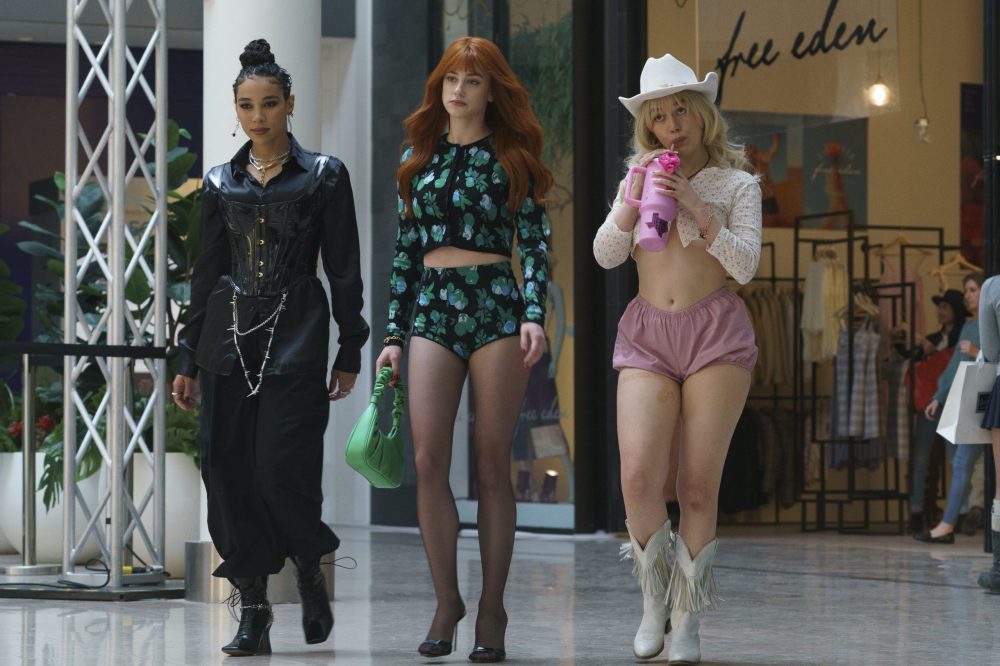
Forbidden Fruits’ poppy opening introduces us to the trio who the other employees at a Dallas-area shopping mall refer to in hushed whispers simply as “The Fruits.” Their ringleader, the fiery-haired Apple (Lili Reinhart), navigates her world with confident coolness; when we first meet her, a pervy man has just pulled up next to her in his car, and he begins masturbating as they lock eyes, Apple goading him with just a look— and subsequently tossing her steaming latte directly into his lap. Cherry (Victoria Pedretti) is the bubbly bimbo, always looking to please Apple (she brought a second latte for her, just in case). Fig (Alexandra Shipp) is the brains of the bunch (or at least, as brainy as they get), trying to keep her new boyfriend and her dreams of doing something with her life beyond working at Free Eden, a generically preppy store that looks like a mash-up of Free People and Forever 21, but casually sells pieces that cost $2500— and that’s the discounted price— on the down-low. They breeze through the food court, stickered Stanley Cups in hand, and settle in at a booth with their burritos and salad bowls that no one would dare charge them for, carefully avoid the escalator while wearing their uber-thin stilettos, and turn heads in their wardrobes, a mish-mash of preppy western wear and midriff-baring, club-ready sequins that feel like they’re reaching too hard for high fashion and just missing the mark. It’s clear in the dismissive attitude they dispense that obliterates nearly everyone in their wake that they don’t have the time or desire to entertain those outside of their group. But they open up their very exclusive doors after Fig strikes up a rapport with the new Sister Salt employee as she plies her pretzels across the food court, discovering that she, like them, is named after a fruit: Pumpkin (Lola Tung). One after-hours ritual of silly chants and imbibing of questionable beverages from a sparkly cowboy boot later, and Pumpkin is now a Free Eden employee. Her autumnal name, as Apple says, completes their retail season.
As the sordid pasts and mysterious motivations of each character are gradually peeled back, Forbidden Fruits zips between espionage and the supernatural with almost nonsensical abandon. The dialogue is as juicy as a freshly-plucked apple, made all the more impactful by the candy-coated production design and the cast’s commitment to the heightened atmosphere. It may fall just short of a pure camp extravaganza, but there are loads of big, genuine laughs in this film, and each performer, with their varying deliveries (early in the film, Apple cuts off Cherry’s babbling about whether or not a pumpkin is actually a fruit with a hilariously sharp, “Do you hate women?”), effectively plays off each other.
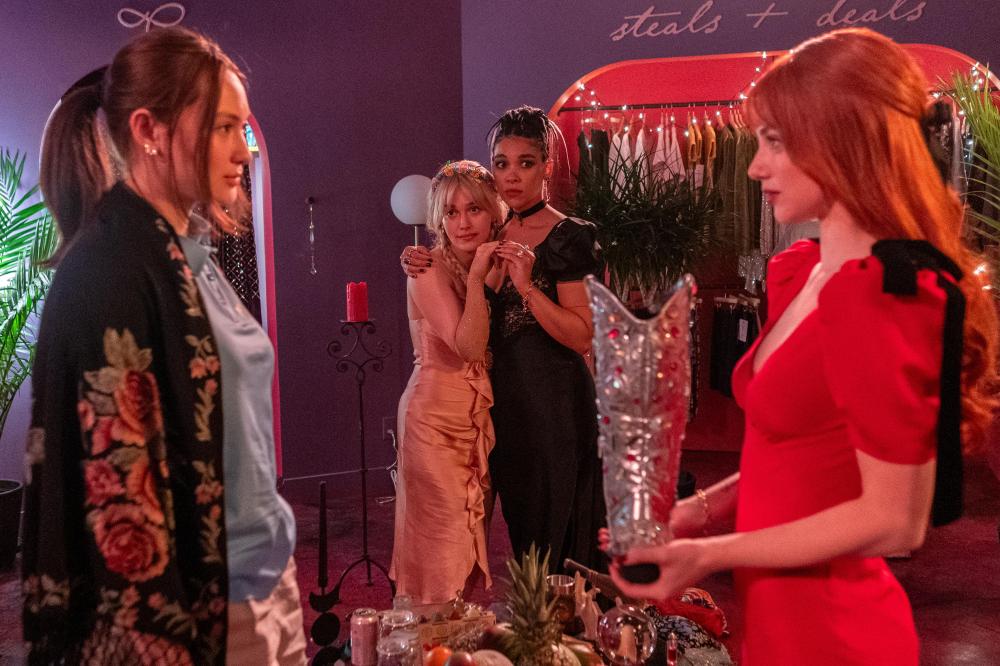
If only the concepts propping up the narrative were just as ably executed. Forbidden Fruits, in addition to not committing to a clear perspective (so much of the film’s language points to Pumpkin as our main protagonist, but the story drifts away from her so often), is brimming with ideas that aren’t fleshed out to their full potential. Take the Biblical allegories, for instance, prevalent in the names of characters and places throughout the film. The girls’ primary habit is called Eden, the upstairs apartment where they enact their spells Paradise. They refer to their enemies as snakes. Apple, in her tantalizing offers of power and belonging, is the forbidden fruit, but a glimpse at her license plate— “Lilith”— also indicates her embodiment of the female figure in Jewish folklore who fled Eden because she didn’t want to submit to Adam. It’s an idea in keeping with Apple’s rules about relationships with boys— (the girls can’t fraternize with them, and can only talk to them in emojis)— and negative attitude toward all men. She automatically assumes that a seemingly nice dad who comes into Free Eden to buy something for his wife and daughters must be trying to compensate for some dalliance, and she adopts Marilyn Monroe as their patron saint because she was too smart to succumb to any man, even the President of the United States (one of the film’s few references that is both smart and effective). But these thoughts become jumbled in a film that, in both writing and tone, is clearly poking at shallow feminist platitudes, but doesn’t seem to know what to say about them beyond acknowledgment of their existence. If anything, the final act— which takes a surprisingly gory turn into straight splatterfest territory— suggests that maybe the person embracing the double standard (cultivating an all-female paradise even while ruthlessly denigrating other women in both words and deeds) isn’t the one who ought to be punished. In struggling so hard to be the Gen-Z iteration of all those movies I’ve already mentioned above, Forbidden Fruits fails to reconcile its meanness with righteousness, opting for extremes that are fun in the moment and likely will maintain some cult appeal, but never cohere into anything meaningful or memorable.
Forbidden Fruits opens in theaters March 27. Runtime: 103 minutes. Rated R.

 Katie at the Movies