The title of Who Moves America, Yael Bridges’ galvanizing crowd-pleaser, poses the film’s central thesis statement with succinct clarity: that the world runs on the labor of the most underpaid and undervalued workers, whose inability to walk away from a consistent, decently paying job— regardless of the long hours and inhumane working conditions— keeps them in check by the capitalist powers that be. And yet, without them, the global economy would collapse. Who Moves America intimately documents this very threat, as the UPS workers’ 2023 contract is about to expire, and their union— represented by the Teamsters— starts putting pressure on the company to improve working conditions and increase pay. The alternative? 340,000 workers across the United States walking off the job and on to the picket line.
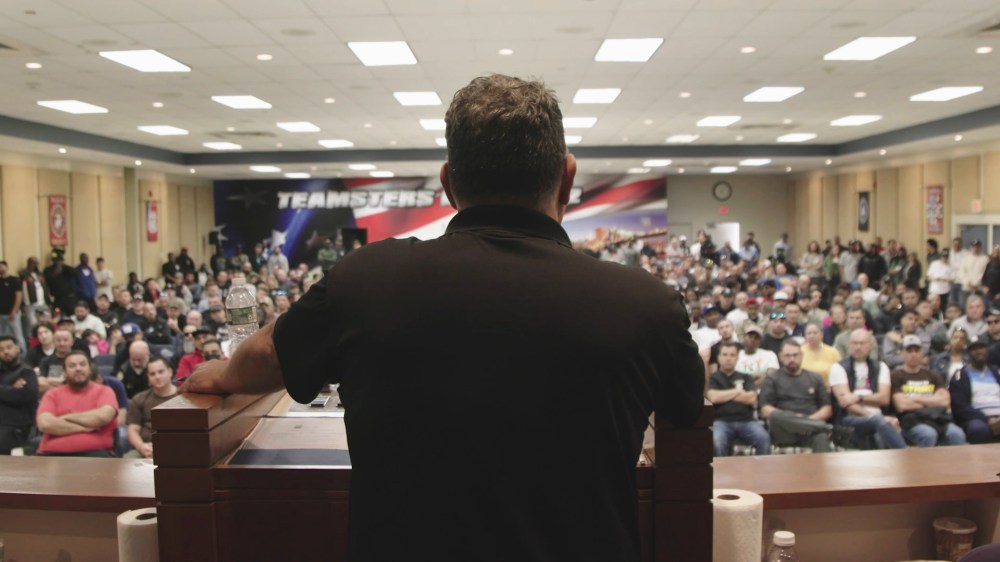
Bridges finds her way into this massive story by zeroing in on a few UPS employees of varying backgrounds and degrees of experience from across the country. These include Justin Alo, a truck driver based in San Marcos, California, who says that he took the job for its security after he and his wife started their family, and Antonio Rosario, a Brooklyn-based 27-year UPS veteran who participated in the historic 1997 UPS strike. The bulk of Bridges’ film consists of sitting in on meetings and conversations held between the UPS workers, granting them the space to air their different beliefs and desires from a new contract— the first to come up following the COVID-19 lockdown, which saw UPS workers stepping up to continue working in unsafe conditions to keep the flow of commerce moving. While the Teamsters’ goal is to present a unified front, behind the scenes, their negotiations are sometimes fraught. A key dividing line is the issue of how much of a pay increase they ought to ask for for part-timers (many of whom are either not planning on remaining with the company for long anyway, or who are hesitant to potentially jeopardize their job security if a strike happens), with some believing that that shouldn’t be a priority, and other full-timers pleading of remembrance for when they also first started out, often putting in full-time hours but only receiving part-time benefits. Other provisions include improved working conditions for what is an incredibly physical job; a group of female packers discuss the back-breaking nature of the work, others mention how part-timers only get a 10-minute lunch, while Bridges integrates heart-breaking news reports about drivers who passed away from heat exhaustion on their routes. UPS trucks aren’t equipped with air-conditioning, the company citing the sheer number of stops most drivers make in a day as the reason why they aren’t needed, but in the overwhelm dry heat of the country’s southwestern states, the interior of a UPS truck can reach 150 degrees Fahrenheit, rendering the packages being stored in them almost too hot to touch.
Who Moves America is a story with clear heroes and villains: the reasoning for every concession the Teamsters asks for makes plain that they are not only reasonable, but overwhelmingly justified, while the intimate glimpses of the subjects’ personal lives plays up the human angle. The higher-ups at UPS, such as CEO Carol B. Tomé (seen only in news interviews and heard in company conference calls), meanwhile, are portrayed as money-hungry capitalists who place profits over people, even as their income swells higher into the millions each year. It’s a sentiment that can be applied to not just UPS employees specifically, but to most working class Americans. That inherent relatability, along with the film’s predictable narrative arc as the action builds toward either a contract ratification or a strike, ultimately renders it as more safe than subversive. The swell of music paired with cross-cutting between the reactions of all of the documentary’s central figures as Sean O’Brien, the General President of the International Brotherhood of Teamsters, announces the securement of a historic tentative agreement, for instance, presses the audience to feel inspired by the climax, even as the subsequent break-down of some of the questionable language in said contract somewhat deflates that.
What is particularly effective about Who Moves America, however, is Bridges’ inclusion of archival footage from the 1997 strikes. Throughout the film, she cuts away from the present day to show snippets from the past: on-the-ground footage from the picket line, or a news conference in which a part-time worker on the verge of tears discusses how she’s been working 60-hour weeks, but she’s willing to put it all on the line for the well-being of her 15-month-old child. This juxtaposition of the past and present day draws chilling similarities between the two conflicts. Unfortunately, as long as the United States remains a capitalist nation, there will likely always be people clamoring for a livable wage, better benefits, and more humane working conditions. But as Who Moves America so clearly indicates, there will also always be people ready and willing to fight for their rights.
Who Moves America had its world premiere at the 2026 True/False Film Fest. Runtime: 87 minutes.

 Katie at the Movies