Łeba, the seaside resort town situated in northern Poland, is known for its verdant landscapes and sunny beaches, which attract 80,000 tourists every summer. Only around 1500 residents remain in the off-season, however. They’re the folks who run the many attractions that crowd the shoreline: the mock pirate ship that transports visitors back and forth, whose “captain” exuberantly points out all the city’s most noteworthy aspects, the gift shops packed with colorful souvenirs, the bumper cars and the knock-off Dumbo aerial carousel and the Ferris wheel whose frame becomes outlined in bright neon lights as the sun goes down. But none of those things hold a candle to Łeba’s crown jewel: Miecia and her fish stand, where out of a tiny shack she serves smoked halibut and cod and trout and other goodies to long lines of customers every day. Along with a handful of trusted colleagues, she’s been running the stand for 40 years, making her such a fixture of the place that tourists ask for photos with her, and the locals bestowed on her a lofty nickname: Queen of Łeba.
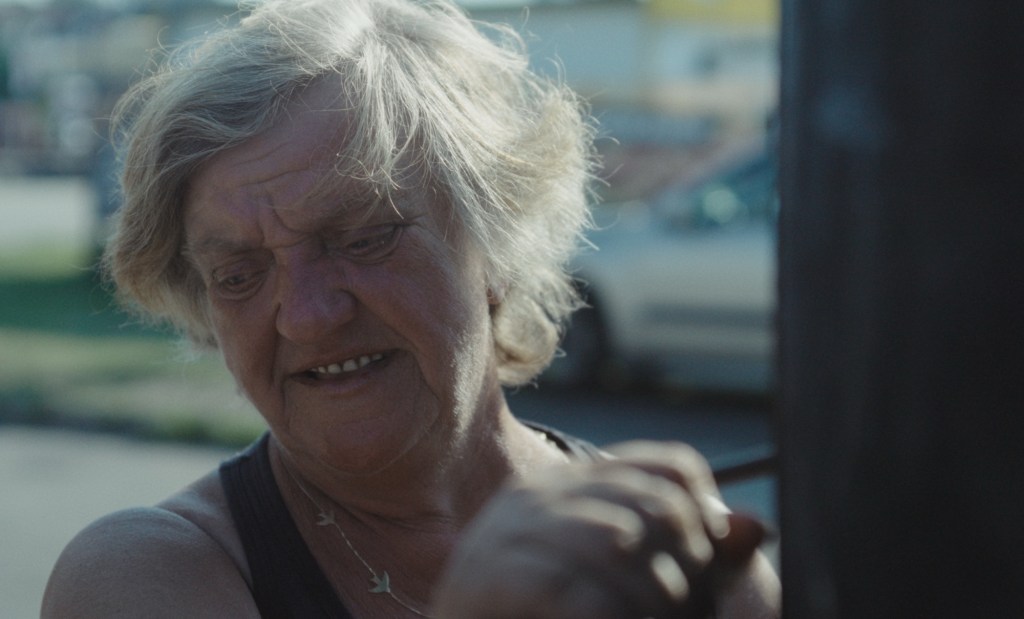
Director Iga Lis’ entertaining character study The Queen and the Smokehouse delights in the textures of Miecia’s surroundings: you can almost smell the food every time she opens the smoker door, pops and hisses accompanying plumes of smoke pouring out and swirling around Miecia’s head. Lis’ film isn’t so much rooted in the daily routine of running the business, however, although she does depict just enough to get some sense of how Miecia runs it like clockwork. She’s more interested in examining Miecia herself, who she finds at a crossroads in her life. The hustle of being an entrepreneur prevents her from spending as much time with her children and grandchildren as she’d like to, while her health takes a downward turn. At one point, Miecia speaks of her smokehouse as one might a lover, saying that they’ll remain together “til death do us part,” and it’s both a clear expression of Miecia’s devotion to her business, and a potentially literal outcome; the smoke has begun so consuming her lungs, that each day she spends at the smokehouse brings her closer to death.

That conflict doesn’t really manifest itself until late in Lis’ short feature, which doesn’t really locate its core thesis until its end: the importance of having people to live for. We get a sense of this in Miecia’s interactions with her coworkers— in their downtime, she demonstrates an interest in their lives, whether it’s relationship drama or what else they’d like to do in their future— and the customers who celebrate her presence and miss her when she takes a break to spend some time at a lavish health spa. Her family isn’t as explicitly present for much of the film, however. It’s one of a couple of topics that the movie gestures toward without fully touching, like the economic fragility of a town whose key trade really only turns a profit a few months out of the year, which Lis illustrates with artfully framed shots of the desolate amusement park. If The Queen and the Smokehouse’sinability to fully settle on an aim is somewhat frustrating, it’s buoyed by Miecia’s mere presence, her no-nonsense personality and sharp sense of humor demonstrated by the first time we see her, as she answers the phone with the name of a funeral home, quipping that they repurpose the smokehouse for cremations in the off-season. Lis balances such light-hearted moments with introspective isolated moments that tenderly convey Miecia’s private concerns, whether we watch her maneuver about the dimly-lit apartment she shares with her fluffy dog, or sitting in her room at the spa, uncertain how to utilize her new-found downtime. With her well-worn features that endearingly crease with either a smile or a scowl, cigarette perpetually in hand, she’s the sort of one-of-a-kind character who makes it simple to see why Lis spotted her in her natural habit and immediately wanted to make a film about her, and how she transformed an ordinary fair food stand into a venerable institution.
The Queen and the Smokehouse screened at the 2026 True/False Film Fest. Runtime: 65 minutes.

 Katie at the Movies