With a lucidity that’s amusingly reflected in the lyrics of the Gershwin tune that recurs over the course of its runtime— “There’s a saying old, says that love is blind”— writer and director Amanda Kramer tackles the absurdity and tragedy of objectification in her latest feature film, By Design, the way that only a filmmaker with as much quirky sensibility and bold style could: by nudging her protagonist toward becoming a literal object.
That protagonist is Camille (Juliette Lewis), whose listlessness toward her current state of being is apparent in the initially presented tableau, accompanied by Melanie Griffith’s softly-delivered, conversational narration. Camille sits largely ignored between her two friends, Lisa and Irene (Samantha Mathis and Robin Tunney), absently listening to their shallow chatter. Every week, they meet for lunch, and every week, they follow up lunch with a shopping excursion, but they never buy— no, never. So when they wander into a furniture store, chairs in all shapes and sizes and colors, some with cushions, some without, some austere, some comfy, scattered across the minimalist space, and Camille voices that she’d like to buy a seat that catches her eye— a sleek, wooden, Mid-Century affair— they voice shock and confusion, albeit in a muted, droll tone that’s accentuated with their flamboyant, pseudo-vintage style. This extends to the simultaneously clipped and breathless exchange between Camille and a disinterested clerk as she attempts to determine if she can afford to purchase the chair.
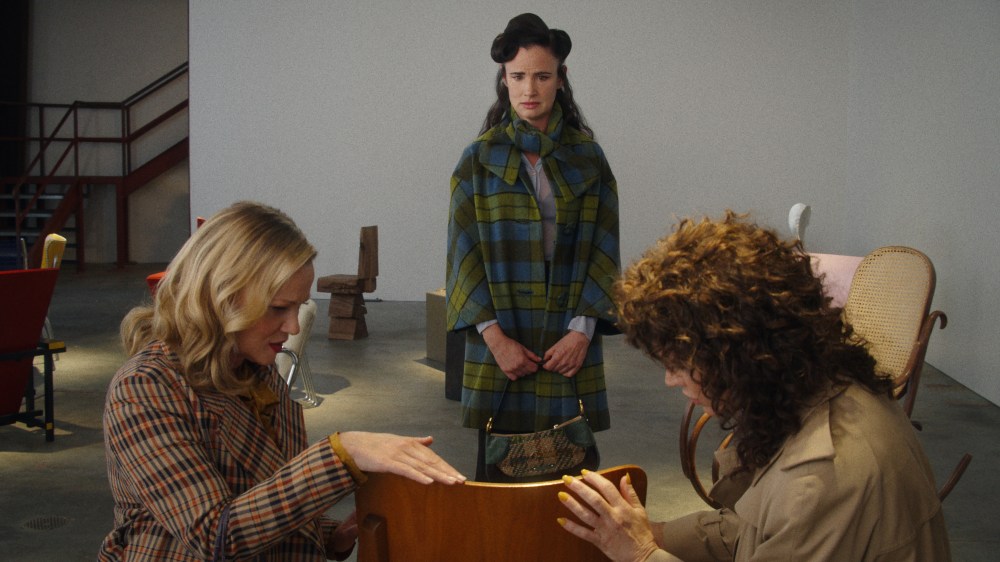
Courtesy of Music Box Films.
The theatricality of Kramer’s work is so clear from these opening minutes— the overly designed sets and costumes, the arch performances, the stark lighting— that it comes as little surprise when Camille’s yearning for the chair culminates in her swapping bodies with the furniture, her consciousness becoming acutely aware of every touch on her arm, and the weight of every body that sits on her, while her human body lays mute and immovable. But— as Griffith’s narration clearly dictates— Camille doesn’t merely covet the chair as a thing she would like to own. She’s envious of the affection others bestow on the object, where beauty meets utility, affection that she has never experienced. As Griffith amusingly states, “Who needs or appreciates Camille as much as they do a chair?”
As By Design stretches its ridiculous premise rather thin even at 90 minutes, it becomes less a character study of Camille (Lewis, who so ably imbues Camille with twitchy insecurity at the start, spends the bulk of the film lying dead-eyed and limp) than that of the people surrounding her, but it’s no less insightful for it. Camille’s friends and her shoe addict mother (Betty Buckley, turning in an immensely engrossing performance in one extended scene in which she essentially plays opposite no one) open up to her more when she is possessed by the consciousness of an inanimate object, speaking vulnerably about their doubts and desires with a sincerity that’s nothing akin to the flippancy they exhibited at the film’s start. Meanwhile, Camille’s chair form is taken possession of by Olivier (Mamoudou Athie), a performer whose partner Marta (Alisa Torres) recently broke up with him, leaving the chair as a parting gift. Olivier— who Athie, with his velvet-smooth vocals, imbues with both warmth and drama— becomes enamored with the chair (he, and others, have an acute sense of Camille’s presence in its structure, even if they don’t understand how or why) and Camille with him. Desires are not only heightened post-transposition, but characters feel more confident in acting upon them, a cleverly-executed if rather blunt examination of projection, objectification, and possession that’s carried throughout the entire cast, which also includes character actor Clifton Collins Jr. as Camille’s perverse neighbor and Udo Kier as the chair’s designer.
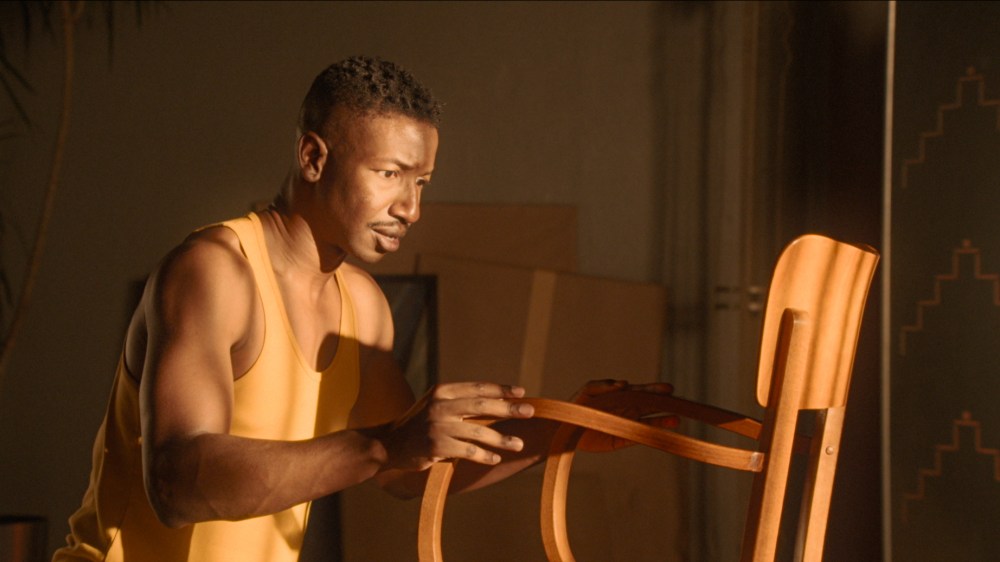
Kramer smartly embraces the avant-garde as a method of injecting movement into a story in which the two main characters mostly remain static. Dance is an integral piece of the film, just as it was in Kramer’s previous feature, Please Baby Please, serving as both a celebration of the body and a physical manifestation of the characters’ erotism (there’s a lot of loving stroking of that chair, which is cheekily given its own credit in the movie). The melding of Camille and chair is made even sharper by Benjamin Shearn’s effective editing, which flashes between the two as they assume various positions. Trapped in a chair, Camille seems to be almost more aware of her wants and needs when stripped of her corporeal form. While By Design’s deadpan tone winks at the audience to not take all this too seriously, it’s far too rooted in real-world concerns about identity and the body to not pack an introspective punch that’s as unsettling as an uncomfortable seat.
By Design opens in theaters on February 13. Runtime: 92 minutes. Not rated.

 Katie at the Movies