A few weeks ago, while rummaging around a cabinet in my office in search of a notepad with some blank pages that I could bring with me to the theater, I stumbled across a morbid little artifact: a thick notebook with gilt-edged pages and a soft, textured pink cover held in place by a metal clasp. Flipping through the mostly still-empty pages, it quickly became obvious that I hadn’t written in this book since college, my scribbles from over a decade ago alternating between two disparate tasks: a food and anxiety log that was homework from my therapist (an exercise that was as short-lived as my relationship with said person), and a list of all the movies I’d seen over that time span, a remnant of the physical diaries I’d keep pre-Letterboxd. A normal person would likely find that rather sad, but I couldn’t help but laugh at how absurdly me this thing I’d completely forgotten even existed was (“here’s how much I wanted to kill myself today, and here’s all the movies I watched”).
Something about the way Eva Victor employs biting humor throughout Sorry, Baby brought this incident to my mind again. In their formidable feature film debut, writer and director Victor zags between impossibly heavy emotions with a light touch that never renders them as inconsequential, even when the characters’ snappy banter occasionally strains credulity. Sorry, Baby is a film that’s characterized by stillness. Victor and cinematographer Mia Cioffi Henry craft carefully composed tableaus that thrust their characters and their actions to the forefront. A peaceful, almost painterly long shot of a house in the rural New England college town where the story is set subtly but clearly conveys that something horrible must be occurring within its walls; as the hazy afternoon sun disappears farther down the horizon with each subsequent shot, time feels interminable, and its weight— and the anxiety over what the outcome of this will be— is tangible. Soon after, when Sorry, Baby’s protagonist Agnes (played by Victor) recounts what happened to her (referred to throughout the film as “the bad thing”), the camera remains close on her face, with minimal cuts. Now, we’re made to confront this bad thing again, but in more explicit detail, even though we never see it. We don’t need to.
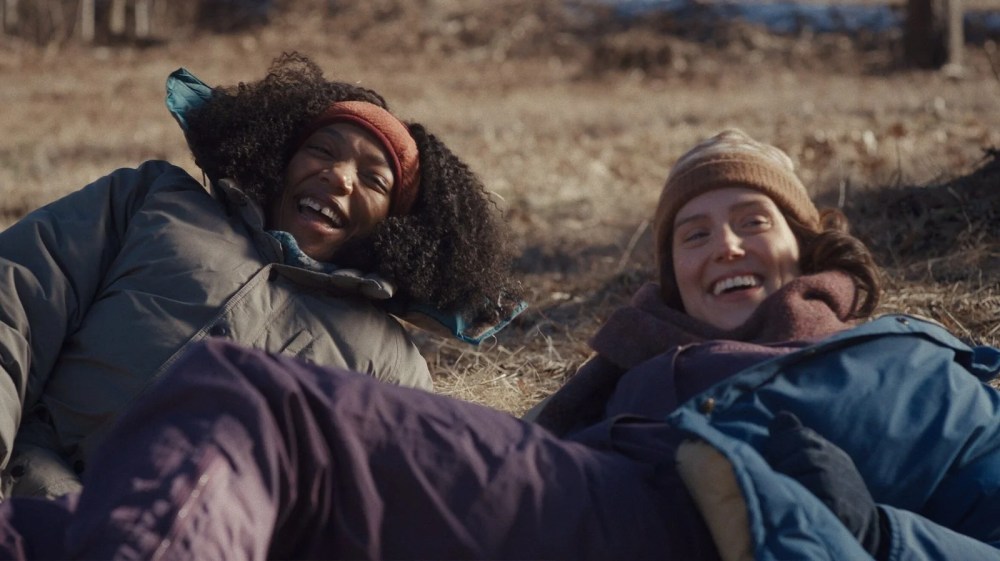
Sorry, Baby tackles a myriad bunch of topics, some directly tied to the bad thing, others not, but it does so through the piercing honesty of its characters’ words and interactions. The comedy/drama begins years after that aforementioned incident, when Agnes— now a literature professor at the college she used to attend, the film’s thoughtful production design and recurring use of the book Lolita carefully pointing to its major incident— is visited by her best friend and former roommate Lydie (Naomi Ackie) for the weekend. Their performances possess such a natural quality, it’s not difficult to believe that they have been friends their whole lives (something beyond friendship, really) as they laze on opposite ends of the couch, blanket draped across their legs, giggling and gossiping about frothy topics like sex, but also the different directions their lives have gone in. Lydie is now married (to a woman who, we later see, bears a remarkably similar physicality to Agnes), lives in New York City, and— as she soon reveals to Agnes— is expecting a child. Agnes lives with her cat, in the same home she inhabited while in college; she’s sleeping with her neighbor, Gavin (a perfectly awkward Lucas Hedges), but it’s far from serious. It isn’t until a reunion dinner with their college colleagues triggers Agnes’ memories of the bad thing that the story jumps back in time and begins to fill in the blanks.
Not all of the blanks, however, and that’s key. It’s in the pauses and looks that exist in the margins of action where Sorry, Baby is its most piercing. Agnes’ identification as non-binary crops up once, as she pauses over the gender question when filling out a form at jury duty; she ultimately makes her own answer, filling in the “female” bubble, making a third bubble between “female” and “male,” and sketching arrows between them. The shift in their relationship when Lydie’s baby comes is all-too recognizable to those that have watched their friends move to exciting new places and get married and have children: that feeling that life has left you behind. But then there’s the frustration when an off-handed remark Gavin makes regarding changing minds about having children clearly rubs Agnes the wrong way. And when Lydie, just prior to leaving Agnes after that trip in the first act, expresses concern over her being by herself, Agnes responds with, “I’m not going to kill myself,” and we instantly understand how she’s struggled without needing to see it.
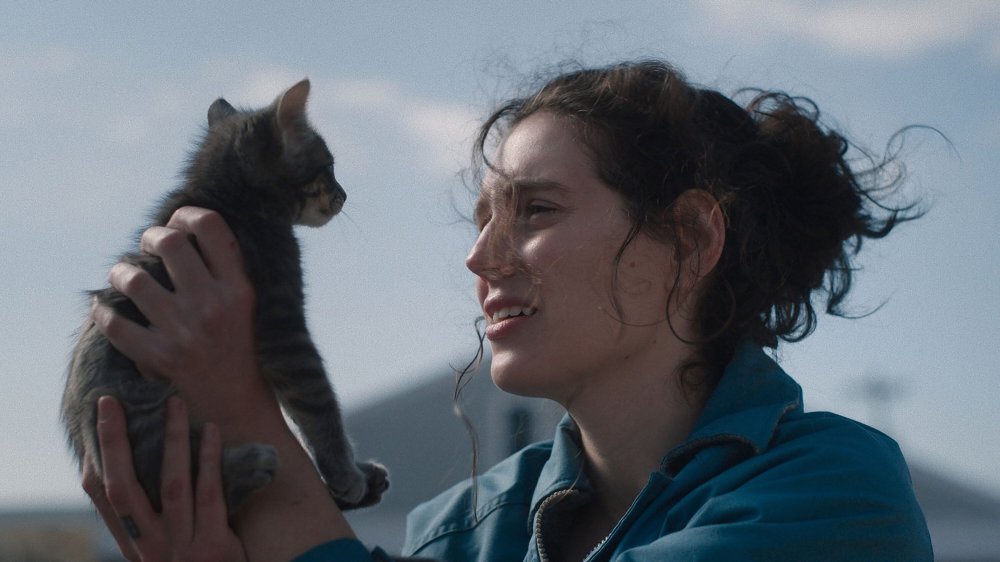
On paper, all this makes Sorry, Baby sound like a film that wallows in misery. It’s sense of humor somewhat tempers it, but it is devastating, particularly in its acute understanding and recognition of the evil that men granted with the tiniest morsel of power are capable of. But it’s punctuated by many lovely little grace notes that are nothing less than optimistic. On a low note during the aftermath of the bad thing, Agnes picks up a little gray cat in the street; “I guess I love you” she bemoans, before sneaking the kitty into the grocery store under her jacket to buy cat food. Years later, she has a panic attack while driving, and pulls over; a shop owner (John Carroll Lynch, a real one-scene wonder) approaches her car to tell her she can’t park there, only to offer her kindness (and a really good sandwich) immediately upon noticing her heavy breathing. But the point that Sorry, Baby makes the best— the point that you may say is its thesis statement— is that it’s possible to be living your best and worst life at the same time. It’s an acknowledgment that Agnes makes in the film’s final scene, a moment that dances dangerously close to reading as trite, but whose emotional honesty wins out in the end. It’s something that we also see when Agnes is awarded a full-time teaching position at the college, a rare feat for someone so young, but one that raises the ire of her colleague and former fellow grad student Natasha (a hilarious Kelly McCormack), who naively laments the fact that everything seems to come to her so easily. It’s also accompanied by her being given the office of her one-time mentor and attacker, the fulfillment of one of her greatest dreams walking hand-in-hand with the perpetuation of her worst nightmare.
In approximately eight days, I am scheduled to board a plane to Italy, a country I have never visited and whose language I do not speak, because for some reason this blog that I started nearly 10 years ago in a hotel room on a layover for my day job because I desperately wanted a place to put my writing after the website I had written for for seven years folded not thinking anyone else would ever bother reading it has been deemed worthy of receiving press accreditation to cover the Venice Film Festival, one of the most prestigious gatherings of cinephilia in the world. I have never been more miserable in my life. But I will go, because some part of me knows that had this happened to me a mere couple years ago, I would have been elated beyond belief, and that 15 years ago, it was an impossible dream for that girl who jotted down lists of movie titles in a pink notebook, and I will try to remember, as Victor puts forth with such disarming sincerity in their movie, that life is bad a lot of the time, but not all of the time.
Sorry, Baby is now playing in theaters, and is available to rent on digital platforms. Runtime: 103 minutes. Rated R.

 Katie at the Movies