Zsa-Zsa Korda ought to be dead. He’s lying face-down in a cornfield, his limbs splayed at odd angles, some feet away from where the wreckage of the plane he was flying in before it began to crumple in mid-air smolders. The remnants of his belongings are similarly scattered about, licked by flames. They’re odd items, like a collection of pornographic books with titles like “Erotic Etchings” and “Peep Shows of the Roman Empire,” and a fruit crate that actually houses rows of hand grenades. And yet, they serve as the perfect encapsulation of Korda, who— despite reports to the contrary— actually is not dead, and eventually rises and stumbles out from the corn stalks with a bloody and bruised face, clutching some unnamed (assumedly not vital) organ that’s popped out of his stomach. He’s cooly resilient, a man who values education as much as self-defense, all traits that are integral to his status as an industrialist and arms dealer whose ability to intercede in almost any large global deal earned him the nickname “Mr. Five-Per-Cent.” It’s also earned him a host of powerful enemies— this plane explosion is the umpteenth assassination attempt made on his person.
And yet, while the plane crash itself is rendered in shades of Looney Tunes— when the side of the plane is ripped asunder, the top half of Korda’s poor unnamed administrative assistant sitting nearby vanishes with a poof, leaving only his legs and a blood-splattered wall behind, while Korda’s pilot rockets out of sight in an ejector seat at the first sign that they’re going down— it shakes something in Korda. An awareness of his own mortality, or a burgeoning realization of important things he’s missed out on, perhaps, prompts him to summon his only daughter, Liesel, to his estate as soon as he has sufficiently recovered, to take over his affairs on a trial basis. No matter that they haven’t seen each other in six years, or that he has nine sons (some adopted, just in case one of them turns out to be the next Einstein) he could bequeath everything to instead, or that Liesel couldn’t be more opposed to Korda and all he stands for— she’s a nun preparing to take her vows, her piety constantly rubbing up against Korda’s mercenary nature (his use of slave labor in his schemes, for one, or the fact that he’s had many people killed on his behalf).
Wes Anderson is no stranger to avaricious protagonists, or strained familial relationships. He’s crossed that terrain time and time again, from Rushmore to The Royal Tenenbaums to his 2023 masterpiece Asteroid City. In the writer and director’s latest film, The Phoenician Scheme, those themes appear in the guise of an espionage thriller. In taking over the family business, Liesel (Mia Threapleton) inherits an assortment of neatly ordered shoe boxes containing Korda’s (Benicio del Toro) plans for an immense overhaul of Phoenicia’s infrastructure. That scheme is effectively shaken when a consortium led by a government agent known only as Excalibur (Rupert Friend) fixes the price of necessary core materials, prompting Korda— with Liesel in tow— to embark on a globe-trotting mission meeting with his network of investors to try to convince them to help cover the funding deficit he refers to as The Gap. They’re joined by Bjørn (Michael Cera), the awkward Norwegian entomologist Korda hired to both tutor him in his latest interest (bugs) and serve in the apparently dangerous role as his new administrative assistant.

That network consists of a passel of Anderson staples and newcomers. Tom Hanks and Bryan Cranston are Leland and Reagan, brothers, business associates, and, seemingly basketball prodigies— they hilariously challenge Kora and Prince Farouk (Riz Ahmed), the heir to the country of Phoenicia, to a game of H-O-R-S-E to determine who covers a percentage of The Gap. Mathieu Amalric plays Marseille Bob, the owner of a nightclub that appears straight out of Casablanca, and Jeffrey Wright plays Marty, the captain of a ship— both investors in Korda’s scheme. Scarlett Johansson appears as Korda’s cousin Hilda (and prospective fourth wife), while Benedict Cumberbatch is Uncle Nubar, Korda’s intense facial-haired half-brother who might have murdered Liesel’s mother, and might actually be her father, a question mark that hangs over the film, and Liesel especially. If all the business talk that spills out of these characters seems overly convoluted, that’s because it is, and not in the way that Asteroid City was, where the constant traveling between narrative levels becomes more meaningful with each subsequent rewatch. Despite Anderson’s inclusion of cheeky title cards tracking each investor’s confirmed percentage of The Gap, or the occasional peeks at the scheme’s ongoing construction— a half-completed railroad here, a dam there— the mechanics of all that ultimately isn’t that important. Rather, it’s the encounters that the scheme prompts that are (to the point where all the business talk starts to get in its own way). While every chapter contains Anderson’s requisite deadpan humor and ordered compositions, he pulls quietly moving moments from the dissonance between the inscrutable personas of his characters and their plain-spoken dialogue that belies an emotional honesty. A revelation during the basketball game prompts him to grant Farouk the chance for glory (even though the prince has never touched a basketball before in his life). He takes a bullet for Marseille Bob, and when he faints as a result later on, Marty gives him a blood transfusion, no question— despite their ongoing arguments about their agreements. It isn’t Korda’s business sense that gets him through each encounter, but the human connection that binds them all together on a deeper level.
Of course, it could also just be due to Korda’s long-suppressed humanity gradually creeping up on him, ever since that plane crash sent him briefly into the afterlife. He continues to have visions of the place following every assassination attempt he survives throughout The Phoenician Scheme, fascinating sequences that Anderson renders in black-and-white, a stark visual contrast to the warm pastel hues that dominate the rest of the film. There, he comes into contact with both Biblical figures (featuring cameos by some Anderson regulars that I wouldn’t dream of spoiling) and figures from his past, as the virtue of his life and work is weighed (basically, he’s got a lot to make up for). Del Toro, who previously appeared briefly in a segment of Anderson’s 2021 anthology film The French Dispatch, cracks just enough at just the right moments, allowing Korda’s vulnerabilities and, ultimately, selflessness, to seep through his otherwise unflappable demeanor. But this is also a deeply goofy film peppered with fast and furious visual gags, and he strikes the right comic tone as well, as when— in perhaps the most hysterical line reading of any movie so far this year— bursts out a frantic “What! What! What!” in response to Bjørn taking out a preying mantis at the dining room table. Threapleton, in her first lead role, matches his stoicism beat-for-beat. For a nun, she doesn’t appear very nun-ly— she smokes a corncob pipe, wears bright makeup, buys a knife at the airport for self-defense, and becomes increasingly easy to convince to imbibe alcohol— but she’s clearly perturbed by Korda’s actions and the mysteries of her past, and views her time with him as an opportunity to harness his vast wealth and resources for something good. The Phoenician Scheme also marks Cera’s first collaboration with Anderson, and— even though his performance briefly walks a line of almost coming off as too silly— it’s hard to imagine anyone fitting into that universe more naturally, even— or especially— after a hysterical third act reveal.
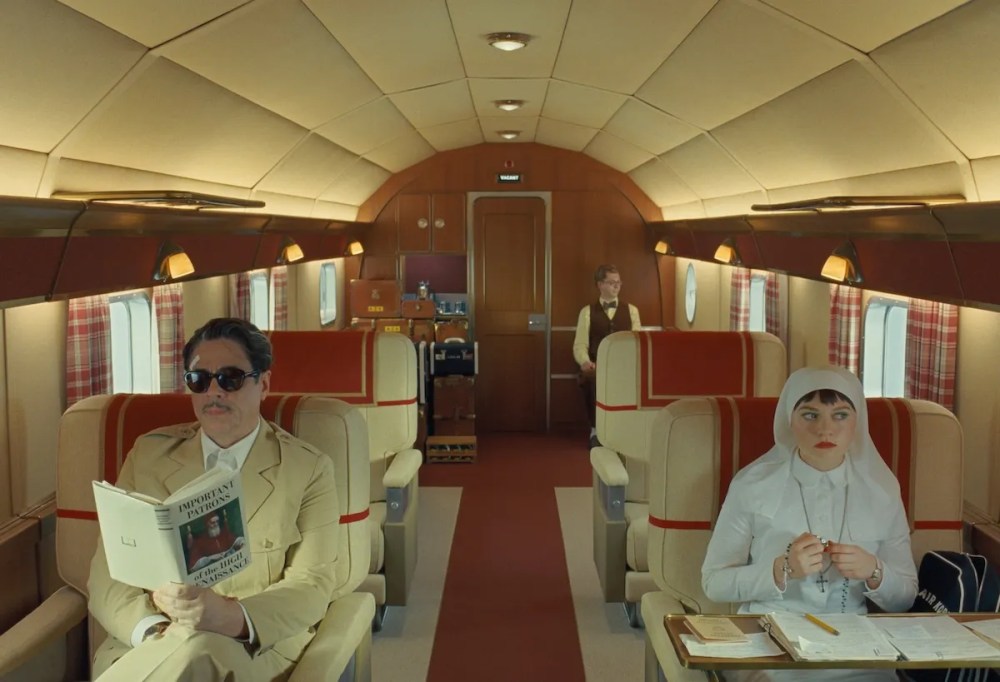
Anderson also works with a new cinematographer on The Phoenician Scheme (Bruno Delbonnel, whose frequently stylized aesthetic is right in line with Anderson’s), while Alexandre Desplat composes the score for an Anderson film for the seventh time, his thrumming music (heavy on horns and percussion) accentuating the sneaky plotting followed by bursts of action. Outside of those aforementioned afterlife sequences that find Anderson (as he has with many of his later-career films) dipping deeper into the philosophical, he doesn’t really deviate from his signature precise, retro style here (this film is likely set somewhere in the 1950s), or the frequent camera pans that allow us to take it all in. Nor does he deviate from an ultimate reconciliation between father and child. While Korda and Liesel may lack the more accessible tenderness of Royal and Chas Tenenbaum, the little moments where their terseness begins to crumble— even if they don’t, or can’t, or won’t, voice their feelings outright— are truly lovely: a thoughtful birthday gift that Korda gives Liesel, or his admission that he’s always tracked her progress (more like spying, in Liesel’s eyes, but still), or his assertion that she is his daughter, whether by blood or not. Solving those little mysteries like Liesel’s paternity or what really happened to her mother are ultimately as inconsequential as the Phoenician Scheme’s fine print. It may be easy to read this skimming of such plot minutiae as slight. And it wouldn’t be the first time that Anderson’s filmmaking style has been prized over his narrative structures. But it’s no accident that— in a film that ultimately reveals itself to be about the legacies one leaves behind— the most important shoebox Korda owns contains family photos and items of a personal nature, or that the film’s final scene is one of intimate simplicity, where a quiet, unassuming life spent with loved ones feels not only deserved, but necessary.
The Phoenician Scheme is now playing in theaters. Runtime: 101 minutes. Rated PG-13.

 Katie at the Movies