It’s like something out of a fairytale: the tall tower of a rustic Italian castle framed against a sunny sky. Suddenly, a chair flies out of an open window, crashing to the ground below. Other objects follow: more chairs, and other bits of furniture and knickknacks. Accented by a breezy, horn-driven score, this opening sequence immediately sets up the offbeat tone of director Peter Kerekes’ documentary Wishing on a Star, but there’s nothing strange about this practice for Luciana and her family. It’s just her way of cleaning house, making way for a fresh start.
You see, Luciana stakes her livelihood on new beginnings. She’s an astrologer, and works to make her clients’ wishes come true, but not in the expected way. Instead of studying tarot cards, she examines the cross-section of her customers’ star signs, birth date, and what exactly they desire, and sends them on a birthday trip to a specific destination where, presumably, their dream will come true. The location of the trip could be anywhere in the world: Brazil or Taiwan, Beirut, Lebanon or Anchorage, Alaska.
Most of her clients desire the usual things— love, for starters (the importance of which is indicated by the film’s English subtitles, which capitalize the phrase “True Love”). “I wish not to feel emptiness anymore,” says another. But for the five individuals Kerekes chooses to focus on, what they want and how they are going to achieve it is a little more complicated. A pair of identical twins with opposite personalities, Adriana and Giuliana, come to Luciana because one wants to raise a childhood, but wants the other to fall in love and actually bear the child for her. A middle-aged undertaker, Giovanni, comes to Luciana looking for love so he can settle down and start a family, but it’s unclear if he wants this more for himself or more to appease his overbearing mother. A mother of two comes to Luciana wishing to rekindle her romance with her cold, butcher husband. And two other women are sent to two extremes of the world to repair fractured familial relationships: a younger woman to Taipei (where she must settle for noodles instead of birthday cake) an older one to Barbados (where she embarks on a freeing swim in the ocean, only to be scooped up by police for trespassing).
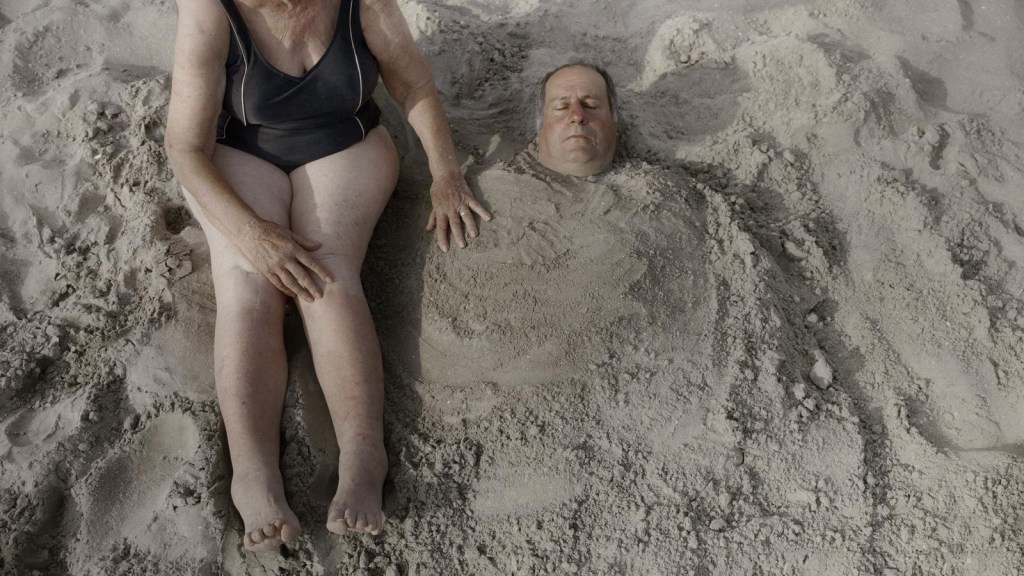
The bulk of the pleasure in watching these various stories unfold is the witnessing the turns each character’s journey takes after they venture outside of Luciana’s office. While hiring a group of female undertakers to look after his practice while he takes his birthday trip to Brazil, Giovanni strikes up a relationship with one of the women. The mother, meanwhile, is unable to make the trip to Alaska, so she ropes her young children into recreating the experience at home: decorating the living room with an enormous stuffed polar bear, huddling in tents while nature sounds hum from a nearby speaker, and sitting bundled in coats and hats while plunging their bare feet in bowls of ice cubes while a fan whips the cool air around. Sure, a many of these scenes are obviously staged for the camera, and there’s something almost annoying rote about the stifling mother/son relationship, but there’s a peculiar charm and artfulness to how Kerekes frames these shots that lends the proceedings a comic tone that borders on gallows humor (tidy coffins stacked against an office wall as Giovanni sits on one side, questioning the qualifications of the group of women situated across from him).
Wishing on a Star’s loosely episodic structure does somewhat work against it, not because we don’t reach a tidy, finite conclusion for all of these stories, but because some of the ones presented earlier in the film just sort of trickle away by its finale. When we do get a sort of closing word on these trips, however, it’s most interesting to see how the clients ended up learning something about themselves, or making peace with the issue at hand, in a way that they weren’t really anticipating. This carries over to Luciana herself, who Kerekes frames as a bit of an eccentric (she works out on her treadmill in high-heeled boots), and it’s fitting that the film ends with her. Through her grown daughter’s bemused recreation of her mother’s interview style, we learn that past-middle-age Luciana would like to move back to Naples, where she’s from, but life and work have always pushed that dream to the side. I’ve never been much of a believer in astrology myself, but there have been times when circumstances have pressed me to reconsider the validity of the practice. A few weeks ago, I went for a run in my local park, and was briefly accosted by a middle-aged woman who wanted to point out the age of the park’s historic pavilions, which date back to Victorian times. She also wanted to comment on the pretty color of my pink jacket, inquire as to where there might be a reliable tire shop nearby, and tell me about navigating living in a studio apartment with an out-of-town friend who was currently staying with her— in other words, by “briefly” I mean that I was probably conversing with this lady for at least 20 minutes. But when she asked me my star sign (libra, if anyone cares), she said that in conjunction with hers, that had some significance, and perhaps we ran into each other for a reason. I’m not sure I still buy the science behind all that (I don’t think Kerekes does either, which contributes to his film’s wryly detached perspective that centers more on people and what drives their desires than on horoscopes), but I do like to think that people and places enter our lives for a reason. Call it destiny, call it fate, but there’s something sweetly optimistic about how Wishing on a Star pushes us to take a more active role in making our dreams come true beyond mere stargazing.
Wishing on a Star screened at the 2025 True/False Film Festival. Runtime: 99 minutes.


