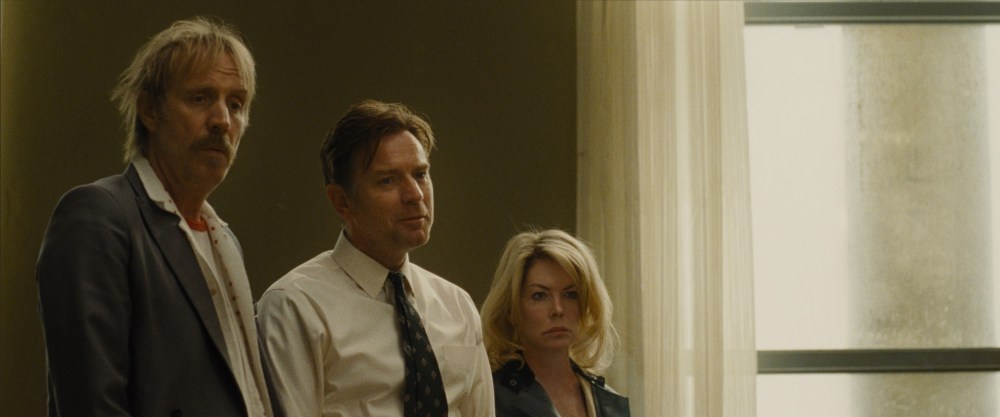
It only takes a few minutes for Swedish writer and director Niclas Larsson’s feature directorial debut, Mother, Couch, to start to feel as tired as an old sofa. It’s a shame, because the story’s absurd premise on paper sounds ripe for comedy, drama, and moments of surrealism: an elderly matriarch (named only as Mother, and played by Ellen Burstyn) visits a furniture store, sits down on one of the display couches, and refuses to leave. She’s already perched there when the film opens on one of her sons, David (Ewan McGregor), rushing across the parking lot toward the store. It’s a shambling sort of place, a vast assemblage of neat displays that could easily be mistaken for rooms in an actual house alternated with cluttered spaces stacked high with lamps, furniture, and other assorted home goods looked after by a perky clerk (Taylor Russell) and twin owners of vastly different demeanors (Marcus and Marco, played by the great F. Murray Abraham). David is soon reunited with his estranged siblings, Gruffudd (Rhys Ifans) and Linda (Lara Flynn Boyle), his efforts to figure out what is going on with his mom interfering with his already fraught home life (his wife, Anne, played by Lake Bell, is at her wit’s end, as David first misses their daughter’s birthday party, and later neglects her in other ways) and prompting family secrets to gradually unspool.
Larsson very loosely adapted Jerker Virdborg’s book Mamma I Soffa as the basis for Mother, Couch, but Virdborg granting him free reign with the material did anything but result in a cohesive, thought-provoking film. At least, it isn’t as thoughtful as it appears to think it is. So much of the dialogue is painfully obvious— Burstyn in particular grouchily delivers a couple monologues about the hardships of being a woman and a mother abused at the hands of cruel men— and delivered in a gratingly pretentious black comic tone suggestive of a much funnier and quirkier film. It’s reaching for something like Buñuel, and the vibes are certainly there (especially as it becomes increasingly apparent that these disparate individuals are being repeatedly thrown together in situations that become increasingly absurd and spiral out-of-hand), but for a long stretch, it’s unclear what Larsson is trying to say with all of this. He’s pondering unreconciled family differences— based on his lack of knowledge about their lives, David doesn’t have much of any relationship with his siblings, who are soon revealed to all have different fathers, and his heated exchanges with Mother imply parental disappointments that have up to now remained unresolved— but he circles those topics without fully embracing the heart of them. The film finally stops spinning its wheels (it drags for so much longer than its 96 minute runtime would indicate) as it approaches its climax, but everything comes together a little too late, the emotional moments overwhelmed by giant bursts of surrealism that feel out of step with what preceded them.

Unfortunately, the stacked ensemble cast can do little to save this material. McGregor is a good lead, but a lot of the time, his performance is too histrionic to register as genuine. It’s a stylish film, with great environments and mind-bending scenarios that recall recent works from filmmakers like Ari Aster, but while Larsson’s technical craft is evidently refined, his story, which leans heavily on obvious metaphors (like the couch as both a source of comfort and a burden), needs a fair amount of retooling.
Mother, Couch is now playing in select theaters nationwide, and screening locally at the Hi-Pointe Theatre in St. Louis. Runtime: 96 minutes.


I found the movie Mother Couch thought provoking. It grappled with eternal questions of the relationship between mothers and their children – when pregnancy and birth often take place within the context of an imperfect world and real people who bring up children within circumstances most often not of their choosing. I wouldn’t describe the movie as a comedy it deals with these questions in an absurd but I think clever way. It may be that the son was too overwrought but this could be the product of a son who is striving to answer his own questions as to how and why of his emotional bewilderment.
LikeLike