KiKi Layne is a star, and that’s no more apparent than when she’s playing a person struggling so hard to become one. In writer and director Nicole Riegel’s second feature, Dandelion, it’s a bit too on-the-nose that Layne’s titular character, a struggling singer/songwriter, is named for the perennial that is famed for its ability to grow and thrive anywhere, even under the harshest of conditions. But that doesn’t mean that Riegel’s film as a whole is a cliched music drama— quite the contrary, as this character study fast proves to be intensely interested in delving into the nitty-gritty of the creative process, with sophisticated craft in the filmmaking to match it.
Within the first few minutes of the film, it’s clear that Dandelion— with her soulful voice and guitar-playing skills to match it— is greatly talented, and greatly struggling. She let go of an opportunity to open for a band that was going on tour to care for her sick mother, Jean (Melanie Nicholls-King). So while all her colleagues have gone on to have successful music careers, she’s still stuck in her home in Cincinnati, playing nightly at a bar to patrons who talk over or outright ignore her, and going home to a parent who nags her about the practicality of her ambitions. Fed up, Dandelion decides to take a chance on a contest held during a motorcycle rally in a South Dakota town. She decidedly does not fit in with that rough crowd (when she goes up on stage, she’s booed while one man yells at her to take her top off, while her portrayal as being sidelined by predominately white audiences can be seen as a subtle commentary on the extra invisibility faced by Black artists), but she does connect with another concert participant, Casey (Thomas Doherty), a guitarist who gave up on his dreams of making it long ago. While hanging out with Casey and the group of misfit musicians he tours around with, Dandelion starts to fall in love with him— but more importantly, with making music again.
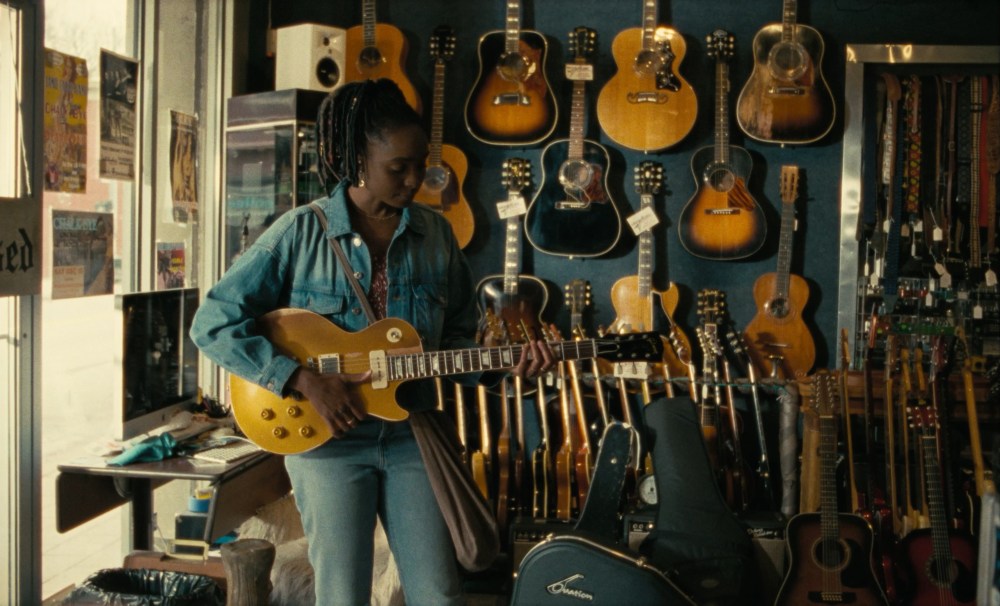
Riegel has stated that her impetus for making Dandelion involved her desire to tell a story about the artistic process and the obstacles that women in particular face in an industry that celebrates creative men while writing off those same qualities in a woman, filtering her own experiences in independent filmmaking through that of a musician. There are certainly some predictable beats that Dandelion hits— Casey possessing some secrets that he doesn’t reveal to Dandelion, for one— but in just about every instance where the film could have turned down a trope-ridden road, it ventures down another path instead. This is where Riegel’s personal experiences and unique voice most clearly shines through the characters. Layne and Doherty’s chemistry feels very charming, and very real. That there’s an almost instant attraction between the pair is undeniable, and Riegel enhances this in the way she shoots them, especially after their initial coupling: tight close-ups on their bodies meshed together, hands entwined.
But Dandelion isn’t really about this romance, and Casey as a character— appropriately, in this instance— is a little more thinly sketched, a bit more of an afterthought. Dandelion is, rather, about what this new relationship prompts Dandelion to discover about herself. The film spends a lot of time with her, both alone and with Casey, riffing, trying out lyrics and melodies. Sometimes they don’t work— and then suddenly, they do, all the right ingredients for the right song (not just a good song, but a good song for Dandelion) fall into place, and the rush of creative adrenaline is palpable. Again, the almost lyrical style of Riegel’s filmmaking, which often opts for montages that consist of snippets of dialogue and textured, sensory images (their bodies, and their natural surroundings) over straightforward conversations, enhances what is unfolding onscreen, causing the film to take on the rhyme and rhythm of a song.

Dandelion benefits further from the regional specificity of its setting (Riegel is from Ohio) and the authentic way cinematographer Lauren Guiteras captures it (contrasting the sterile bar Dandelion sings at with the warm, homey glow of the campfire where she shoots the breeze with other musicians like her), and a great original soundtrack that features songs by Bryce and Aaron Dessner. But the film is especially elevated thanks to the presence of Layne, for whom good roles have come less often than not since her knockout debut in Barry Jenkins’ 2018 feature If Beale Street Could Talk. She’s electric, particularly in her ability to believably articulate so many roiling emotions in one person at once: sorrow, love, anger, excitement. That she serves as an executive producer on the film, in addition to cowriting a few of the songs, further demonstrates her commitment to the character and the story, but you don’t need to know that to understand that she, like Dandelion, was born to do this.
Dandelion opens in theaters nationwide and locally in St. Louis at Ronnies 20 and the St. Charles 18 Cinemas on July 12. Runtime: 113 minutes. Rated R.

 Katie at the Movies
Ooohh, I just got the screener for this one and I’m even more excited to watch it now after reading your review. “…this character study fast proves to be intensely interested in delving into the nitty-gritty of the creative process” – this sounds very promising indeed!
LikeLiked by 1 person
Absolutely loved the movie!!!!!!!
LikeLike