In 1994, Kevin Smith’s black-and-white, low-budget comedy Clerks took the indie film world by storm, first at its Sundance premiere (which it entered with virtually no buzz), then critics and audiences, cracking many end-of-the-year lists. Smith’s 1995 follow-up Mallrats was less well-received. But it’s Smith’s third film set in the same universe, the 1997 romantic comedy Chasing Amy, that perhaps possesses the most intriguing legacy. The film centers around a comic book artist, Holden (played by Ben Affleck), who hits it off with a fellow comic creator he meets at a convention, Alyssa (Joey Lauren Adams), only to discover that she’s a lesbian— but that little fact doesn’t deter him from trying to win her over. Chasing Amy has been praised in some circles for its queer representation, especially when it comes to Alyssa’s fluidity, and denounced in others for its story that’s filtered through a straight white man’s lens, which could be read as endorsing the idea that all a queer woman needs is the right man to set her straight.
Chasing Amy did resonate, however, with Sav Rodgers, whose life changed (and was in fact saved) when he watched it for the first time at 12 years old as a closeted queer Kansas teen lacking the language to express his identity. Rodgers watched and rewatched Chasing Amy obsessively, in fact, at one point at least once a day. As Rodgers quipped in a TED Talk on the ways the movie shaped him as a adult, “To be fair, I didn’t know there were other queer movies.” But it’s that TED Talk that went viral, ultimately capturing the attention of Kevin Smith himself. And now, Rodgers is the director of his own film: the documentary Chasing Chasing Amy.
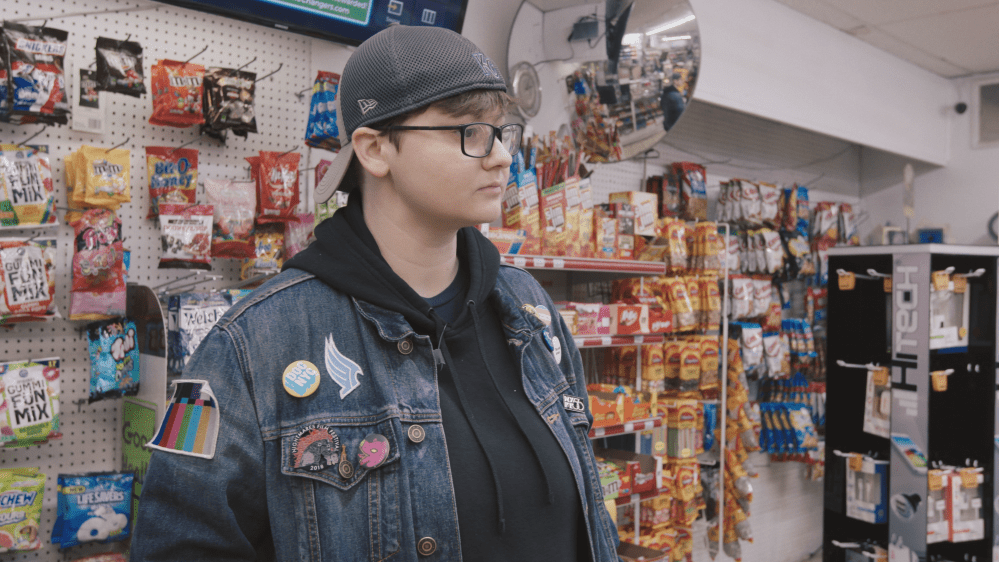
At the start of Chasing Chasing Amy, Rodgers lays out his thesis statement for his movie: to excavate this film he loves’ polarizing reputation among the queer community. At first, it appears like just another talking heads documentary; among the subjects Rodgers interviews are critics, folks who worked on the film, and others close to it, such as Guinevere Turner, the writer and star of another black-and-white, 1994 Sundance premiering indie movie, Go Fish, a drama steeped in lesbian culture. Go Fish hasn’t remained as prominent in the cultural zeitgeist as Clerks, but Turner and director Rose Troche did befriend Smith and his producer Scott Mosier, with Mosier and Turner’s close relationship serving as the basis as the one Smith wrote for Holden and Alyssa, while drawing on his own relationship with star Adams— who he was dating at the time—for Holden’s extreme reaction to what he learns about Alyssa’s past sexual encounters. And there’s a playful sequence in which Rodgers recreates a montage from Chasing Amy, visiting the movie’s Jersey filming locations with all the awe of a true fan, while transition points are marked by comic book style illustrations.
But Chasing Chasing Amy fast morphs into something other than a history and critical analysis of the movie that spurred the project in the first place. It’s a document of self-discovery for Rodgers, one that is rooted in Chasing Amy even when that film’s presence seems to somewhat shift just out of the documentary’s focus. Over the course of the making the movie, Rodgers becomes engaged and later married to his longtime girlfriend Riley. The strength of their relationship and the depth of their love for each other is a pivotal piece of the film, as Riley is every bit as integral a figure in Rodgers’ identity (they’re also just a really adorable couple; I mean, they met on Tumblr). Rodgers also comes out as a transgender man during production, a piece of himself that he wasn’t sure he could reveal before he started having these conversations surrounding the movie, and his transition marks the passage of time in the film’s latter half.

Chasing Chasing Amy tackles a lot, and some of it, while essential to the film Chasing Amy itself, feels tangential to Rodgers’ journey. This includes some discussion of Smith’s regrets that so much of his professional success was due to former distributor, now convicted sex offender Harvey Weinstein picking up his movies, a fact that he cannot change no matter how much he wants to. Smith, who reached out to Rodgers after seeing his aforementioned TED Talk, actually figures quite significantly into Chasing Chasing Amy, which could have easily turned this into a less-objective documentary. But Rodgers gracefully portrays his perspective of Smith moving from hero to friend, while leaving ample room for criticism. This manifests itself most in what Rodgers considers the film’s turning point, a one-on-one interview he conducts with Chasing Amy star Joey Lauren Adams, who reveals what a horrible time her life was during the making of the movie, and how unsettling Smith’s insecurities with her past relationships was to her. His version of events— that they broke up due to the pressures of working on the movie together—may have been somewhat true, but it wasn’t her truth. It’s a powerful reclamation of history for Adams, and an eye-opening moment for Rodgers, who learns how to still love Chasing Amy, but also no longer need it the way he used to. Rodgers’ near-constant on-screen presence helps cement Chasing Chasing Amy in his personal experience, granting the film an emotional core that is sometimes tear-jerking, but ultimately hopeful, while affirming that while movies are time capsules, but they aren’t stuck in time; it’s more than possible, even crucial, to hold cinematic works in constant conversation. With his eye-opening film, he proves himself to be a competent filmmaker and heartfelt storyteller. And at a time when basic human rights are being stripped away from trans people in several conservative-leaning states across America, stories like this are more necessary than ever.
Chasing Chasing Amy had its world premiere at the 2023 Tribeca Film Festival on June 8. Runtime: 95 minutes.

 Katie at the Movies