It all started around 2010. In the aftermath of the studio’s return to animated princess stories with The Princess and the Frog and on the heels of the release of their next one, Tangled, then-Walt Disney Animation Studios chief creative officer John Lasseter stated that the storied animation house—the bulk of whose legacy rests on the shoulders of its 1937 landmark first feature Snow White and the Seven Dwarves—didn’t have any more plans for princess tales in the near future. The fear was that fairytales alienated young boys, while the young girls of the current generation reportedly thought they were “too cool” for princesses; this belief emerged in Disney’s development of Tangled, renaming the film from its original title Rapunzel and injecting the film with more action sequences and playing the presence of them—and the adventurous male lead Flynn Rider—up in the movie’s trailer. Within a few short years, Disney’s main studio began ramping up production of live-action remakes of their animated classics, and—with the #MeToo movement shaping the conversation once again—they tried, with a few exceptions, to have it both ways: cash in on the familiarity of the characters and stories (an ever-present and essential presence in Disney’s merch, theme parks, and public image), while shunning what some perceived as anti-feminist messaging (female protagonists who seemingly only long for marriage to prince) in favor of fresher, more modern takes. Even Disney’s later animated films with female leads promoted adventure and independence over romance; I vividly remember attending a panel at San Diego Comic-Con in 2016 detailing the making of Disney’s upcoming animated musical Moana, and the directors making plain—to cheers from the audience—that there would be no romance angle in the story.
The debate over the concept of the “strong female character” has gotten increasing out-of-hand over the last few years, to the point where a woman’s desire for love, marriage, or domestic life is often construed as a weakness. That’s carried over in the lot of the press surrounding Disney’s redoes of their classics, particularly their latest, The Little Mermaid. But for all of the cast and crew’s annoying posturing in interviews—asserting that, for instance, lyrics to the song “Kiss the Girl” were altered to avoid any assumption that Prince Eric was forcing himself on the story’s protagonist, the, at this moment in the narrative, voiceless Ariel—those sorts of big changes aren’t all that evident in the actual film. That’s because, as with the previous Disney live-action remakes, the endgame is not to make new art, but to bank on nostalgia for easy money. The Little Mermaid may not be nearly as dire as Jon Favreau’s shot-for-shot The Lion King remake, but it’s still a shockingly lazy piece of filmmaking that barely captures of a shadow of the magic of the 1989 animated classic, whose critical and commercial success was responsible for rejuvenating the struggling studio and ushering in a new era (dubbed the Disney Renaissance) of incredible work.

Director Rob Marshall’s The Little Mermaid is roughly 50 minutes longer than the 1989 original, and yet it’s utterly lacking in pizazz, humor, heart, and the sense of awe that made the story (based on the Hans Christian Andersen fairytale) so magical and enduring. The first act of the movie—set almost entirely in the underwater kingdom of Atlantis—is particularly dire. Mermaid princess Ariel (Halle Bailey), the youngest daughter of King Triton (Javier Bardem), expresses a curiosity about the human world above-ground that her other sisters don’t share—and that infuriates her father, who cites humans as the cause of her mother’s death. Ariel collects human artifacts she gathers from shipwrecks and from her seabird friend Scuttle (Awkwafina), hiding them in a secret grotto, and becomes even more enamored with the human world after saving Prince Eric (Jonah Hauer-King) from a shipwreck and witnessing his compassion for his shipmates.
Almost everything about this segment of the movie, which is responsible for setting up Ariel’s desires and the conflict to follow, is abhorrent. Disney has rarely succeeded in translating their 2D animated creature characters into “live-action”: aka, 3D animated characters that need to appear realistic enough to convincingly fit in to the real world environments and people who surround them, while also retaining some cartoonishness so that their personalities come through in more ways than just the voice actors. The Little Mermaid accomplishes this slightly better than some of Disney’s other remakes, such as when it came to the inanimate objects in Beauty and the Beast, or the too photo-real animals in The Lion King (which also didn’t feature any human characters for the creatures to play off of). Sebastian, the crab advisor to Triton whose reluctant responsibility to watch over Ariel is the source of the bulk of the story’s humor, is vibrantly voiced by Daveed Diggs (they couldn’t have gotten an actual Caribbean actor to voice him though?), but he emotes mostly with his eyes. Ariel’s fish friend Flounder (Jacob Tremblay) has virtually zero presence. And Awkwafina’s voice never quite vibes with Scuttle, who is too rigidly animated for a character with such a large comedic presence. With drawings and models for 3D animated movies, character designs that exaggerate aspects of the character’s physical make-up, allowing for squash and stretch that permit them to really emote, whether for dramatic or comedic effect, are possible. With a live-action/animated hybrid like The Little Mermaid, the uncanny valley that’s created is, above all else, unsettling.
But it isn’t just the character designs that don’t play well. The mermaid characters look off too, the movements of their tails, faces, and hair not really matching up in an unsettling way. None of the characters appear properly composited against their environments, contributing further to the film’s phony sheen. Many of the shots—perhaps in the pursuit of that aforementioned realism—are poorly lit and murky. My favorite example? During the pivotal “Part of Your World” number, Ariel sings in her grotto, “Look at this stuff/Isn’t it neat?” But the background around her is so dark, you can’t see any of her stuff. Furthermore, the music numbers throughout the film are poorly blocked, rather surprising considering director Marshall’s extensive history with helming movie musicals (including Chicago, Into the Woods, and, most recently for Disney, Mary Poppins Returns). Attempts to recreate nearly shot-for-shot iconic moments from the original—such as the scene during the “Part of Your World” reprise where Ariel props herself up on a rock, the waves crashing over her as she belts out the final note—ring hollow. Other numbers, like “Under the Sea,” are staged differently (and quite colorfully and fantastically rendered) but confusingly; the lyrics in the latter aren’t changed, but the “hot crustacean band” Sebastian and the other sea creatures sing about never manifests on screen.
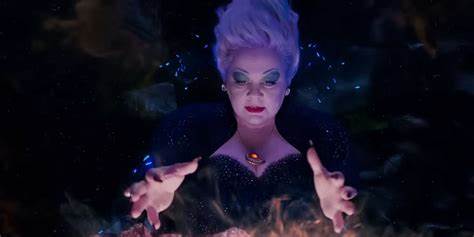
The performances across the board are flat too, but if you soldier through the opening, the film does become much more tolerable after Ariel gives up her voice to the sea witch Ursula (Melissa McCarthy in a pale imitation of Pat Carroll’s bombastic and bawdy vocal performance in the original) in exchange for legs, and the action moves out of the water and on to the shore. Alan Menken, who composed the score for the original movie alongside late lyricist Howard Ashman, is joined by Lin-Manuel Miranda for a few new tunes and some fresh lyrics to existing ones. A couple songs are cut (including the fun but tangential number “Le Poisson”), and new ones—including “Wild Uncharted Waters” for Eric and “For the First Time” for Ariel as she starts to experience the human world first hand—aren’t especially memorable tunes, while putting a finer point on the characters’ wants that frankly isn’t necessary. “The Scuttlebutt,” on the other hand, a comedic back-and-forth between Scuttle and Sebastian that utilizes Miranda’s signature raps, is borderline embarrassing. Bailey has a lovely voice, but she really proves her mettle with her facial acting in this segment, effectively conveying Ariel’s wonder at the world around her, and her developing affection for Hauer-King’s blandly handsome Eric, with who she establishes a warm and sweet chemistry. She’s the embodiment of the Disney princess, a role model for young girls who is both strong and kind.
This iteration of The Little Mermaid also imbues the narrative with some Caribbean flavor which is nice to see, particularly in a marketplace scene that’s my personal highlight of the movie. But the film never really recovers from its disastrous opening and relapses for its climax, in which Ursula—whose presence as the villain is never deeply felt, and whose machinations against Ariel are rendered unnecessarily confusing—attempts to stop Ariel from kissing Eric and regaining her voice. So, is this Little Mermaid another instance of Disney sidestepping any embarrassment over aspects of their previous films that some may view as problematic, while still cashing in on the same story? It certainly skews further from musical romance and more toward action/adventure. The small changes that were made such a big deal out of in the press don’t particularly register; it’s Disney again trying to gain points for progress and diversity with nothing to prop up those ideas with. Judging by the comments that are already floating around regarding Disney’s next live-action remake, the story of their original princess, Snow White, we’re about to go through this exact same conversation again next year. But for all their tweaking in an attempt to make certain elements bigger, fresher, and more relevant for a new generation, the filmmakers not only lose sight of what made the original movie so great, and what still makes it great today, but almost entirely misread it. Ariel falls in love, but she’s always been buoyed by curiosity about the world first and foremost. That balance has always been present, rendered even more striking by the imaginative animation, the levity of the music numbers, the yearning for something just out of reach, the terror manifested in the manipulative Ursula usurped only by the terror of being stuck living in a world you don’t feel like you belong in. In the new Little Mermaid, Ariel’s sweetness and curiosity—in large part thanks to Bailey’s performance—is still there. But the movie surrounding her is propelled not by artistry, but by a checklist of things to get through.
The Little Mermaid is now playing in theaters. Runtime: 135 minutes. Rated PG.

 Katie at the Movies
I love this review as it encompasses all problems I have with the whole Disney animated classics live action remake series.
LikeLiked by 1 person
Thanks for reading!
LikeLike
I love the animated version so much up until now, even my bath towel is The Little Mermaid!! But I can’t bring myself to watch it as I couldn’t even bear seeing the trailer. Sebastian the cartoon character is so adorable (I even had the stuffed animal as a kid) but the live-action version is scary looking. I think the only thing I liked was Melissa McCarthy as Ursula, well based on the clip I saw on YT anyway. I’ll be skipping this, maybe I’ll watch clips of it when it’s free on Disney+.
LikeLiked by 1 person
I really enjoyed reading your article, and perspective on the new Disney narrative. Love to see your writing cousin!
LikeLiked by 1 person
Thanks so much for reading it!
LikeLike