As the days wind down, fading as fast as the sun dropping below the swelling waves outside, the walls of reality cave in, flimsy as a house of cards. Fourteen days before Theranos founder Elizabeth Holmes begins an eleven-year sentence in federal prison for defrauding investors, Nathan Fielder fully moves into the San Diego beach house she shares with her partner Billy Evans and their two small children, in the hope that being more present will lend some clarity to the befuddling scenarios he and his film crew have witnessed after already closely observing the notoriously private family (it had been seven years since Holmes dipped out of the public eye) for the past 20 days. Trying to parse through an especially circuitous conversation he had with Holmes about the specific language she used in promoting her company’s supposedly revolutionary blood-testing device, and whether or not she understood how her words could be misconstrued by others, Fielder sits down and plays her a clip of comedy duo Bud Abbott and Lou Costello’s legendary “Who’s on First?” routine. The bit is a masterclass in how slippery wordplay paired with rhythmic, rapid-fire delivery leads to misunderstandings that mount with increasing hilarity, and it continues to land with viewers decades on. Fielder— whose entertainment roots are in writing and performing sketch comedy— commits his field’s cardinal sin: he explains the joke, in almost mechanical detail. But it turns out, he needed to. Holmes, while claiming she found the routine funny, didn’t get it. She simply doesn’t appear to understand how one person can say and mean one thing, and another person can receive that information and interpret it as an entirely different thing.
They say that the more you see, the less you understand. Does Holmes truly, as Evans affectionately details, have a brain that just thinks about language differently from most people? Or is she willfully manipulating her image in an attempt to sell her innocence to the public? You Can See Everything, which Fielder co-directs with Lance Oppenheim, finds the filmmakers engaged in a constant push-and-pull with Holmes and Evans, and while the effort to suss out what makes these fascinatingly inscrutable people tick is riveting to watch, what’s more astounding is how Fielder and Oppenheim translate their encounters with this specific conflict to a discombobulating portrait of the broader, contemporary zeitgeist, in which bad faith arguments dominate headlines and political discourse and rapidly evolving and readily available technology has plunged the uncanny valley into unfathomable depths, forcing us to question whether everything we see and hear is real.
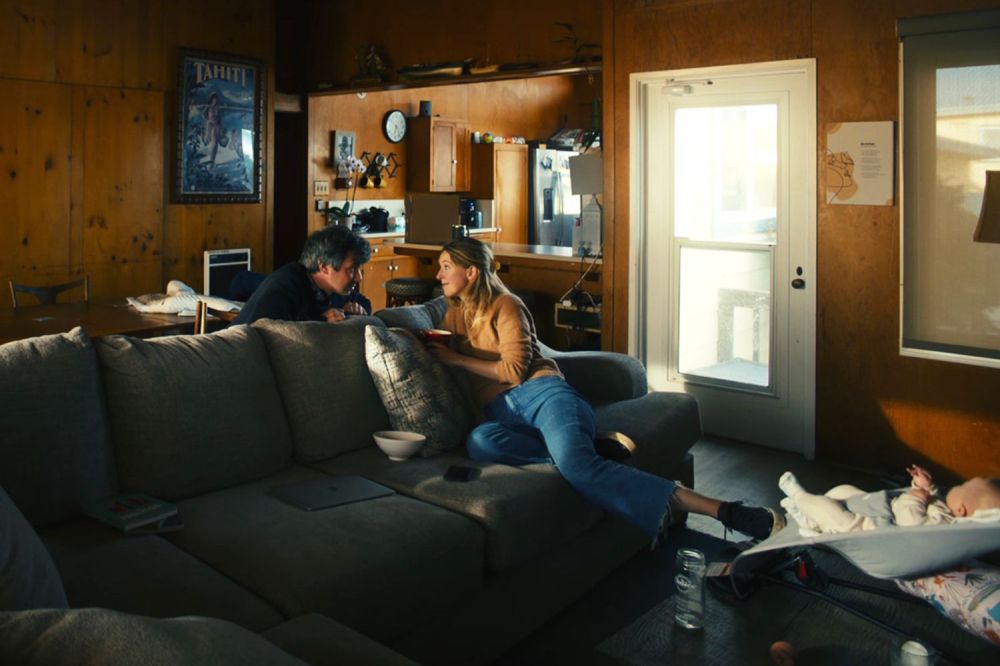
Conversations play out in battles of wills that unfurl almost entirely in uncomfortably tight, unblinking close-ups that offer no breathing room, no escape. They’re backed by frequent Oppenheim collaborator Ari Balouzian’s queasy score, sampling from Bernard Hermann’s score for Alfred Hitchcock’s 1958 thriller Vertigo, which is possibly the most famous dissection of perception versus reality in cinema history. That music cue may be about as on the nose as the filmmakers’ early insert of a shot of Evans fully nude in the shower, an amusing illustration of the literality of their film’s title. But the fact is, while the unprecedented access granted to Holmes and her private life is the documentary’s primary selling point, the real magic trick— or rather, mind fuck— is conjured in the second half, after Holmes goes to jail and disappears for the remainder of the film, which picks up after a two year time jump. With access to his primary subject restricted beyond belief, Fielder must rely on his memory and notes of discussions that weren’t able to be filmed or recorded to put the pieces together, all while Evans’ exertion of control over Holmes— his constantly interrupting her when she was around morphs into manipulation of her public image that she can’t control and possibly has no knowledge of after she’s away— and the film project becomes increasingly uneasy. The shift to primarily utilizing reenactments of scenes such as Holmes and Fielder’s first meeting and a stunning conference between Evans, the directors, and A24 executives, is an invigorating one, the prodding at what’s really knocking around in these peoples’ heads rendered all the more destabilizing by the heavy involvement of the surprise actress enlisted to play Holmes in these recreations. Holmes and Evans actually instigated the documentary project themselves, desiring to push back against the public’s perception of Holmes as some villain, images largely conjured by photos and quotes lifted out of their context and repurposed, and Amanda Seyfried’s portrayal of her in the 2022 Hulu miniseries The Dropout. Holmes herself voices her fears over manipulation of her image. That Evans has an A.I. rendering of her crafted that he can make say or do whatever he wants is frightening, but is it fundamentally different from Fielder hiring an actress to adopt her appearance and speech patterns to parrot her words?
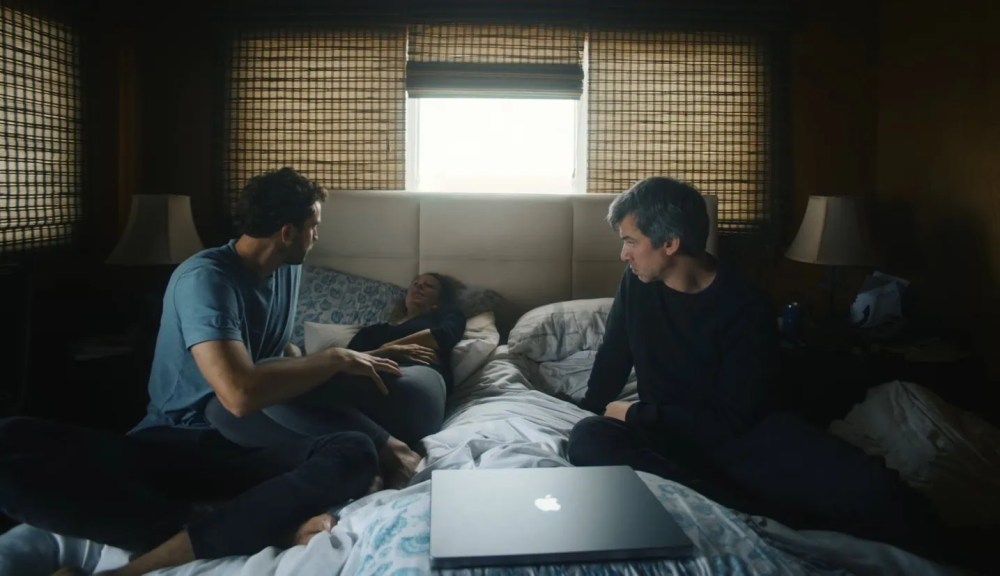
Fielder and Oppenheim are the perfect creative pairing to sift through all that noise, as it turns out, the former having reached out to the latter following the release of his breakthrough 2020 documentary, Some Kind of Heaven. A charming portrait of dreams and disillusionment among a group of seniors living at the sprawling Florida retirement community The Villages, Oppenheim’s documentary work marries close character studies with a cinematic formalism that lends itself to heightened studies of reality. You Can See Everything is perhaps more in line, however, with Primetime, Oppenheim’s recently-released first narrative feature that employs the real life figure of host Chris Hansen and his hit television show To Catch a Predator as an unconventional through-line to examining the post-9/11 media landscape as a reflection of America’s collective reaction to a hard-to-grasp new reality. Fielder, meanwhile, frequently blurs the lines between fantasy and reality in his comedy, which he navigates via his socially awkward persona. His series The Rehearsal, for instance, hinges on painstakingly detailed recreations of real people and places to allow his subjects to prepare for intimidating social interactions, but his tampering with reality to reach a certain end often only leads to more insecurities. As his crew’s on-screen representative in You Can See Everything, Fielder’s dogged, point-blank questioning frequently provokes laughter, but this reads not so much as an intentional pivot toward humor (even though the serpentine nature of their conversations is, like the pitter-patter of Abbott and Costello, inherently funny), and more as the default reaction to a bold attempt to break up tension that feels antithetical to how most people behave in similar scenarios. There’s a sincerity to his presence that points to someone earnestly interested in scrutinizing his subjects in the interest of some greater good, not merely doing it for a bit, and it’s that sincerity that makes the film’s final act— in which Fielder’s interest in possibly protecting Holmes begins to toe the line between objective observer and subjective participant— that much thornier. Whether or not we can trust Fielder himself, and the idea that the filmmaker may be selectively leaving out bits of dialogue or occurrences as he molds his own version of reality from the pieces, is a question that could apply to any non-narrative work, really, but one that this film noticeably leaves on the table. When You Can See Everything ends, Holmes is vigorously working to start up Theranos 2.0 while still behind bars, Evans continues speaking for her publicly with troubling brashness, and Fielder is left grappling with the disparity between a couple whose love appears like a genuine beacon in a swirling sea of lies and deception. After they watch the “Who’s on First?” bit earlier in the film, Fielder tells Holmes that he finds their conversations confusing to a comedic degree. In a world where none of us seems to comprehend what’s real anymore, sometimes you do just have to look around you and laugh: at the bold-faced manipulation of the truth, at the satire that suddenly becomes a real news item, at the fact that no matter how much time you spend with them or how long you talk to them or how others perceive them, you can never fully know another person.
You Can See Everything is now playing in theaters. Runtime: 174 minutes. Rated R.


