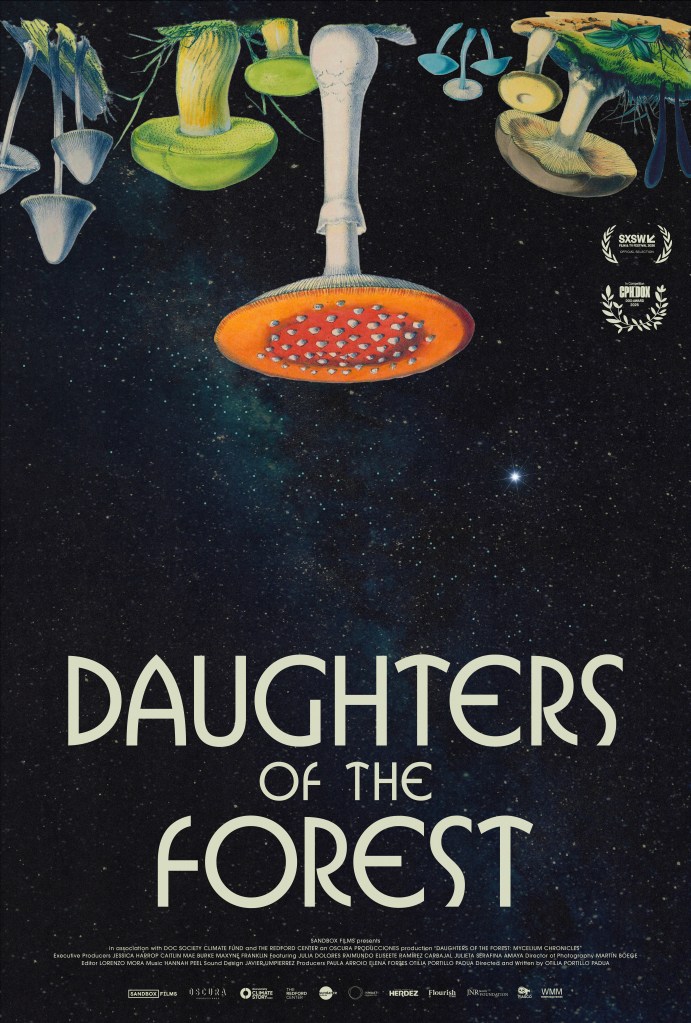
Daughters of the Forest opens with lush images of verdant forests and mind-boggling close-ups of fungi, their movements slowed down to allow us to luxuriate in their strangeness as they puff out spores in clouds of smoke. They more closely resemble alien creatures than anything you’d expect to find on Earth, a sentiment that’s echoed in the hushed whispers of the accompanying narration, the first line of which is, “We come from a distant point in spacetime.” It soon becomes apparent that this script is being employed as the voice of the mushrooms, which, combined with the trippy imagery, skews closer to a vintage sci-fi feature than a documentary set in the present-day. But Daughters of the Forest, which is directed by Otilia Portillo Padua and subtitled Mycelium Chronicles, is precisely the latter.
Yes, this is a film about mushrooms. But it is riveting to witness how Padua takes that one very specific and potentially banal subject and crafts a multi-layered exploration of environmental devastation, cultural and familial traditions, biology, and female empowerment from it. Daughters of the Forest takes a more grounded turn after its introduction, but it returns to those psychedelic visuals repeatedly throughout its runtime, lending the film an otherworldly tint that seeks to spark wonder in those watching it. That’s needed, because a significant part of Daughters of the Forest is dedicated to bringing awareness to the impending loss of the environments where these magnificent mushrooms thrive. The film is set in Mexico, primarily the Oaxaca and México State regions, and divides its focus between Lis and Juli, young mycologists who channeled their upbringing naturally diverse areas into missions to educate others on the importance of the country’s wild edible mushrooms. Lis founded a group called Hongueras Pjiekakjoo, which works with the community to promote the nutritional and cultural value of mushrooms. Juli wrote a thesis detailing over 40 species of mushrooms native to the Zapotec Community, of which she is a member.
While Padua includes some scenes following them at work— whether that be foraging in the forest, or examining samples under a microscope in a lab, or sorting and processing mushrooms for cooking— she also dedicates plenty of time to the significance fungi has to their families. Lis demonstrates how she learned so much about mushrooms from her grandmother, who can recall the names of countless species on sight, the passing on of knowledge taking on cultural as well as scientific import. When we first meet them, they are walking in the forest together, grandmother determinedly maneuvering her walker over the uneven terrain. Juli, meanwhile, seeks to continue the work of her father, who passed away. Intimate conversations with her mother detail not only how deeply they feel his loss, but also what happened to him when he consumed a mushroom that is considered a sacred species; he saw a vision of his future that included his death, and Juli wants to participate in the same ritual.
These stories construct the emotional backbone of Padua’s film, which admittedly takes on so much that it at times feels aimless, or at the very least that Padua wasn’t certain what precisely she wanted to focus on. That may cause Daughters of the Forest as a whole to weigh less than the sum of its parts, but those parts contain value nonetheless. And Padua demonstrates admirable aptitude for the craft. Her camera is almost always mobile, granting a perpetual sense of movement even to scenes you’d expect to be still, like people standing and talking in the forest. Animated spores drift through the forest scenes, further stylizing the fantastical nature of the environment, while the layered soundscape of insects chirping and rustling greenery immerses the audience in something akin to forest ASMR. Women, as the title points to, are the central (human) characters of the movie, and while the film doesn’t delve deep into the difficulties they face with misogyny in the scientific world— in a roundtable discussion, a group of indigenous women voice the hardships of being a minority in the scientific field in more ways than one, but it doesn’t venture far beyond that— the importance of the work they do in their communities, on both large and small scales is abundantly obvious. Padua follows them on all manner of excursions, painting a well-rounded portrait their work and the sheer variety of mushrooms out there, red ones and white ones and skinny ones and ones with massive, umbrella-like caps and ones that appear in tiny clusters, with names like “charcoal burner” and “little tortilla”; at one point, a group goes foraging at night, a blacklight illuminating the fungi in brilliant pinks and blues and greens.
Like so many contemporary nature documentaries, Daughters of the Forest also serves as an urgent plea for conservation. The forests in Mexico where these mushrooms thrive are threatened by deforestation. Aerial shots depict brown, barren landscapes criss-crossed by fallen tree trunks, a stark contrast to the saturated environments where the fungi themselves are given so poetic a voice. Early in the film, someone asks, “Without the forests, what will become of us?” while detailing the trickle-down effect of losing nutritional and medicinal sources. That feeling is repeatedly with decidedly more bluntness in the final title cards, which directly address the audience with the statement, “What we do matters.” The aesthetic beauty of Padua’s film alone makes the case for preserving these environments. Hopefully, audiences will also listen to what the mycologists have to say.
Daughters of the Forest had its world premiere at CPH: DOX 2026. Runtime: 95 minutes.

 Katie at the Movies