In this video for Letterboxd, Jessie Buckley cites Barbara Stanwyck’s performance in the 1933 drama Baby Face as a key influence on her dual role as Mary Shelley and the Bride of Frankenstein in Maggie Gyllenhaal’s The Bride! (the obvious comp is Elsa Lanchester’s dual role as the same in James Whale’s 1935 film, although in that same video Gyllenhaal expresses some ignorance about that movie that would suggest otherwise) In Baby Face, Stanwyck’s Lily Powers is a working girl who’s pimped out by her father, is encouraged by the one man in her small hometown who doesn’t want to hit on her to use men to get what she wants, goes to New York City, and does exactly that, finagling her way into a job at a Manhattan office building and literally sleeping her way to the top. It’s a performance so sharp it could draw blood; with just a glance, you can see the gears turning in Stanwyck’s head as she outwardly plays coy. Whatever Lily does, whether it’s using her body to progress socially and economically, or choosing real love over money, it’s always clear that she’s acting on her own terms.
I’m not really sure what to make of Buckley’s Bride, though, as committed as she is to a performance that sees her gamely straddling wild tonal shifts, song-and-dance numbers, and switching accents. When we first meet her, the Bride (named Ida) is carousing in a lounge circa 1936 Chicago, when she is suddenly possessed by Shelley’s ghost, the latter expressing a desire to now tell the story she was never able to tell in her lifetime. Ida is killed shortly therefore, unceremoniously tossed down stairs by a gangster’s henchman (John Magaro, who is also a welcome face to see) to keep her quiet about some illegal activities (the details are a little fuzzy, and ultimately not too important). Meanwhile, Frankenstein’s monster, who cutely calls himself Frank (Christian Bale, whose stitched-up facial features certainly pay homage to the Boris Karloff’s iconic iteration of the character), visits the home of Dr. Cornelia Euphronius (Annette Bening, a bold and entertaining counterbalance to Bale and Buckley’s mopey monsters), having read about her work with reanimation. After wandering the country for a century alone, he wants a companion, so the pair find and successful revive Ida’s corpse. She, somewhat reluctantly, acquiesces to going off with Frank, not possessing any memory of her former life and being left with little option other than to accept his explanation that she is his bride and suffered amnesia following an accident. But this is no world for those who are different (Ida’s striking post-death look is marked by a frizzy blonde mane and black ink-like stains dotting her skin), and they quickly find themselves involved in a fatal conflict, and on the run.
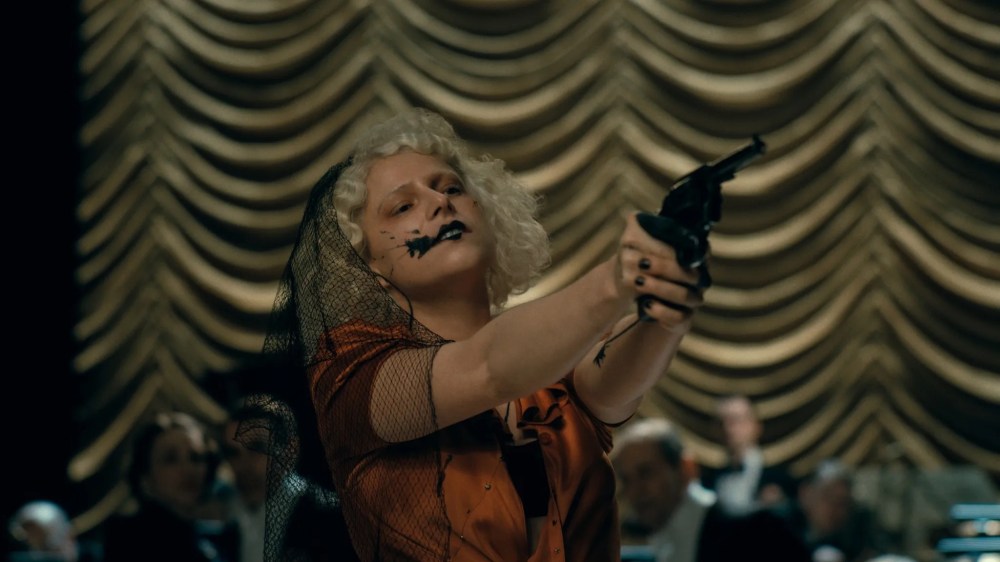
Like many of Stanwyck’s working class dames, Ida’s no stranger to loose behavior while expressing a yearning for a genuine connection, but her aim is fuzzy, although it ultimately coheres into some sort of vengeance toward the mobster who enjoys cutting out the tongues of women who talk too much and preserving them in jars. That’s the kind of ham-fisted feminism you can find throughout The Bride!, which names one character Ida and another Lupino (clear homages to the pioneering female director), which makes sure there’s a lady doctor and a lady detective present in the cast, and whose stylistic choices— the exclamation mark in the title, the giant, bold title cards— loudly announce its bold swings, but it really doesn’t commit to any thoughtful portrayal of intersectional feminism. The latter doesn’t amount to much more than the acknowledgment that women across America become so inspired by the Bride/Ida’s rebellious persona, they begin modeling themselves in her image and rioting against men. But the implication that Shelley is controlling Ida as a method of taking back control over her own narrative— one that, once out of her hands, has been bent and twisted in pop culture the world cover— also doesn’t make it seem like she is acting on her own terms. It’s incredibly perplexing, and her climatic assertion that she isn’t the “Bride of Frankenstein,” just “the Bride,” belonging to nothing and no one, is frankly eyeroll-inducing.
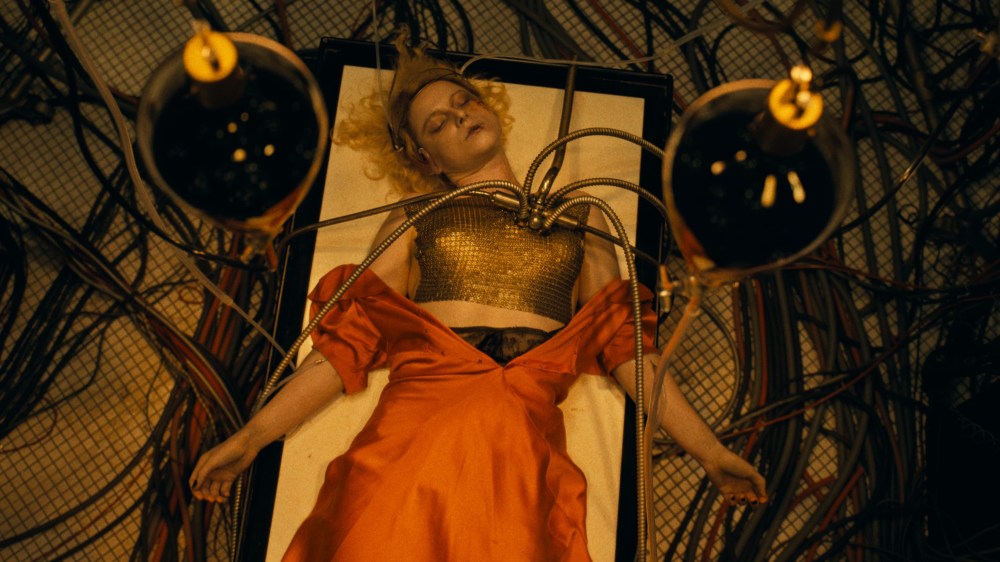
All that to say, as pleasurable as it is to see a female filmmaker being given the budget and the thumbs up from a major Hollywood studio to take some really weird and ambitious swings, I don’t think Gyllenhaal had a well-thought out feminist take or queer reading on this story, which is too bad, because her first feature The Lost Daughter is excellent. She’s definitely riffing on a lot of 1920s and 30s Hollywood, which is fun to see, even if the references are all over the place. The production design, costumes, and lighting throughout the film play up red and green tones that evoke two-strip Technicolor. The Shelley segues, meanwhile, are shot in stark black-and-white, akin to the Universal monster classics of the era. The Bride’s reanimation scene, with all the metal contraptions attached to her that make her appear almost robot-like, is straight out of Metropolis while the third act essentially remakes Bonnie and Clyde (those two references alone ought to indicate Gyllenhaal’s struggle to balance the fantasy and gritty realism that were prevalent in pop culture in equal measure in Depression-era America). Jake Gyllenhaal appears as a Fred Astaire-inspired musical star the lonely Frank idolizes to the point where he inserts himself into the movies in his dreams; at one point, he’s inserted into the Shadow Waltz sequence with its unmistakable neon violins from Gold Diggers of 1933. In one of the film’s more off-kilter music numbers and obvious pulls, Frank and Ida lead a dance to “Puttin’ on the Ritz” à la Frankenstein and his monster in Young Frankenstein. Later, he and Ida crash a screening of the Halperin Brothers’ 1932 horror film White Zombie (I’ve also seen this credited as their 1936 film Revolt of the Zombies, which recycles a lot of White Zombie footage and was conceived as a loose sequel to that film). Ida does a Marlene Dietrich impression, singing a bit of her famous song “Falling in Love Again (Can’t Help It)” from her 1930 movie The Blue Angel, her first of a legendary run of films with director Josef von Sternberg. Ida and Frank go to a place in Niagara Falls called the Honeymoon Hotel (hello, Footlight Parade). Penélope Cruz plays a detective named Myrna Malloy (are you kidding me). I’m fairly certain I actually saw Kay Francis’ face on a poster in the background of a movie in the year of our lord 2026; I definitely saw Ida and Frank run past posters for William Wellman’s Midnight Mary, another 1933 drama about a working girl from the wrong side of the tracks. That one arguably skews closer to “The Bride!” than Baby Face, as Loretta Young’s Mary ends up falling in with the mob, reciting her life story from the stand after being accused of murder. I’m sure we’re meant to read Ida as the equivalent of a typical pre-Code heroine, brassy and uncompromising and confident and independent but also desiring of love. I’m not sure I’m quite there.
The Bride! is now playing in theaters. Runtime: 126 minutes. Rated R.

 Katie at the Movies
I wanna see the movie so bad
LikeLike