New College— the public liberal arts school located in Sarasota, Florida— sits on a picturesque campus right by the water. Its buildings are dominated by towering palm trees. Some of its students dedicate time to maintaining gardens that showcase the region’s native greenery. Its exterior beauty reflects its original mission; established in the early 1960s, the university became a beacon of free and independent thought, the rare beam of liberal sunlight in a state typically darkened by conservative shade.
That all changed in 2023, when Florida Governor Ron DeSantis instigated a hostile takeover of the school, firing its president, Patricia Okker, decimating its trustee board, and installing a cadre of his right-wing associates in their place with the intention of demolishing its so-called “woke” ideals and constructing a conservative, evangelical institution in its place. The new trustees include Chris Rufo, a conservative activist known for his opposition to critical race theory, and acting president Richard Corcoran, a Republican politician who formerly served in the Florida House of Representatives.
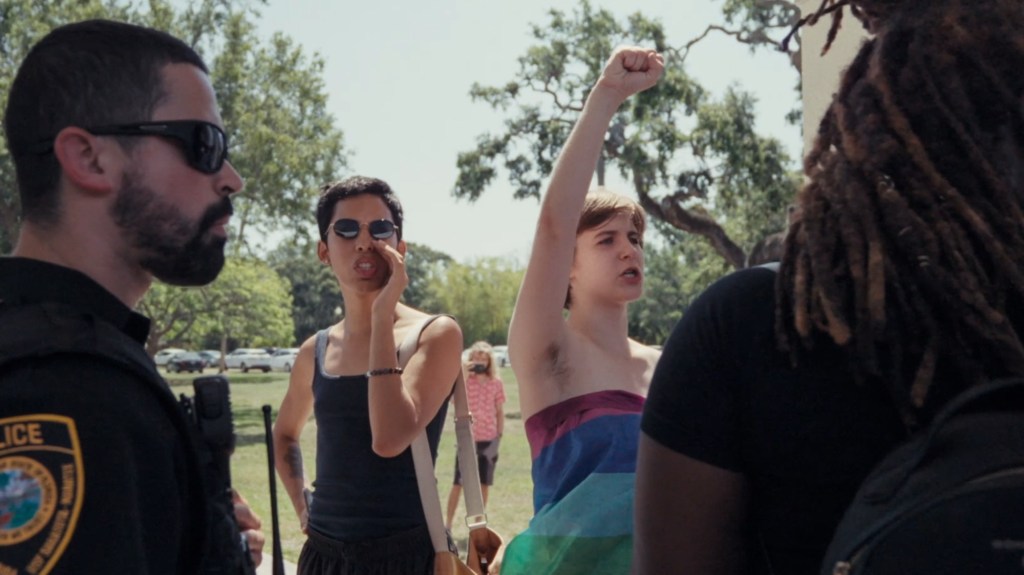
Patrick Bresnan’s gripping documentary First They Came for My College chronicles the existing faculty and students’ battle for New College from the frontlines. Concerned parents (one tearfully wonders what may happen to her transgender child under the school’s new regime) set up headquarters in a hotel room, the walls covered with bulletin boards that at first glance appear as if they are attempting to suss out a conspiracy— which in a way, they are. They speak out at board meetings, the issues they raise falling on largely deaf ears. Ultimately, the trustees on their side can only accomplish so much when the conservative members outnumber them. The new board’s actions venture from petty (under the guise of a devastating hurricane, they have numerous trees and plants in the student garden cut down, and they vote on a new school mascot while most of the students are home for summer break and don’t have a say in the decision) to stupid (Rufo counters Amy Reid’s, trustee as well as New College’s gender studies professor, suggestion to institute a Hispanic Heritage Day, questioning what the school will do to recognize Columbus Day and Florida’s Italian-American citizens) to downright evil. The pile-on of roll-backs and disbandments of progressive institutions is shocking and scary. The board dissolves New College’s Title IX office, the department responsible for enforcing the federal law that prohibits sex-based discrimination. They dissolve the gender studies program; Reid invites students to her office and encourages them to take any books they can before they are seized. They withdraw scholarships and financial support from the existing students, and offer what amount to bribes to new students to enroll at the school, instigating a turnover in enrollment that is comprised of less open-minded and academically-curious kids (some footage captures a group of athletes calling a queer student a homophobic slur as they cross paths on campus). Arguably, the most enraging act, the act that’s both unfathomable to imagine occurring in 2020s America and an encapsulation of the encroaching fascism we’re facing under the current administration, is the disposal of hundreds of books from the school’s library. They’re found in an enormous dumpster outside, and they’re all titles related to Black life, and sexuality, and liberal thought. The image of so much history being so casually discarded is massively sobering. “Only Nazis burn books,” intones one witness.
Bresnan may be the film’s credited director, but the close working relationship he established with New College’s students and staff comes through on screen. According to him, the students shot about 100 hours of footage themselves; as such, the documentary is not only able to venture into more intimate, closed-off moments, but also able to grant the students the opportunity to tell their own story. They may not be filmmakers— in one early scene, Gaby (one of the core students the film follows), voices her doubts about how to work the camera as she’s shooting— but they transport viewers straight to the heart of their fears, anger, drive, and even joy. Toward the end of the film, a group of students mount a production of The Rocky Horror Picture Show, allowing many of them to express themselves in spite of the current administration’s attempts to suppress them. Many scenes are set during meetings of the school’s newspaper, the students hashing out the events unfolding on campus while their teacher encourages them to pursue stories, but never without sacrificing journalistic integrity. It’s integrity in the face of everything thrown at them that these students and staff exhibit. None of them asked for this, but instead of just taking it, they rose to the occasion. First They Came to My College follows a lot of characters without really settling on a few central protagonists, which causes its perspective to feel a bit scattered. Some figures, like the parents, for instance, fade out of the picture after the start of the film. But that also effectively illustrates the collective effort of those opposed to the takeover. The film stacks up an infuriating amount of evidence throughout its runtime, and concludes with the assertion that what happened at New College serves as the blueprint for similar right-wing takeovers occurring at schools across the country. You may not think something like this could ever happen at your university, but as we see with New College, it very well could. That’s upsetting, but Bresnan’s film works as a rousing call to action, serving as just an effective a blueprint for how to fight back.
First They Came for My College had its world premiere at the 2026 True/False Film Fest. Runtime: 105 minutes.

 Katie at the Movies