It’s been 30 years since Mihail (Galin Stoev) left his home country of Bulgaria behind for Canada, emigrating with his young daughter Roza following the loss of his wife. Now, he’s a Montreal-based art consultant, his validation of new talents prized by curators and collectors. He’s wholly left his Bulgarian roots behind; when the now-adult Roza (Michelle Tzontchev) moves back in with him with her own son, he questions her desire to teach him their native language, and maintain a connection to a place and a people she can barely remember. So Mihail is particularly taken aback when one of his clients asks him to return to Bulgaria to appraise the work of an eight-year-old artist whose abstract paintings, composed in the barn of her family’s rural Bulgarian home, have gone viral.
The mystery of whether or not the young artist, Nina (interchangeably played by identical twins Sofia and Ekaterina Stanina, although the difference between them is so slight you’d never know it otherwise), actually painted her works herself or with the assistance of her family or others in town (many of who prove to be artistically inclined) ultimately just serves as the background to Québécois filmmaker Geneviève Dulude-De Celles’ introspective and sneakily moving sophomore feature, Nina Roza. As the dual names in the title suggest, Mihail begins drawing parallels between the disarmingly wise Nina and his own daughter, who was approximately the same age when they left Bulgaria behind. What sort of life would they have had, and what sort of person would she have become, had they stayed?
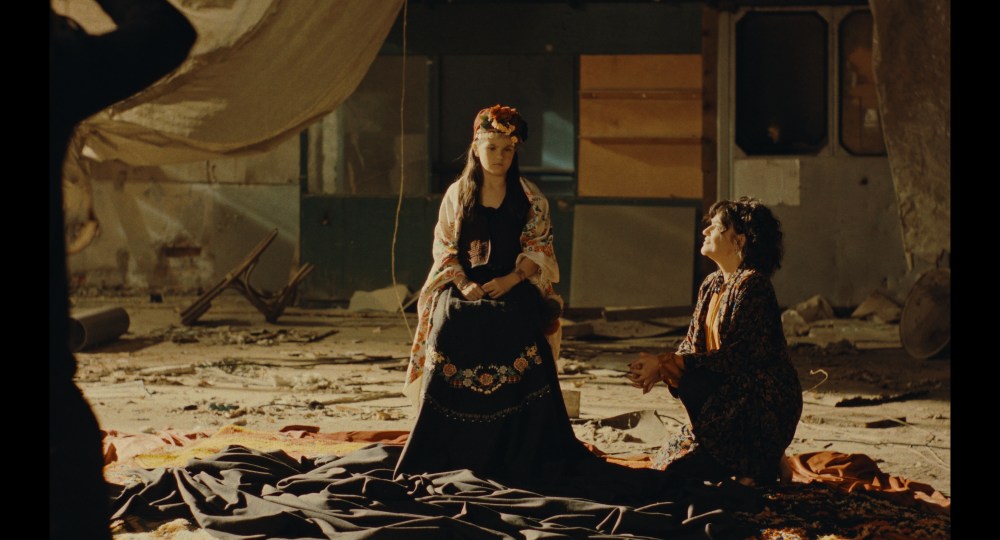
Roza isn’t physically present in the film that much, and the memories of her that occasionally flash through Mihail’s brain like lightning are abstract rather than informative, rendering someone who’s clearly intended to be a key character in the narrative as quite slight. But Nina Roza, rather than miring itself in concrete vision of the past, explores feelings and regrets about the past through actions in the present. This becomes particularly evident with the mid-film introduction of Giulia (Chiara Caselli), the agent who immediately scouted Nina, but also— as she discusses with Mihail— realizes that she can only play the child prodigy card for so long. She wants to move Nina and her family to Italy, where Nina can study in Florence or Rome and further refine her skills. Nina— whose enigmatic persona makes her private conversations with the curious Mihail that much more beguiling, and prompts the audience to believe that there truly is something special about her, whether her paintings are good or not— has recently decided, for non-specified reasons, that she no longer wants to paint. She wants to remain in her hometown, with her friends and her animals. It’s less a skewering of the absurdities of the art world— which Dulude-De Celles’ gestures toward in a few scenes, like one where Nina, outfitted in fancy traditional garb, reluctantly participates in a photo shoot— and more a subtly piercing commentary on the impact of forced migration and the erasure of one’s cultural roots.
Stoev turns in an admirable lead performance as Mihail, who he plays with gravitas while imbuing him with pain and confusion as he navigates being a stranger in his homeland, a feeling that a third act reunion with his estranged sister further illuminates, as well as the knowledge that his assessment of Nina’s work could steer her toward a future she doesn’t necessarily want for herself. The villagers, meanwhile, poke fun at his accent, but they also welcome him. Bulgaria’s quiet beauty shines through director of photography Alexandre Nour Desjardins’ lens, which renders the countryside in warm, painterly tones. Where pieces of Nina Roza may come off as half-baked or contrived— like the aforementioned Nina/Roza parallel, or Mihail’s initial deception of his identity toward Nina and her family— it makes up for it in its assured directorial approach and effectively pensive take on the complexities of immigration, nostalgia, and identity.
Nina Roza had its world premiere in competition at the 2026 Berlinale. Runtime: 103 minutes.

 Katie at the Movies