The opening titles of Wuthering Heights— writer and director Emerald Fennell’s 2026 adaptation of Emily Brontë’s 1847 novel— dance across a black screen, accented by the sound of quick creaking, and a man’s increasingly heavy groans and sighs. It proves to be a moment of black amusement when the final credit cuts away to the source of the noise, not moans of pleasure of but cries of pain as the rope around his neck ends his life, his now-still body left swinging from a wooden post as the scores of people gathered around the platform to observe the hanging reacting with mingled shock and rapture as Fennell’s camera cuts to a close-up of the dead man’s visible erection. It’s an incendiary introduction to a classic of English literature that’s emblematic of Fennell’s penchant for provocation, as evidenced in her first two feature films, the controversial 2020 feminist revenge thriller Promising Young Woman, and her far more derivative 2023 Teorema-riff, Saltburn. Fennell’s Wuthering Heights exists on some middle plane, revealing itself to be a straightforward bodice-ripper aimed right at young women, its most contentious elements being its major deviations from the source material and its dispensing of its themes of class conflict and obsession. Divorcing it from Brontë’s novel, it works rather well as the former. And after all, when has a film adaptation of Wuthering Heights, from William Wyler’s moody 1939 version that’s a classic example of a heightened Old Hollywood drama to Andrea Arnold’s textured and naturalistic 2011 take, ever strictly adhered to the original work?
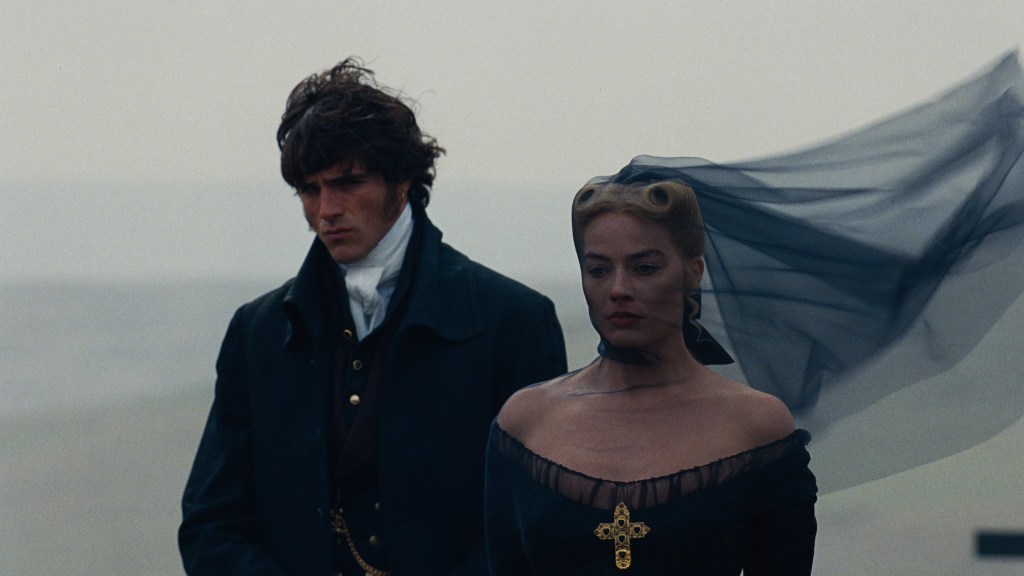
The story opens in 1771 with that hanging, at which a child named Catherine Earnshaw (Charlotte Mellington) is present with her paid companion, the illegitimate daughter of a local lord called Nelly (Vy Nguyen). Wuthering Heights is the name of the estate situated in the Yorkshire Moors where Cathy lives with her rough, alcoholic father (a part that could be easily exaggerated, but that Martin Clunes dials into with a perfect mix of horror and empathy) and their servants. Mr. Earnshaw returns home one day with a young boy (Owen Cooper) he found on the streets of Liverpool, without a thing to his name— including a name. He essentially gifts him to Cathy as a pet, and she names him Heathcliff (after her deceased brother, she says). They quickly become inseparable companions, promising to always protect and never leave each other. This promise is tested when the pair reach adulthood (played by Margot Robbie and Jacob Elordi) and Cathy becomes taken with the wealthy new family who moves into the neighboring estate, Thrushcross Grange, the prospect of what she could possess and accomplish if she married into such a fortune— particularly as her father’s erratic behavior and alcoholism sinks her family deeper and deeper into debt— outstripping her love for Heathcliff, who has nothing to offer her beyond himself.
Fennell has said that she intended her Wuthering Heights— whose title is stylized in quotation marks, further delineating it as a version of the original novel, and not a straight adaptation— to reflect how she felt reading the book for the first time as a teenager. If that was the goal, she accomplished it with aplomb. This Wuthering Heights is all about excess, which at least sits in spiritual, if not actual, alignment with Brontë’s potent mixture of Romanticism and Gothic fiction, in which love is rendered not as an earthly emotion but as an intertwining of souls that when thwarted quickly curdles into passionate yearning, unhealthy fixation, vengeance, and a possibly literal haunting. Linus Sandgren (Fennell’s Saltburn cinematographer), along with the film’s over-the-top production design, visualizes the film as an illustration on the cover of a romance novel, from the fog-enveloped moors to the blood-red sunset that colors Heathcliff’s sudden horseback departure after learning of Cathy’s engagement to that rich yet dull neighbor, Edgar Linton (Shazad Latif). The increasingly dark and derelict Wuthering Heights— at one point, a literal mountain of liquor bottles are seen stacked behind Mr. Earnshaw, a tableau that’s perhaps to blunt to be poetic, but is effective all the same— is neatly contrasted with the overtly lavish Thrushcross Grange, with its lush gardens and glittery interiors, Cathy’s new wardrobe draped in ribbons and tulle. That these visuals are backed by a soundtrack of original songs by pop star Charlie XCX (along with a score by Anthony Willis, also of Saltburn) confirms— even though they aren’t employed as heavily throughout the film as its marketing suggests— Wuthering Heights’ younger target audience. Not unlike the contemporary, teen-focused renditions of classic literature that were prevalent in 1990s Hollywood— think Baz Luhrmann’s grungy 1996 Romeo + Juliet, a vehicle for stars Leonardo DiCaprio and Claire Danes— Fennell’s film pares down the complex plot and myriad characters, beguiling a crowd who may not otherwise be drawn in by classic fare with a simplified plot, gobs of eye candy, sensual interludes that are just explicit enough to tantalize, and just tame enough not to alienate, and popular and beautiful movie stars. Robbie and Elordi (despite Fennell declining to cast a person of color, as the novel suggests Heathcliff is, lending additional layers to his outcast status, because that’s not how she pictured him when she read the book) are excellently cast, the former deliciously wicked, the latter appropriately brooding, with Fennell playing to the strengths of her lead actor’s extreme height; the film’s most erotic moment stems not from anything more sexually explicit, but from Heathcliff lifting up Cathy to his eye level by her bodice laces with only one hand.
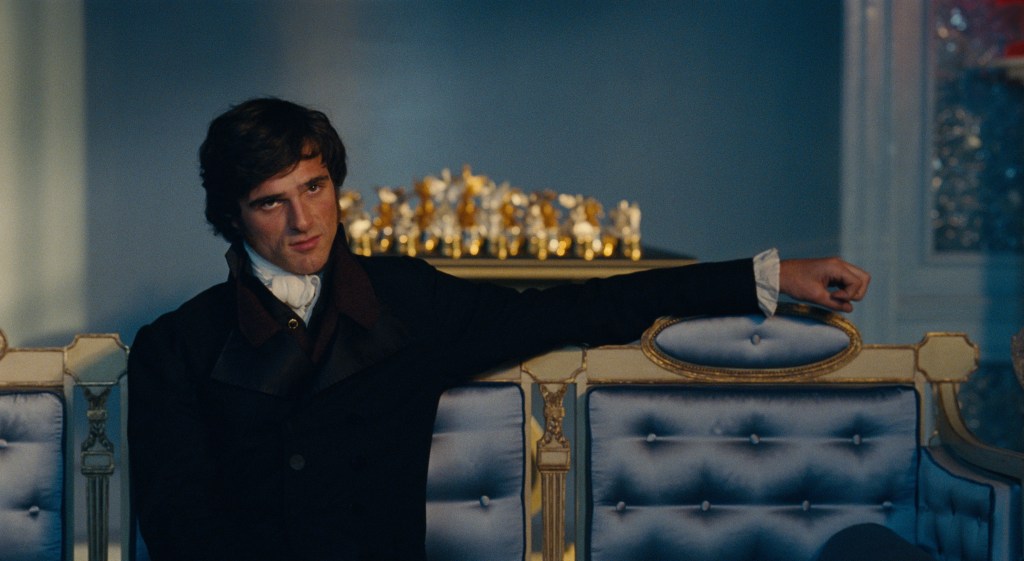
But while the jolt of carnal pleasures that Fennell injects in her Wuthering Heights is a welcome reprieve from mainstream Hollywood’s current celibacy, it’s also the biggest detour from the novel in an adaptation that takes many twists and turns, from the erasure of Cathy’s brother Hindley, whose disdain for Heathcliff prevents him from rising in stature and possessing Cathy in turn, to a fleshed out backstory for Nelly that thrusts her into the narrative’s romantic entanglements on a more emotional level. And it immediately undoes any potential for this film to climb to some less shallow plane. The consummation of Heathcliff and Cathy’s relationship into a torrid sexual affair serves as a sort of wish fulfillment for romance fans who want to witness these two gorgeous, messy individuals go at it, and there is certainly pleasure in watching that, and the various wrenches that Edgar, Nelly, and Edgar’s starry-eyed, girlish sister Isabelle (portrayed by a memorable Alison Oliver, whose eccentricities are certainly played up for comedic effect in this version) throw at their happiness. At the same time, it’s a choice that utterly eliminates the yearning, the tragedy of unrequited love, and the haunting of what could have been had either of them deigned to be more level-headed at the right moment in time. Ultimately, this is still Wuthering Heights, and Wuthering Heights can only end one way. Thanks to Fennell’s approach, this becomes a more illogical and less impactful endeavor as the story is wrenched away from its frivolous, passionate segue and shoved back on the path toward catastrophe, even as it indulges in some glimpses— arriving too little too late, really— of the novel’s shocking and depraved acts of vengeance. As a purely aesthetic and sensory exercise, however, it’s quite effective. The enduring impact of Fennell’s Wuthering Heights likely won’t be the film itself, but the sensibilities and interest its extravagance stirs in viewers to explore and expand their palates.
Wuthering Heights is now playing in theaters. Runtime: 136 minutes. Rated R.

 Katie at the Movies