Chloé Zhao’s Hamnet opens with a quote from a 2004 article by Stephen Greenblatt titled “The Death of Hamnet and the Making of Hamlet”: “Hamnet and Hamlet are in fact the same name, entirely interchangeable in Stratford records in the late sixteenth and early seventeenth centuries.” It’s a plain, matter-of-fact statement, not the sort of punchy quote that typically opens movies, let alone a film as emotionally wrought as Zhao’s, which is based on Maggie O’Farrell’s 2020 novel of the same name (the pair co-wrote the screen adaptation together). Yet, it succinctly and effectively, if impersonally, communicates to the audience the reason for the existence of the story they are about to watch, a story rooted in fact but also purely speculative: that William Shakespeare’s tragic play Hamlet was at least partially inspired by his son Hamlet, who died suddenly at the age of 11.
Hamnet, to its credit, skews the focus of that life-shattering incident away from the more famous Shakespeare and his work and toward his wife, Anne Hathaway— or Agnes, as she’s called in the film, in keeping with how her father in real life referred to her in his will. Played by Jessie Buckley, when we first see her, she’s wandering in the woods near her rural England home, practicing falconry. With her loose hair and evasive manner and clearly close connection to a bird of prey, there’s something wild about her. Will (Paul Mescal), who is currently working for Anges’ family to help pay off his own family’s debts, falls for her on sight, and pursues her with almost reckless abandon. It isn’t long before Agnes is pregnant, and the pair are hastily married. Agnes gives birth to a daughter, Susanna, and years later, twins: Judith and Hamnet.

Much of the first half of Hamnet is mounted in a beguilingly haunting, almost witchy manner. Agnes frequently returns to the verdant forest, whose lush green foilage is lovingly traced by cinematographer Łukasz Żal’s camera, and accented by a layered soundscape; it’s where she chooses to give birth to Susanna, where she and her family experience happy times, where she and Will fell in love, where she appears to be most connected to herself. Agnes’ ties to the otherworldly aren’t just evident in her preferred environment and her penchant for crafting remedies from the natural items she gathers, but in the visions she experiences; in one, following Susanna’s birth, she says that she will only have one more child, that death would follow any more. It’s why, after she discovers that she’s having twins after delivering Hamnet, she panics. Judith is resuscitated after appearing to be stillborn, but health problems continue to plague her as the years pass; Judith, however, isn’t the one they need to worry about, and that premonition will come back to haunt Agnes.
Hamnet is ultimately a story about grief, specifically the loss of a child to a parent, and how art can be a powerful form of restorative therapy. Will eventually becomes a successful enough playwright to be able to afford to move his family from their attic room to a home in Stratford-upon-Avon, but his frequent trips to London to work take their toll (the film wisely doesn’t dwell much on the exact nature of his work, effectively grounding the story more without cramming it with any unnecessary winks or references). Recurring imagery (like that of an inky black hole in the woods, leading to nothing and nowhere) illustrates how he and Agnes’ passion for each other starts to fade over time; early in their marriage, she sits working in the kitchen as he prepares to leave, only for him to keep running back to her for more wild kisses. After Hamnet has passed, Will’s departure at such a time is a source of resentment and anger; Agnes, sobbing, hits him until they are essentially brawling in the kitchen. But, in contrast to the scenes set in nature, a lot of these interior scenes are sterilely composed in a manner that alienates the viewer: encounters and conversations between even only a couple of characters are framed in wide shots filmed from a high angle, a perplexing choice for such an intimate, character-driven story that becomes even more confounding when considering how over-worked the rest of the film is. This is a story with big emotions, and Hamnet plays them big. Mescal is effectively more reserved, but Buckley gets loud; it’s a credit to how committed she is to the physicality of her craft and her ability to manipulate the livewire flame that burns inside of her that her screams of pain and loss don’t read as overacting.
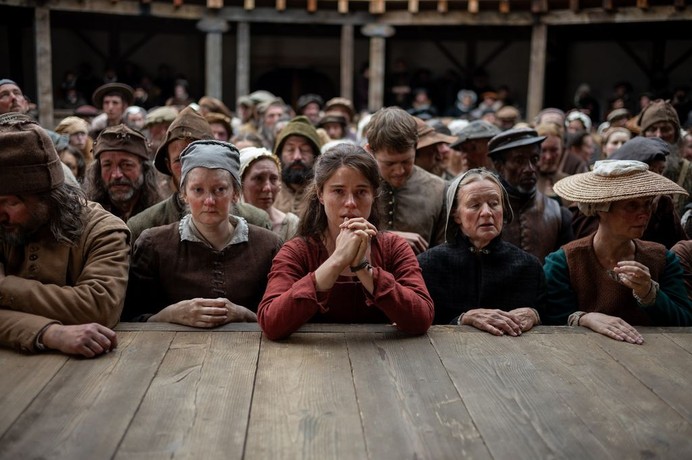
Zhao doesn’t appear to exhibit much trust in her actors or what’s on the page to communicate those emotional clearly enough, however. Max Richter’s score is employed with a heavy hand, directing the audience toward what they need to be feeling rather than allowing those feelings to emerge organically: a simple closeup on Buckley’s openly vulnerable, tear-stained face would have accomplished that. This especially undoes the film’s third act, in which Agnes discovers that her husband’s latest play isn’t another comedy, but a family tragedy. She attends the production at the Globe Theater, the climax of the film focusing on her internal response to watching Hamlet on stage (he’s played by Noah Jupe, whose younger brother Jacobi plays Hamnet in a particularly clever bit of casting). There’s some wonderfully moving moments of connection between hands and eyes, the real world of the audience colliding with the onstage magic in a manner that is noticeably cathartic not just for Agnes but also the entire community surrounding her, but the whole sequence is so drawn out, with that heart-tugging score and choral music laid on top of it, that it largely falls flat. It doesn’t help that as the film moves along, Agnes and Will start to feel less like distinct individuals— the wild girl with the falcon, the rascal with a pen— and more like cardboard archetypes of grieving parents. The mysticism that whirled through many of the movie’s earlier scenes similarly falls away in favor of a more routine healing power of art film, a thread that perhaps feels so lacking because Will has been so absent. We can infer that his art is the only way he can truly communicate his feelings. It still makes for a weepy that is far too overwrought to feel genuine.
Of course, I’m not a parent, and cannot understand and likely will never be able to understand the body blow of an impact the loss of a child can make on a person. It’s the sort of impact that has kept scholars guessing for centuries as to its influence on Shakespeare’s work; there are, after all, so few records of the man and his family. I see it less in Hamlet and more in his comedy, Twelfth Night, which could be read as an attempt at a sort of revisionist history: the main character, Viola, believes that her twin brother has died, only to discover by the end that he is actually alive. It’s for that reason that I respect and occasionally admire what Zhao sets out to accomplish with Hamnet. I just don’t think I can love it.
Hamnet will be released in select theaters on November 26 before expanding to wide theatrical release on December 12. Runtime: 125 minutes. Rated PG-13.

 Katie at the Movies
Great review!
LikeLike