Sepideh Farsi couldn’t enter Gaza. From Cairo, where she traveled in the hopes of crossing the Egypt/Palestine border to document the ongoing war in Gaza, an Israeli-imposed blockade obstructed all paths. But while speaking to Palestinian refugees in Cairo, Farsi met a man who suggested that she speak to Fatma (Fatem to those close to her) Hassona, a 24-year-old Palestinian photojournalist still living with her family in north Gaza. Farsi and Hassona never meet in person; their encounters, the basis for Farsi’s documentary Put Your Soul on Your Hand and Walk, are conducted via jittery WhatsApp video calls, the lack of service and constant threat of Israeli bombs meaning that every conversation could be their last, and rendering their every successful effort to connect a miracle.
Farsi is no stranger to politically invigorating filmmaking. Imprisoned at age 16 following the Iranian Revolution and and forbidden to return to her native country since 2009 due to her activism in opposition to the current Iranian regime (who has banned all her films), resistance is in her blood. It’s no wonder then that she chose a subject for her film who comes from country similarly rife with turmoil. Through her conversations with Hassona— occurring over the course of about a year, from April 2024 to April 2025— Farsi captures the genocide that has only become increasingly tragic since Israel first invaded the Gaza Strip on October 7, 2023 in real time. But the film’s urgency is rooted not in reciting cold hard facts and recapping major events (occasional cutaways to TV news reports provide the necessary context), but in the story told by Hassona’s face. Her radiant smile greets Farsi— and us— every time she picks up the phone. The unwavering optimism she exhibits is sort of unfathomable; even as she treks kilometers away from her partially-destroyed home to a friend’s house where she can have internet and cell service, even as she bemoans the growing scarcity of certain foods, even as neighbors’ homes are being bombed and drones buzz in the background, even as she recounts the senseless deaths of numerous family members (from her grandmother to a one-year-old child), she declares with an inspiring dose of conviction how proud she is to be from Gaza, and that she has no desire to permanently leave her home. As the months wear on, however, slight, almost imperceptible changes illustrate the war’s very human toll; her face is a little less bright, and the big dreams she extolls in their first chats— going to Rome, seeing the world outside the country she’s never left— morph into something as simple as wanting to taste chocolate again.
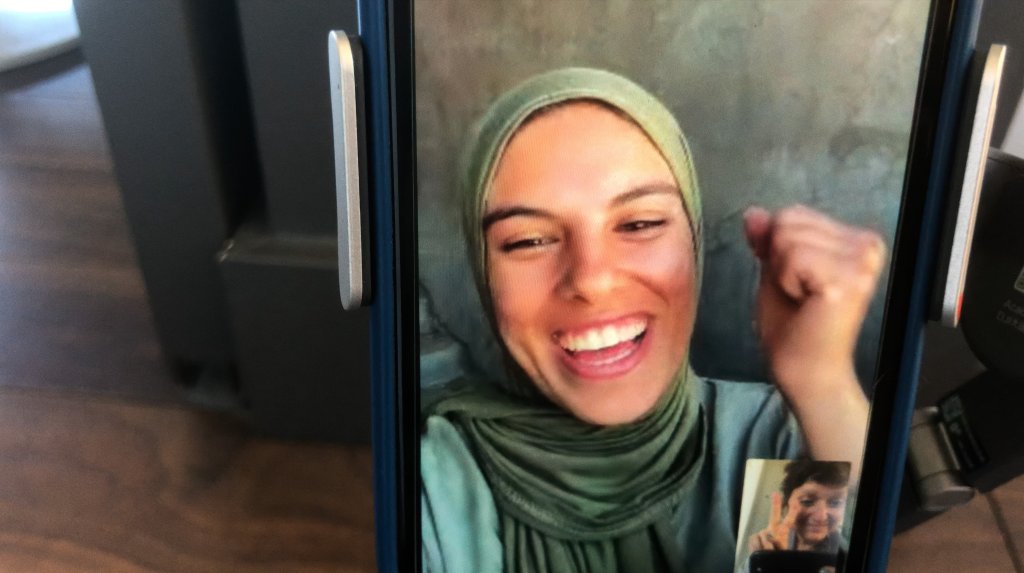
Hassona effectively stands in for the entirety of Palestine, whose existence is under threat merely for existing. Witnessing her struggles— her despair, her hope, her fear, her bravery— grants us a firsthand, phone-screen-sized window into the lives Palestinians in Gaza live under constant siege. It’s a way of life that will be unimaginable to most people watching the film, including the filmmaker. She speaks of events like air strikes and her aunt’s head being found the next street over from where her home was bombed with a matter-of-factness that indicates how things that shouldn’t be normal have become normal. Farsi’s freedom of movement stands in stark contrast to Hassona, whose world only seems to shrink as the film progresses; some of the few glimpses we’re afforded of her environment reveal her sheltering with her entire family in one small room. Farsi, meanwhile, updates Hassona on her travels; one day she’s at her home in Paris (even the couple of times Farsi swings her camera around, physically moving away from her video call with Hassona to let her cat into the room, demonstrates an ability to travel that we never see from Hassona) another in Italy premiering a film. Hassona delights in hearing the ocean when Farsi tells her she’s at the beach. You could write this off as insensitive on Farsi’s part, but it’s integral to illustrating not only the ease with which these two women share their lives with each other (their conversations comfortably flow from subjects as heady as the war to something as mundanely curious as Farsi inquiring about Hassona’s hijab) but also the privilege and helplessness that all of us possess in this scenario. We can go almost anywhere we want, do anything we want, eat whatever and however much we want, and we can talk to people like Hassona, but we are powerless to do anything to help her.
The way that Farsi not only uses technology, but depicts the technology she uses, in the film also works to visualize the distance between her and Hassona. Sure, screen-capturing her calls with Hassona would have made Put Your Soul on Your Hand and Walk a much cleaner-looking film. Instead, Hassona holds her camera up to her phone screen, recording their conversations in a way that allows the viewer to see the technology being used, and invites them to really listen. A device that fits into the palm of your hand can provide a tenuous connection to a whole other world; the footage of Hassona she receives is frequently pixelated, the audio occasionally indecipherable, and when the call cuts out— which happens often— we see Farsi’s frustrated finger tapping the screen in an effort to reconnect, because that’s about all she can do.

Put Your Soul on Your Hand and Walk is about as urgent as call to end the genocide in Gaza as they get, without actually saying as much; it’s enough to bear witness to the catastrophe through Hassona’s eyes, an experience exemplified by a fact that most audiences will already be aware of upon entering the movie: Hassona and nine members of her family were killed by Israeli bombs in the middle of the night on April 16, 2025, one day after Farsi called her to tell her the film she’d made about her had been accepted into the Cannes Film Festival. Hassona’s response to Farsi’s invitation to her to attend the premiere was an affirmative—but only if she could return to Gaza after. Put Your Soul on Your Hand and Walk is as much an intimate tribute to her as it is a broader portrait of existence in a war zone. Hassona’s voice figures prominently throughout the film, from a poem she wrote that she recites to Farsi, to her vibrant photography. Montages of her photos serve as occasional interludes from the video calls, documenting life otherwise going on against a landscape of destruction, people walking and children laughing and playing enveloped by the twisted skeletons of what once may have been someone’s home or store or school. I don’t remember the last time I experienced such an intense rush of chills running through my body as I did as Farsi’s final call with Hassona faded into the film’s ending title cards. It’s a privilege to become acquainted with her through this film, a tragedy that she lost her life as senselessly as thousands of Palestinians have, and a burden that we all have to bear, knowing that a genocide is occurring before our eyes, and being helpless to do anything about it.
Put Your Soul on Your Hand and Walk is now playing in select theaters. It screens locally at the Webster University Film Series on November 22, 23, 25, and 28. Runtime: 112 minutes.

 Katie at the Movies