He looks at the art, but he isn’t really looking at it. As he slowly slopes around the museum galleries, one of his young sons chattering animatedly in the otherwise silent place as the guard snoozes in his chair nearby, it’s clear from his furtive glances that he’s searching for something. Eventually, he sets his museum guide down, approaches a case of figurines situated in the middle of the room, and delicately fingers the lock on its side. It isn’t actually locked, as it turns out; he pops the clasp with ease, pulls out the drawer just enough to reach inside, and plucks a figure from the lineup. He closes the drawer, and— moving just as laconically as he did before— approaches his family sitting on a bench nearby, and casually tosses the figure into his wife’s purse. She— and everyone else— are none the wiser.
From this sequence alone, you’d be justified in believing that James Blaine (“J.B.”) Mooney (Josh O’Connor) is a smooth operator worthy of the movie’s title. But Kelly Reichardt’s The Mastermind fast proves itself to be ironically named. It’s 1970 in Framingham, Massachusetts, and J.B.— an art school dropout and failed architect, currently jobless— engineers a plan to steal four abstract paintings from one of the Framingham Art Museum’s small off-shoot galleries. He scopes out the museum on his frequent visits, chooses the artwork he wants to swipe, and hires a getaway driver and a couple of goons to actually enact the heist while he remains as physically far removed as possible. All great heist movies have a hitch when it comes to actually completing the job, however. The Mastermind contains plenty. Seemingly, everything that could go wrong does: J.B.’s two sons (played by Sterling and Jasper Thompson) unexpectedly have the day off school, forcing him to quickly figure out what to do with them while his wife Terri (Alana Haim, in an admittedly pretty thankless suffering wife role) is at work. His driver bails, so he has to take his place. And one of the guys he hired, a young upstart named Ronnie (Javion Allen) turns out to be a live wire who might cause the whole thing to blow up.

That all sounds like the sort of lean, tense thriller that belongs more in Steven Soderbergh’s territory, not Reichardt’s, whose films are character studies frequently characterized by slowness and stillness. The heist sequence itself in The Mastermind is still relatively nerve-clinching, if only due to its audacity, and because we’ve already witnessed multiple things in the lead-up go south for J.B., unfurling with a gradualness and a silence that’s akin to a miniature take on the famous half-hour, dialogue-free robbery in Jules Dassin’s seminal 1955 thriller Rififi. But Reichardt (also serving as editor), imbues the scene with a touch of humor through a couple of well-timed cuts, and the whole thing plays out as low-key as Rob Mazurek’s smooth jazz score. In other words, it’s exactly what you’d expect from Reichardt’s take on the genre: casual, not flashy.
What is unexpected, however, is Reichardt’s choice of protagonist. Her films typically center on people who exist on the margins of society, whether it’s a homeless woman searching for her lost dog in Wendy and Lucy, or a Chinese immigrant and an introverted chef in eking out a living in 1820s Oregon in First Cow, or even a quiet artist struggling to create as pressures big and small increasingly threaten to crush her in Reichardt’s last film, Showing Up. O’Connor’s J.B. is, in a way, a sort of dark inversion of Michelle Williams’ protagonist from that movie, an example of what can happen when consistent creative failures rub up against an ego that feeds on tangible success, and the quest for greatness takes on increasingly desperate and dangerous forms. It’s a role that’s tailor-made for O’Connor, who previously proved himself adept at portraying scrappy anti-heroes in such films as Alice Rohrwacher’s La Chimera or Luca Guadagnino’s Challengers, but his character in The Mastermind exists in a sort of purgatory, coming from a much more distinguished background than most of Reichardt’s protagonists while also clearly not fitting in to those trappings. He may not have a job, but his middle class existence is still evident. He has the typical suburban American family: wife, two kids, a car, and a nice if blandly-furnished home (a telling scene post-heist depicts J.B. replacing one of the generic store-bought framed prints hanging over his living room sofa with one of the bold stolen paintings). His father (Bill Camp) is a respected local judge, and his mother (Hope Davis) is the sort of person whose reaction to hearing about the stolen paintings on the news is lamenting that they don’t use their museum membership enough, and who easily cuts a large check for J.B. when he asks her to borrow some money, presumably to help him get on top of a big architect gig he’s come in to, but actually to pay the guys he’s hired for the job until he can sell the paintings. The way he hungrily eyes the check as his mother writes it out across the table speaks volumes. Late in the film, J.B. visits some old college friends, and one of them (played by one of Reichardt’s lucky charms, John Magaro) tells J.B., “You’re no longer chipping away at the edges. You walked in and blew the whole thing up.” But that was not the gaze of a man acting out of need, but of a man acting out of lust and greed.
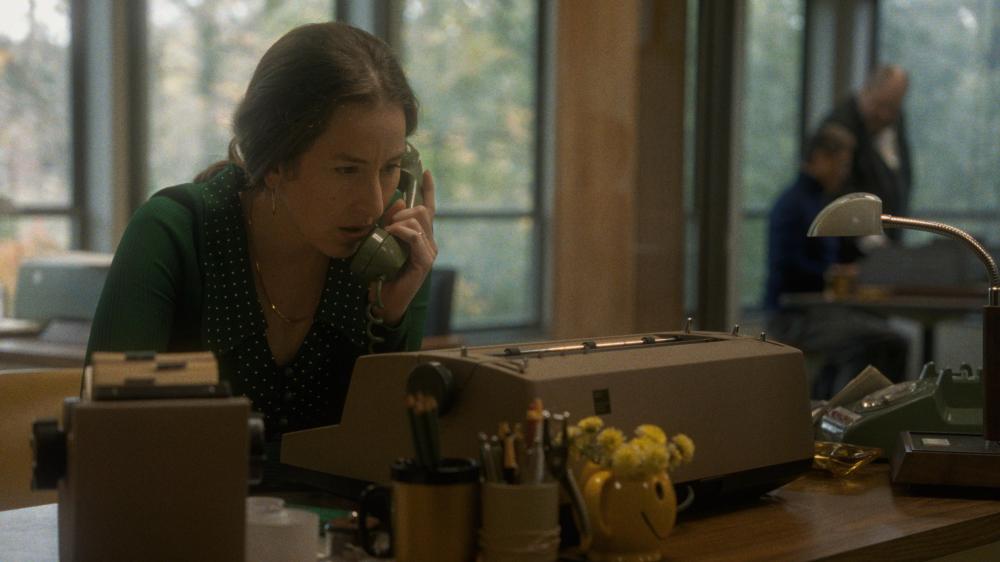
With its autumnal New England backdrop and vintage sheen (punctuated by some fabulous knitwear), The Mastermind may easily be mistaken for cozy, were it not for its rotting center, a scathing indictment of abusive power structures and the haplessness of one man who tried in vain to circumvent them. Reichardt’s typically long, observational takes allow us to peer into the lives of her characters, and by extension, the world theyinhabit. In this case, the occasional news broadcast at the start of the film, or a cluster of anti-war protesters gathered on a street corner, firmly situate The Mastermind as taking place at a time when negative sentiment toward the U.S. involvement in the Vietnam War was spiking. As the film progresses, however, it becomes clearer that the inclusion of this isn’t mere window-dressing. Protesters and hippies take on a more prevalent and active role in the story, pointing to groups of like-minded individuals— who could be considered as acting on the margins of the social status quo— advocating for a worthy cause. It all serves to make clear how divorced J.B.— no matter how much he may seem to believe that he’s Doing Something— is from any sort of real cause or community. The final shot of The Mastermind is about as perfect as endings come: a sick joke on an unlikeable guy, but also a somber reflection on the impossibility of out-gaming a system that just wasn’t built for certain people to win.
The Mastermind is now playing in theaters. Runtime: 110 minutes. Rated R.

 Katie at the Movies