We’ve all been there before, regardless of what precisely we celebrate or believe in: the family holiday party. The tense reunions, the awkward introductions of new partners, the petty squabbles over everything from politics to what’s for dinner. And we’ve all seen it depicted on screen countless times, too. So it’s a testament to Alexander Helmer that his feature, aptly titled A Christmas Party, subverts expectations as it treads familiar territory, resulting in a holiday comedy that is as gently moving as it is uproariously funny.
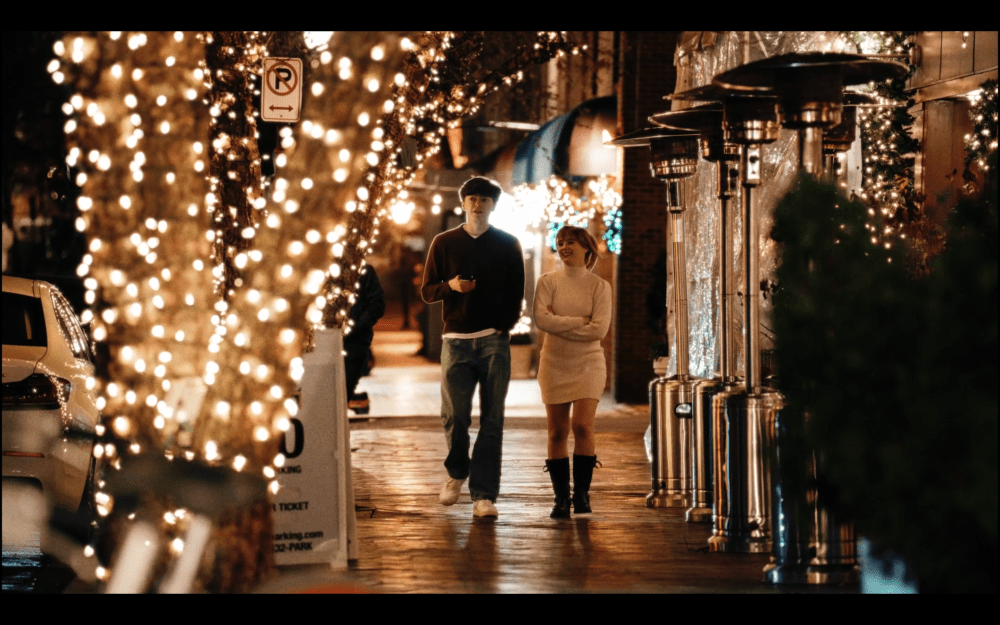
The film, written by Helmer and Guy David Knoll, opens in the car on the way to the titular party, immediately introducing the audience to the main protagonist we are intended to zero in on across this broad ensemble: 19-year-old Adam (Jaxon Keller), who is sacrificing an evening with friends to attend this family gathering with his parents. They’re the first to arrive at the home of their host, Juliet (Bohdana Madlova), but the space isn’t quiet for long, Juliet having providing her guests with a little extra incentive to be punctual and promising that whoever arrives closest to seven will be permitted to abstain from the neighborhood homeless drives for the coming year. Helmer, whose film is warmly lensed by cinematographer Spencer Bruttig, showcases an ability to keep the camera moving even within fairly tight confines, allowing the chaos of the family (further accentuated by quick transitions and split screen effects) piling into the house to dominate the frame first and actually introducing everyone later. There’s the loud-mouthed Marco (Joe Marano), who’s brought his Ukrainian girlfriend Olha (Maya Sienkiewicz), who doesn’t speak any English. There’s Adam’s dad Jason’s (Dan Grogan) brother Orson (Mk McManus), a powerful Hollywood movie producer. There’s Danny Caine (Jack Wielar), whose liberal, activist parents Gene (David Peter White) and Gina (Rebecca Grutz) are raising him to be the next big teen singer/songwriter. There’s Juliet’s partner Shaun (Richard Sexton), whose sympathetic ear makes him a consistent sounding board for Adam’s problems over the course of the evening, all while he rehearses for his role as a butler in an upcoming community play. And then there’s Ally (Sarah-Grace Donnelly), Juliet’s daughter and Adam’s childhood friend who he now has a massive crush on despite them having grown apart over the years, although she arrives with her British boyfriend Roman (Max Cazier) in tow.

Pacing is, admittedly, an issue throughout A Christmas Party. Sequences often extend for longer than necessary, particularly the final act, which works too hard to neatly wrap up the characters’ individual arcs and the evening as a whole. But the characters— the actors all doing solid work to imbue them with unique personality tics that make them instantly distinguishable from each other— are so endearing that that feels more like a nitpick than a major flaw. At times, the dialogue feels like it is straining to either land as funny or moving, rather than allowing those emotions to emerge organically (this is apparent, for instance, in Adam’s rush to declare his love for Ally during the climactic dinner). But for the most part, the jokes land, and Adam’s sincerity grounds the absurdity he’s frequently in the midst of. Keller and Donnelly share believable chemistry as individuals who were once close and are now fumbling to figure out where they stand with each other, and the sequence in the middle of the film when they genuinely begin to reconnect is truly quite sweet.
A Christmas Party plays with established conventions in compelling ways, too. For instance, the dreaded clash of opposing political ideologies perpetually simmers in the background of many on (and off) screen holiday gatherings, eventually boiling over into angry exclamations of broad epithets. A Christmas Party pulls that to the forefront by making one of the leads, Ally, an aspiring politician working for a conservative congressman, who himself makes a surprise late-film appearance. Therefore, politics here aren’t merely used to illustrate the general differences between characters; they’re used to push characters already at a turning point in their lives to consider what’s really important to them, in their beliefs, in their work, and in their relationships. It’s a tricky balance that the film mostly pulls off, addressing the contemporary fraught political climate (while other references, such as COVID-19 outbreaks, firmly situate the action as being set in the 2020s) but without so much specificity as to impact the overall timeless nature of the story. Raunchy humor and cynicism swirls with hopefulness and love in the grand tradition of so many holiday classics that make them such a joy to return to every year, like revisiting old friends. It’s always a pleasure to witness a fresh new take on a tried and true formula, and A Christmas Party certainly deserves a spot in the annual rotation.
Runtime: 107 minutes.

 Katie at the Movies