In this dispatch from the Venice Film Festival, I’m looking at three terrific documentaries from established auteurs that premiered out-of-competition at the fest: Werner Herzog’s Ghost Elephants (which the director received a lifetime achievement award in conjunction with), Lucretia Martel’s Nuestra Tierra, and Laura Poitras and Mark Obenhaus’ Cover-Up.

On a remote plateau in the African country of Angola, it’s rumored that mega-giant elephants— nicknamed ghost elephants for their elusive nature— reside. That isn’t where director Werner Herzog’s documentary Ghost Elephants begins though. Rather, it opens within the confines of the Smithsonian National Museum of Natural History, where a large, circular room leads visitors to its central display: Henry, an 11-ton African elephant (the largest on record; for context, the largest male African elephants typically weigh up to 8 tons) who was shot and killed by a hunter in 1955. A fixture in the museum since 1959, now Henry’s wrinkled body stands inert, lifeless, yet perfectly preserved for all to see.
One of those people is Dr. Steve Boyes, a naturalist based in South Africa who has spent years tracking elephants in Angola in a Moby Dick-esque odyssey to find Henry’s giant descendants. Herzog and his team follow Boyes— and the Kalahari bush trackers whose knowledge of the land is integral— as they drive undriveable roads and cross uncrossable rivers to reach the elephants’ purported home.
Ghost Elephants doesn’t reach the crazy heights of Herzog’s wild 2005 documentary Grizzly Man, nor does it suggest the behind-the-scenes chaos of his narrative features shot on location, namely Aguirre, the Wrath of God and Fitzcarraldo. And Herzog (who narrates the film, offering his own wry asides, as he does with most of the documentaries the 82-year-old filmmaker has turned to making) seems to enjoy venturing down whatever avenues he finds intriguing, whether they are relevant to the big picture story he is telling or not. And a lot of these asides are pretty insane, like the discussion of a poison so deadly, if it seeps into your bloodstream you have no choice but to cut off the limb to stop it from spreading, or the creatures the team encounters on their journey (a poisonous spider who carries hundreds of babies on her back), or the fact that to enter the sacred elephant territory, the group has to obtain the permission of a local king.
The epilogue of Ghost Elephants, which tracks what happens with the research the team gained after they return, works toward the film’s attempt at a plea for conservation that it’s otherwise lacking outside of the unnecessary inclusion of footage from the 1966 Italian documentary Africa Addio, which features graphic footage of the poaching that was so prevalent at the time. Ghost Elephants, however, is more a film about the chase, so perhaps you won’t be too surprised to learn that the human participants are more centralized than the animals. There’s a scene where Boyes is being interviewed about potentially finding the thing he’s been looking for for so many years, and he says that maybe it’s better that it remains a dream, and while his quest that is referred to as his white whale within the film is rendered as far tamer than that literary influence, it’s just as futile, and sobering.
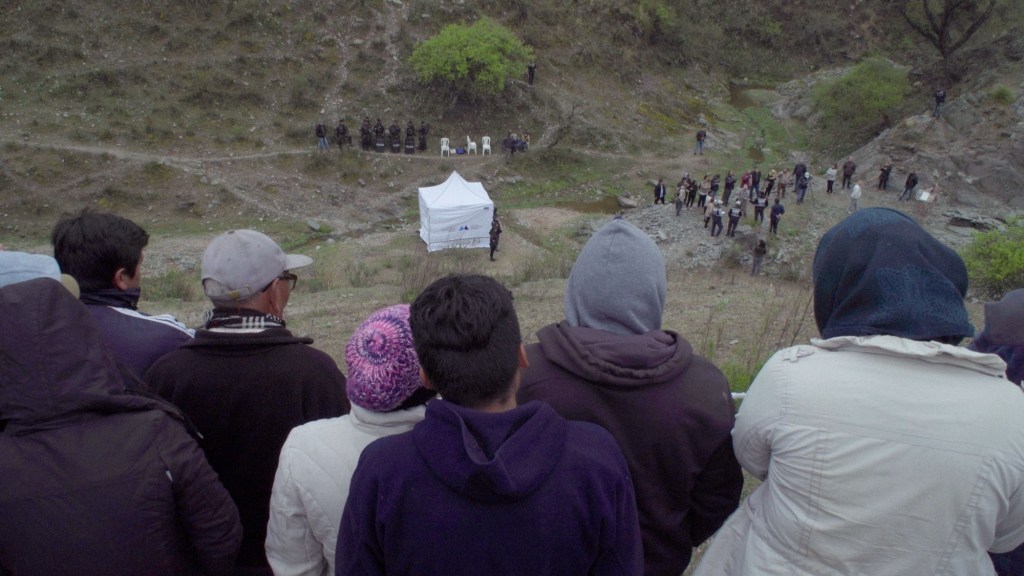
A searing indictment of colonialism and and ravishing reclamation of long-suppressed narratives, Argentinian filmmaker Lucretia Martel turns her eye to the indigenous Chuchagasta community in the Tucumán Province of northwest Argentina, where in 2009, 68-year-old Javier Chocobar was shot and killed (and two other members of his community wounded) while trying to defend himself from being forcibly evicted from his land. His murder was filmed and uploaded to YouTube, and the three men involved— two former police officers, Luis Humberto Gómez and José Valdivieso, and a wallet landowner, Dario Luíz Amin— put on trial.
That isn’t where Martel’s Nuestra Tierra (or Landmarks, the film’s more aloof English language title) begins, or ends, however. It’s through reckoning with this one, present day conflict that Martel, with a formal rigor that trades in sentimentality for clear-eyed potency, lays bare centuries of strife. Land disputes between the Chuchagasta and European settlers over the former’s fertile ancestral land have been occurring since the latter arrived, and Argentinian authorities tend to side with the group who possesses more power and deeper pockets. Fly-on-the-wall footage from inside the courtroom as the murder trial unfolds provides Nuestra Tierra with its narrative momentum, but it’s interspersed between sweeping aerial shots of the landscape that imbue the film with an epic sense of awe. These scenes are accompanied by voiceover interviews with the Chuchagasta community— including Chocobar’s widow, Antonia— who are still reeling from the killing. But they speak not just on the conflict at hand, but on their personal histories growing up as indigenous people in a country whose systems constantly work to devalue them, allowing us to witness the scope of the conflict through a more intimate lens.
Nuestra Tierra’s gradual pace may try the patience of some. But Martel is a patient filmmaker; the fact that this is only her fifth feature length film since her acclaimed 2001 debut La Ciénaga is testament to that. While it may appear more straightforward than her daring fictional features, her eye for sound and images, finding unexpected people and things within the frame to focus on— the servers in the background distributing coffee to the trial participants in the courtroom, for instance— make Nuestra Tierra unmistakably hers.

A damning portrait of war crimes and government negligence, Cover-Up tracks some of the most incriminating events in U.S. history from the mid-century onward from the perspective of the man who broke the stories: Pulitzer Prize-winning journalist Seymour Hersh, who began his reporting career at the City News Bureau in his hometown of Chicago in 1959, eventually going on to work for the Associated Press, The New York Times, and freelancing. His story is one that Laura Poitras, who co-directed Cover-Up with Mark Obenhaus, has been chasing since she met him 20 years ago.
That Poitras (whose most recent documentary All the Beauty and the Bloodshed won Venice’s Golden Lion) is such a bold investigative filmmaker herself makes Cover-Up the perfect pairing of creator and subject matter. Thrillingly assembled by editor Amy Foote, it makes extensive use of archival footage, bringing the stories Hersch covered to life with an urgency that only becomes more pressing as the film progresses. Cover-Up leaps from the My Lai massacre in Vietnam to Watergate to the discovery of domestic spying conducted by the CIA. One of the film’s interview subjects is Camille Lo Sapio, revealing her identity for the first time as the anonymous source who provided Seymour (who goes by Sy) with the Abu Ghraib prison torture photographs in 2004. Watching decades of atrocities unfold one after another makes for a simultaneously enraging and draining experience, and its presentation— which features occasional comments from new interviews with Herschel’s contemporaries, the likes of Bob Woodward and David Obst— would likely read as overly clinical were it not for the participation of Hersch himself. Occasional cuts to conversations between the filmmakers and Hersch conducted in his home office present Hersch as someone who reflects on the past with self-deprecating charm, and is guarded about the present. He and Poitras— two journalists going toe-to-toe— lightly butt heads (he’s still reluctant to participate in the film he’s dodged for two decades), even though the documentary treads over Hersch’s controversies (like his mistaken use of forged letters about John F. Kennedy and Marilyn Monroe in his research for his 1997 JFK biography The Dark Side of Camelot) with zero antagonism. While his reflections create a dialogue between past and present, Cover-Up also looks to the future, observing Hersch, now writing for his own Substack newsletter with the freedom that corporate-owned media conglomerates don’t always afford, conducting phone interviews regarding the atrocities of the ongoing genocide in Gaza with an inside source. As long as oppression and devastation ripples across the globe, there will be those who resist.

 Katie at the Movies