In Macedonia, there’s an ancient folk story about a rural farm boy named Silyan. Sick to devoting his life to strenuous farm work, he decides he wants to leave and go elsewhere, but his father, displeased, casts a spell that turns him into a stork. No longer human, and not accepted by the other storks, Silyan is condemned to spend the rest of his existence migrating from place to place, unable to settle on a home of his own.
Tamara Kotevska’s 2019 documentary Honeyland— the devastating vérité tale of a Macedonian beekeeper who loses everything— became the first film ever to be simultaneously nominated for Best Documentary and Best International Feature Academy Awards. With The Tale of Silyan, she turns her gaze to another facet of Macedonian culture with this gorgeous piece of visual poetry. The film centers on Nikola, who operates a farm in Northern Macedonia alongside his wife Jana. Harvesting is a family affair; their adult daughter Ana and her husband and daughter share the fruits of their labor (potatoes, melons, and the like) which the couple afterwards totes to the farmer’s market to sell. But it’s there that the problems begin to unveil themselves: no one is buying. And new government policies have made family farming so expensive as to become unsustainable. In a memorable early scene, Kotevska shoots a protest, farmers on tractors throwing their harvest to the ground and plowing over it until the street is drenched in the juicy rinds of watermelons. Many of the farmers, however, are left with little options other than putting their land up for sale. Effectively simple compositions— shots of barren fields populated by nothing more than a handmade sign advertising the cost of the land— communicate as much. Nikola and others take jobs at a local landfill, the sort of space that has subsumed the fields of grapes and taters and berries.
Seeing few other options, Ana and her family accept promising jobs in Germany. They don’t anticipate the high cost of childcare, however, and request that Jana join them to care for their daughter until they can begin to accumulate some savings. Nikola is alone, until he finds a stork with an injured wing at the landfill and— the village vets unequipped to provide proper care for a wild animal— brings it home.
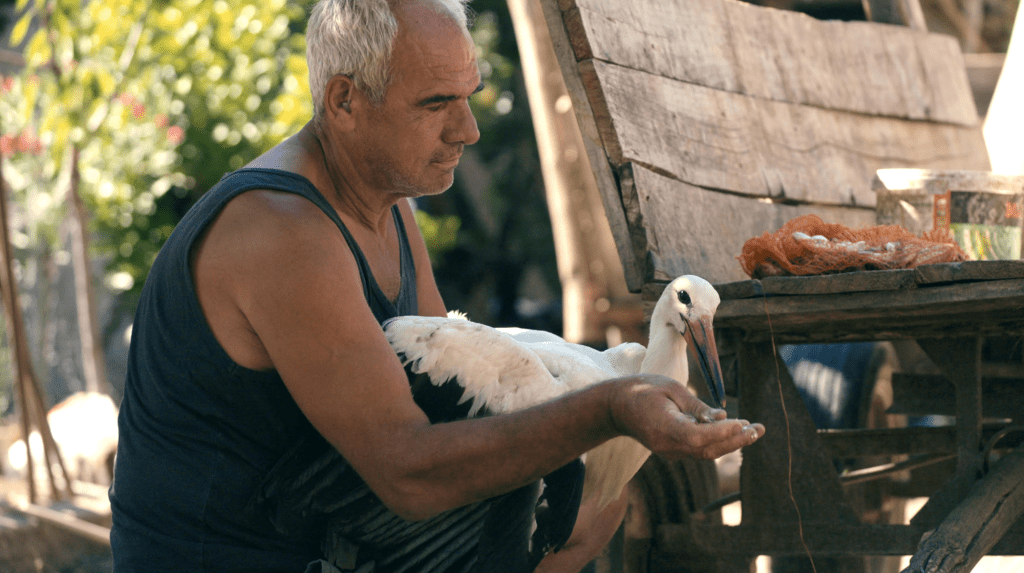
Merging magical realism with grounded vérité footage and some of the most stunningly immersive nature photography you’ll ever lay eyes on (courtesy of cinematographer Jean Dacker, who also worked with Kotevska on her documentary The Walk) is a fable brought to life, as well as an urgent plea for conservation and economic justice. Throughout, the tale of Silyan runs parallel to the tale of Nikola and the life-altering bond he forms with his stork (also called Silyan), but the similarities stretch beyond the surface. The white storks, you see, call those same Macedonian farmlands their home. The relationship between man and bird is symbiotic. If the farmers’ fertile ground is snatched up by landfills and factories, the storks’ feeding grounds disappear too, turning The Tale of Silyan into more than just the story of a guy and his bird.
That is the crux of it though. Kotevska possesses a keen eye for relationships. She lingers on the loving, playful touches Nikola and Jana share, care that Nikola extends to Silyan in her absence and that motivates him to take back his life. She tracks migrations (a common thread throughout her filmography) and how the movement of living beings has a trickle-down effect on the creatures and places in their orbit. Against all odds, The Tale of Silyan plants some kernels of optimism, especially compared to the dour and rather cruel Honeyland, but that lightness ought not to be mistaken for shallowness. The mere presentation of this footage serves as an urgent plea for change and— not unlike the fable that forms its backbone— a lesson to be learned.
The Tale of Silyan had its world premiere out of competition at the 2025 Venice Film Festival. Runtime: 81 minutes.

 Katie at the Movies